1982-09-29-Journal_and_Courier
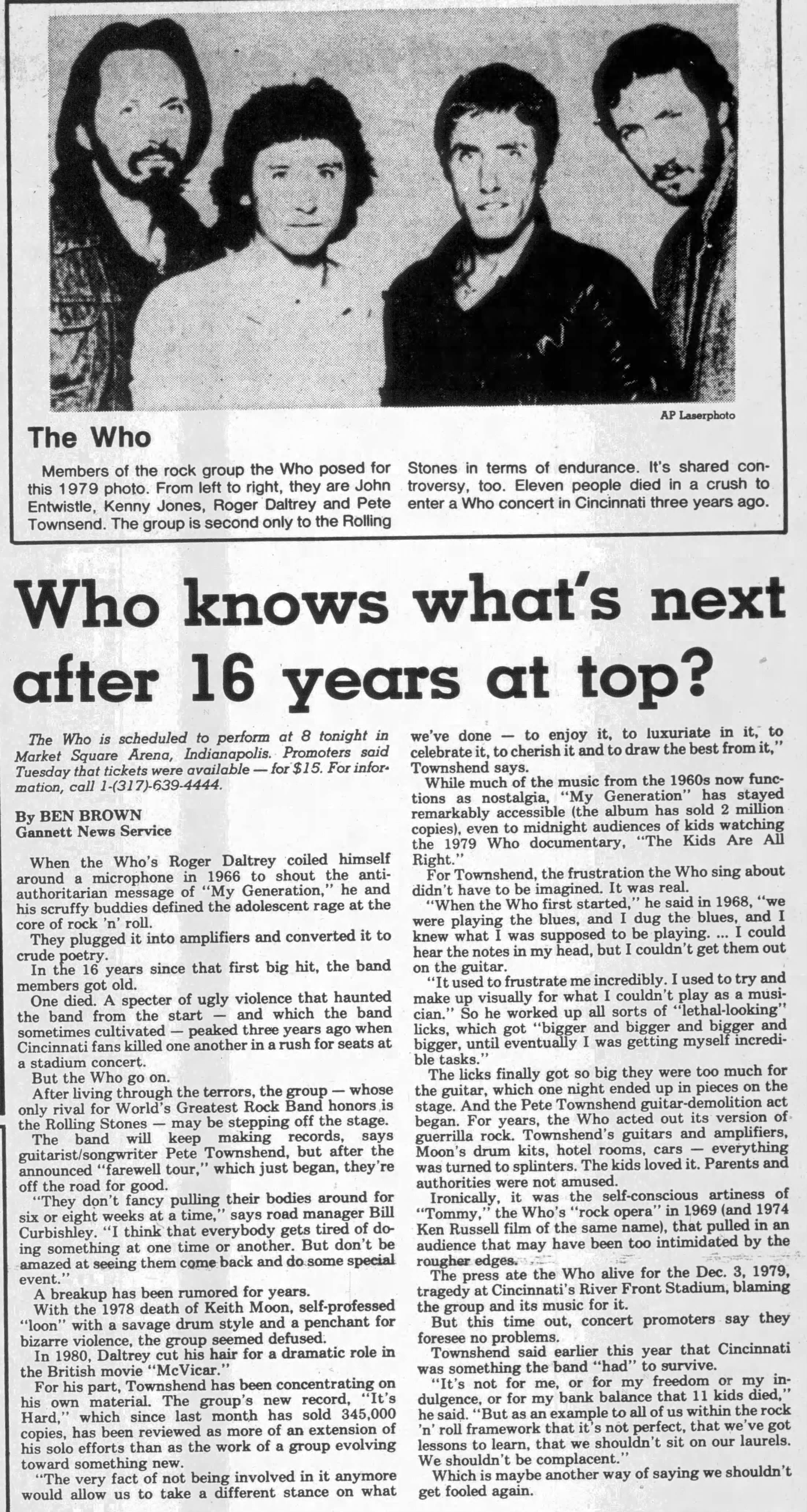
Members of the rock group The Who posed for this 1979 photo. From left to right, they are John Entwistle, Kenny Jones, Roger Daltrey and Pete Townshend. The group is second only to the Rolling Stones in terms of endurance. It’s shared controversy, too. Eleven people died in a crush to enter a Who concert in Cincinnati three years ago.
Who knows what’s next after 16 years at top?
The Who is scheduled to perform at 8 tonight in Market Square Arena, Indianapolis. Promoters said Tuesday that tickets were available — for $15. For information, call 1-(317)-639-4444.
When the Who’s Roger Daltrey coiled himself around a microphone in 1966 to shout the antiauthoritarian message of “My Generation,” he and his scruffy buddies defined the adolescent rage at the core of rock ’n’ roll.
They plugged it into amplifiers and converted it to crude poetry.
In the 16 years since that first big hit, the band members got old.
One died. A specter of ugly violence that haunted the band from the start — and which the band sometimes cultivated — peaked three years ago when Cincinnati fans killed one another in a rush for seats at a stadium concert.
But the Who go on.
After living through the terrors, the group — whose only rival for World’s Greatest Rock Band honors is the Rolling Stones — may be stepping off the stage.
The band will keep making records, says guitarist/songwriter Pete Townshend, but after the announced “farewell tour,” which just began, they’re off the road for good.
“They don’t fancy pulling their bodies around for six or eight weeks at a time,” says road manager Bill Curbishley. “I think that everybody gets tired of doing something at one time or another. But don’t be amazed at seeing them come back and do some special event.”
A breakup has been rumored for years.
With the 1978 death of Keith Moon, self-professed "loon” with a savage drum style and a penchant for bizarre violence, the group seemed defused.
In 1980, Daltrey cut his hair for a dramatic role in the British movie “McVicar.”
For his part, Townshend has been concentrating on his own material. The group’s new record, “It’s Hard,” which since last month has sold 345,000 copies, has been reviewed as more of an extension of his solo efforts than as the work of a group evolving toward something new.
“The very fact of not being involved in it anymore would allow us to take a different stance on what we’ve done — to enjoy it, to luxuriate in it, to celebrate it, to cherish it and to draw the best from it,” Townshend says.
While much of the music from the 1960s now functions as nostalgia, “My Generation” has stayed remarkably accessible (the album has sold 2 million copies), even to midnight audiences of kids watching the 1979 Who documentary, “The Kids Are All Right.”
For Townshend, the frustration the Who sing about didn’t have to be imagined. It was real.
“When the Who first started,” he said in 1968, “we were playing the blues, and I dug the blues, and I knew what I was supposed to be playing. … I could hear the notes in my head, but I couldn’t get them out on the guitar.
“It used to frustrate me incredibly. I used to try and make up visually for what I couldn’t play as a musician.” So he worked up all sorts of “lethal-looking” licks, which got “bigger and bigger and bigger and bigger, until eventually I was getting myself incredible tasks.”
The licks finally got so big they were too much for the guitar, which one night ended up in pieces on the stage. And the Pete Townshend guitar-demolition act began. For years, the Who acted out its version of guerrilla rock. Townshend’s guitars and amplifiers, Moon’s drum kits, hotel rooms, cars — everything was turned to splinters. The kids loved it. Parents and authorities were not amused.
Ironically, it was the self-conscious artiness of “Tommy,” the Who’s “rock opera” in 1969 (and 1974 Ken Russell film of the same name), that pulled in an audience that may have been too intimidated by the rougher edges.
The press ate the Who alive for the Dec. 3, 1979, tragedy at Cincinnati’s River Front Stadium, blaming the group and its music for it.
But this time out, concert promoters say they foresee no problems.
Townshend said earlier this year that Cincinnati was something the band “had” to survive.
“It’s not for me, or for my freedom or my indulgence, or for my bank balance that 11 kids died,” he said. “But as an example to all of us within the rock ’n’ roll framework that it’s not perfect, that we’ve got lessons to learn, that we shouldn’t sit on our laurels. We shouldn’t be complacent.”
Which is maybe another way of saying we shouldn’t get fooled again.