1982-10-01-Detroit_Free_Press_2
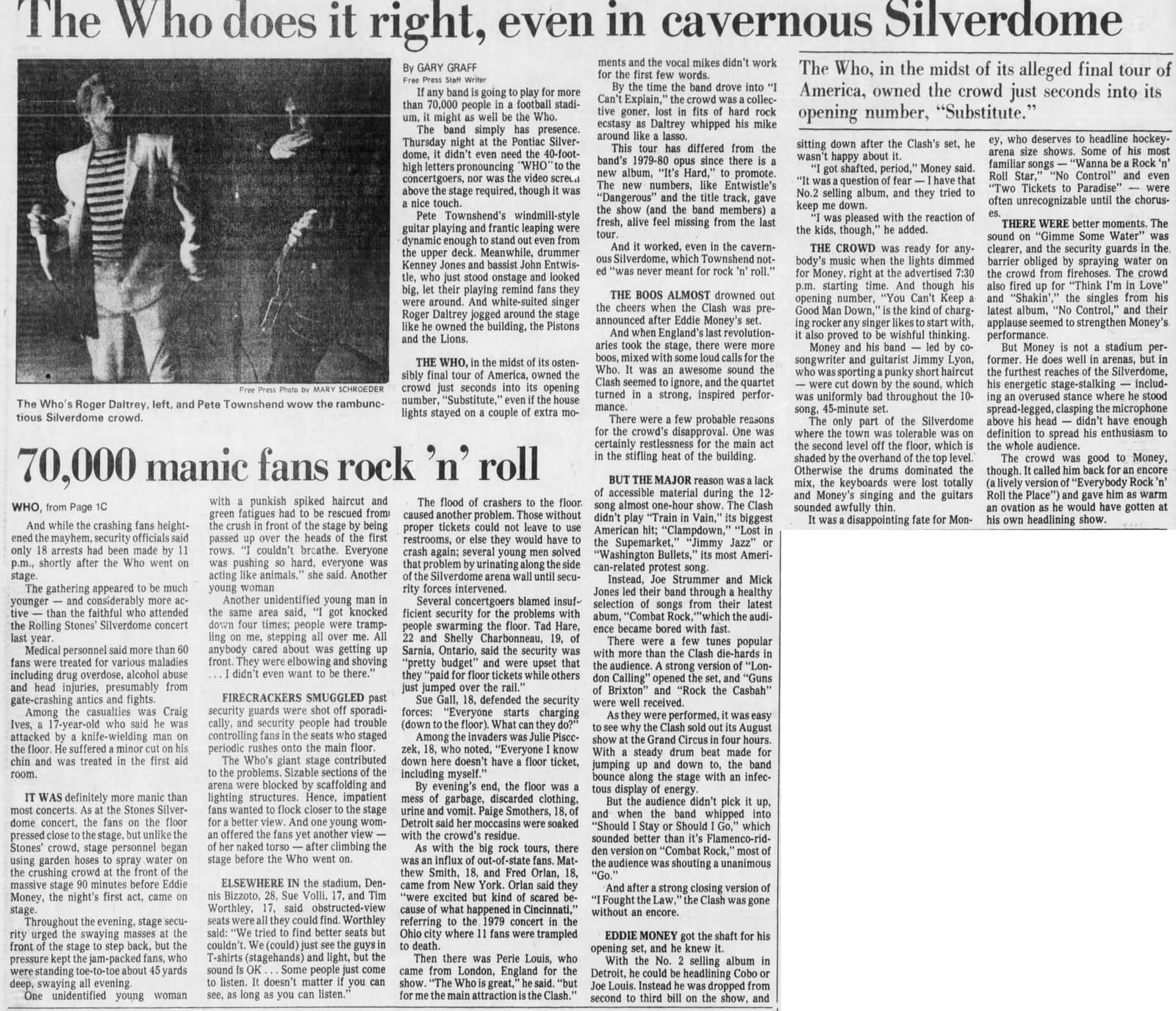
The Who’s Roger Daltrey, left, and Pete Townshend wow the rambunctious Silverdome crowd.
If any band is going to play for more than 70,000 people in a football stadium, it might as well be the Who.
The band simply has presence. Thursday night at the Pontiac Silverdome, it didn’t even need the 40-foot-high letters pronouncing “WHO” to the concertgoers, nor was the video screen above the stage required, though it was a nice touch.
Pete Townshend’s windmill-style guitar playing and frantic leaping were dynamic enough to stand out even from the upper deck. Meanwhile, drummer Kenney Jones and bassist John Entwistle, who just stood onstage and looked big, let their playing remind fans they were around. And white-suited singer Roger Daltrey jogged around the stage like he owned the building, the Pistons and the Lions.
THE WHO, in the midst of its ostensibly final tour of America, owned the crowd just seconds into its opening number, “Substitute,” even if the house lights stayed on a couple of extra moments and the vocal mics didn’t work for the first few words.
This tour has differed from the band’s 1979-80 opus since there is a new album, “It’s Hard,” to promote. The new numbers, like Entwistle’s “Dangerous” and the title track, gave the show (and the band members) a fresh, alive feel missing from the last tour.
And it worked, even in the cavernous Silverdome, which Townshend noted “was never meant for rock ‘n’ roll.”
THE BOOS ALMOST drowned out the cheers when the Clash was pre-announced after Eddie Money’s set.
And when England’s last revolutionaries took the stage, there were more boos, mixed with some loud calls for the Who. It was an awesome sound the Clash seemed to ignore, and the quartet turned in a strong, inspired performance.
There were a few probable reasons for the crowd’s disapproval. One was certainly restlessness for the main act in the stifling heat of the building.
BUT THE MAJOR reason was a lack of accessible material during the 12-song almost one-hour show. The Clash didn’t play “Train in Vain,” its biggest American hit; “Clampdown,” “Lost in the Supermarket,” “Jimmy Jazz” or “Washington Bullets,” its most American-related protest song.
Instead, Joe Strummer and Mick Jones led their band through a healthy selection of songs from their latest album, “Combat Rock,” which the audience became bored with fast.
There were a few tunes popular with more than the Clash die-hards in the audience. A strong version of “London Calling” opened the set, and “Guns of Brixton” and “Rock the Casbah” were well received.
As they were performed, it was easy to see why the Clash sold out its August show at the Grand Circus in four hours. With a steady drum beat made for jumping up and down to, the band bounced along the stage with an infectious display of energy.
But the audience didn’t pick it up, and when the band whipped into “Should I Stay or Should I Go,” which sounded better than its Flamenco-ridden version on “Combat Rock,” most of the audience was shouting a unanimous “Go.”
And after a strong closing version of “I Fought the Law,” the Clash was gone without an encore.
EDDIE MONEY got the shaft for his opening set, and he knew it.
With the No. 2 selling album in Detroit, he could be headlining Cobo or Joe Louis. Instead he was dropped from second to third bill on the show, and
ey, who deserves the headline hockeyarena size shows. Some of his most familiar songs — “Wanna be a Rock ‘n’ Roll Star,” “No Control” and even “Two Tickets to Paradise” — were often unrecognizable until the choruses.
THERE WERE better moments. The sound on “Gimme Some Water” was clearer, and the security guards in the barrier obliged by spraying water on the crowd from firehoses. The crowd also fired up for “Think I’m in Love” and “Shakin’,” the singles from his latest album, “No Control,” and their applause seemed to strengthen Money’s performance.
But Money is not a stadium performer. He does well in arenas, but in the furthest reaches of the Silverdome, his energetic stage-stalking — including an overused stance where he stood spread-legged, clasping the microphone above his head — didn’t have enough definition to spread his enthusiasm to the whole audience.
The crowd was good to Money, though. It called him back for an encore (a lively version of “Everybody Rock ‘n’ Roll the Place”) and gave him as warm an ovation as he would have gotten at his own headlining show.
70,000 manic fans rock ’n’ roll
WHO, from Page 1C
And while the crashing fans heightened the mayhem, security officials said only 18 arrests had been made by 11 p.m., shortly after the Who went on stage.
The gathering appeared to be much younger— and considerably more active — than the faithful who attended the Rolling Stones’ Silverdome concert last year.
Medical personnel said more than 60 fans were treated for various maladies including drug overdose, alcohol abuse and head injuries, presumably from gate-crashing antics and fights.
Among the casualties was Craig Ives, a 17-year-old who said he was attacked by a knife-wielding man on the floor. He suffered a minor cut on his chin and was treated in the first aid room.
IT WAS definitely more manic than most concerts. As at the Stones Silverdome concert, the fans on the floor pressed close to the stage, but unlike the Stones’ crowd, stage personnel began using garden hoses to spray water on the crushing crowd at the front of the massive stage 90 minutes before Eddie Money, the night’s first act, came on stage.
Throughout the evening, stage security urged the swaying masses at the front of the stage to step back, but the pressure kept the jam-packed fans, who were standing toe-to-toe about 45 yards deep, swaying all evening.
One unidentified young woman with a punkish spiked haircut and green fatigues had to be rescued from the crush in front of the stage by being passed up over the heads of the first rows. “I couldn’t breathe. Everyone was pushing so hard, everyone was acting like animals,” she said. Another young woman.
Another unidentified young man in the same area said, “I got knocked down four times; people were trampling on me, stepping all over me. All anybody cared about was getting up front. They were elbowing and shoving … I didn’t even want to be there.”
FIRECRACKERS SMUGGLED past security guards were shot off sporadically, and security people had trouble controlling fans in the seats who staged periodic rushes onto the main floor.
The Who’s giant stage contributed to the problems. Sizable sections of the arena were blocked by scaffolding and lighting structures. Hence, impatient fans wanted to flock closer to the stage for a better view. And one young woman offered the fans yet another view — of her naked torso — after climbing the stage before the Who went on.
ELSEWHERE In the stadium, Dennis Bizzoto, 28, Sue Volli, 17, and Tim Worthley, 17, said obstructed-view seats were all they could find. Worthley said: “We tried to find better seats but couldn’t. We (could) just see the guys in T-shirts (stagehands) and light, but the sound is OK . . . Some people just come to listen. It doesn’t matter if you can see, as long as you can listen.”
The flood of crashers to the floor caused another problem. Those without proper tickets could not leave to use restrooms, or else they would have to crash again; several young men solved that problem by urinating along the side of the Silverdome arena wall until security forces intervened.
Several concertgoers blamed insufficient security for the problems with people swarming the floor. Tad Hare, 22 and Shelly Charbonneau, 19, of Sarnia, Ontario, said the security was “pretty budget” and were upset that they “paid for floor tickets while others just jumped over the rail.”
Sue Gall, 18, defended the security forces: “Everyone starts charging (down to the floor). What can they do?”
Among the invaders was Julie Piscczek, 18, who noted, “Everyone I know down here doesn’t have a floor ticket, including myself.”
As with the big rock tours, there was an influx of out-of-state fans. Matthew Smith, 18, and Fred Orlan, 18, came from New York. Orlan said they “were excited but kind of scared because of what happened in Cincinnati,” referring to the 1979 concert in the Ohio city where 11 fans were trampled to death.
Then there was Perie Louis, who came from London, England for the show. “The Who is great,” he said, “but for me the main attraction is the Clash.”