1982-10-29-The_Los_Angeles_Times_1
Friday, October 29, 1982
THE WHO TAKES FINAL BOW WITH DIGNITY AND PUNCH
Times Pop Music Critic
SAN DIEGO – No one can accuse rock fans of not respecting their elders. Consider the Who's farewell tour, which includes a 3 p.m. stop today at the Los Angeles Memorial Coliseum.
More than 2 million of those fans are paying nearly $35 million on this tour to see a band that is 10 years past its creative peak. Now, that's loyalty.
The truth is that you have to go back to 1971's "Who's Next" to find even one Who collection as stimulating as any of the five albums released since 1977 by the Clash, which will be one of the two opening acts on today's Coliseum bill.
But it's not the new music that really matters on this tour. The attraction is the legacy of the Who — the songs and images this band introduced in the '60s when it did almost as much as the (by now) saintly Beatles to define and stretch the boundaries of rock.
As with the Rolling Stones' tour last year, the Who concert before 53,000 fans at Jack Murphy Stadium here Wednesday night was a celebration, one in which audience emotion all but overshadowed the performers at times.
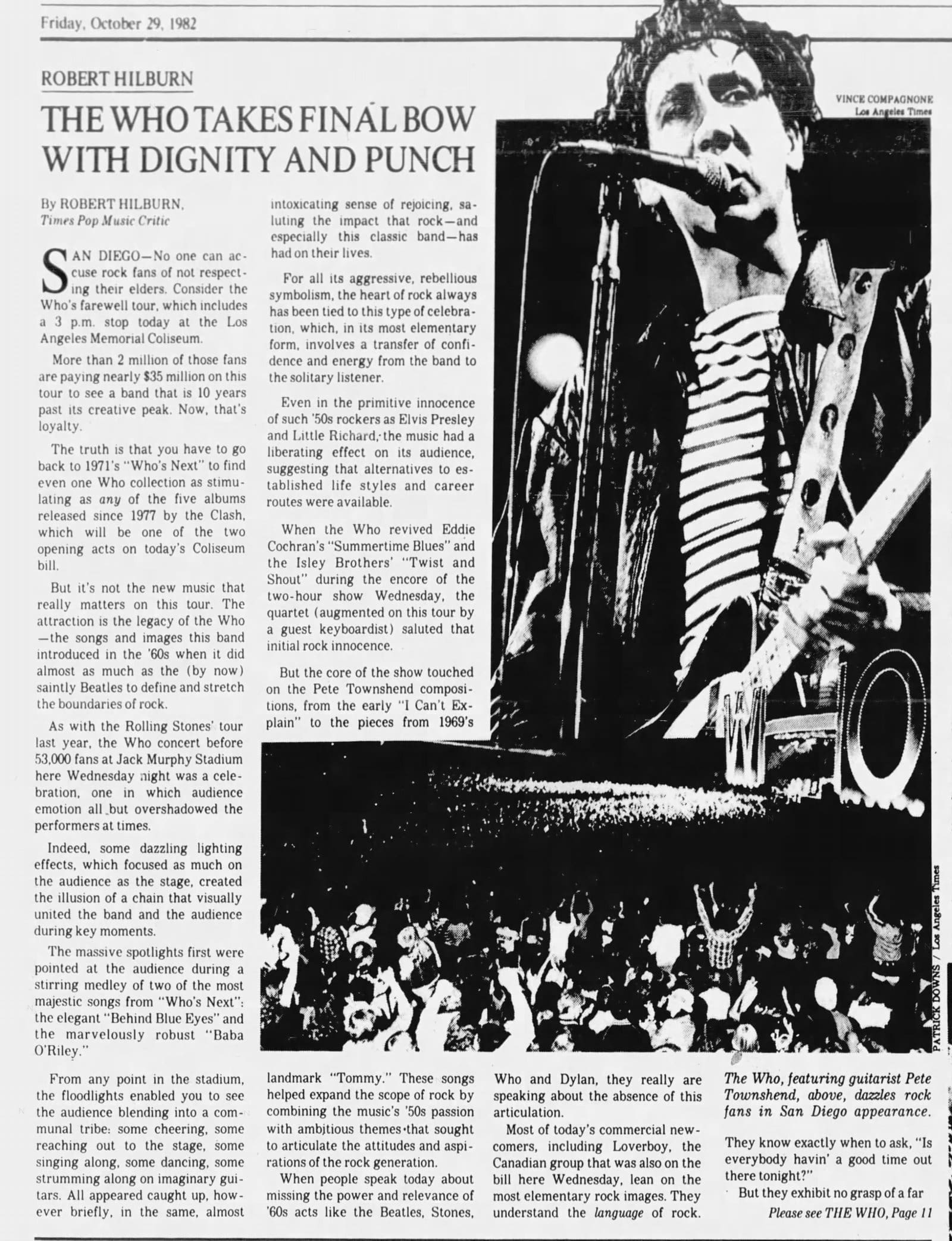
Indeed, some dazzling lighting effects, which focused as much on the audience as the stage, created the illusion of a chain that visually united the band and the audience during key moments.
The massive spotlights first were pointed at the audience during a stirring medley of two of the most majestic songs from "Who's Next": the elegant "Behind Blue Eyes" and the marvelously robust "Baba O'Riley."
From any point in the stadium, the floodlights enabled you to see the audience blending into a communal tribe: some cheering, some reaching out to the stage, some singing along, some dancing, some strumming along on imaginary guitars. All appeared caught up, however briefly, in the same, almost intoxicating sense of rejoicing, saluting the impact that rock — and especially this classic band — has had on their lives.
For all its aggressive, rebellious symbolism, the heart of rock always has been tied to this type of celebration, which, in its most elementary form, involves a transfer of confidence and energy from the band to the solitary listener.
Even in the primitive innocence of such '50s rockers as Elvis Presley and Little Richard; the music had a liberating effect on its audience, suggesting that alternatives to established life styles and career routes were available.
When the Who revived Eddie Cochran's "Summertime Blues" and the Isley Brothers' "Twist and Shout" during the encore of the two-hour show Wednesday, the quartet (augmented on this tour by a guest keyboardist) saluted that initial rock innocence.
But the core of the show touched on the Pete Townshend compositions, from the early "I Can't Explain" to the pieces from 1969's landmark "Tommy." These songs helped expand the scope of rock by combining the music's '50s passion with ambitious themes that sought to articulate the attitudes and aspirations of the rock generation.
When people speak today about missing the power and relevance of '60s acts like the Beatles, Stones, Who and Dylan, they really are speaking about the absence of this articulation.
Most of today's commercial newcomers, including Loverboy, the Canadian group that was also on the bill here Wednesday, lean on the most elementary rock images. They understand the language of rock.
The Who, featuring guitarist Pete Townshend, above, dazzles rock fans in San Diego appearance.
They know exactly when to ask, "Is everybody havin' a good time out there tonight?"
But they exhibit no grasp of a far
Please see THE WHO, Page 11