1982-10-31-The_Daily_Breeze_2
Who
For those who look for meaning and relevance in their rock ’n’ roll, the loss of the Who represents a crippling blow to rock music as an arena for social thought.
Largely left with generic, plain-wrap rock — the formula music of Styx, Aerosmith and Asia that dominates the FM airways — or New Wave, with much promise but little lyrical direction as yet, (or video games, among the main culprits according to Townshend), a creative gap seems to be growing in rock music and its listeners.
It isn’t a good time to lose the Who.
But if they have to leave the road, a life they began in 1964, they at least did it on an up note Friday night.
They displayed the energy and power that first dazzled American audiences during the pop festivals of the mid- to late-’60s, following “My Generation” — their familiar teen anthem of the 60s — with “Can’t Explain,” another of their hits from that era.
What followed, however, was not the chronological “History of the Who” show they could have performed. Instead, it was an excellent mix of past and present, relying heavily on 1969’s “Tommy” and their 1970s masterpieces — “Who’s Next” and “Quadrophenia” — as well as several songs from their new album, “It’s Hard.”
Touted by most reviewers as the band’s best work since “Who’s Next,” the new album supplied the show with its third song, Entwistle’s “Dangerous,” and three other numbers, “It’s Hard,” the moving “Eminence Front,” and the rocker, “Cry If You Want.”
Other great moments were supplied by back-to-back masterworks off “Who’s Next” — “Behind Blue Eyes,” a song showing Daltrey’s versatility as a singer, and “Baba O’Riley” — followed by another early hit, “I Can See For Miles,” and a bluesy version of “Drowned” off “Quadrophenia,” sung and powerfully played by Townshend with some effective blues harmonica work by Daltrey.
Before leaving the stage for the first time to deafening cheers, they played a frenetic list of songs that would have made an excellent “Best of . . .” album. It started
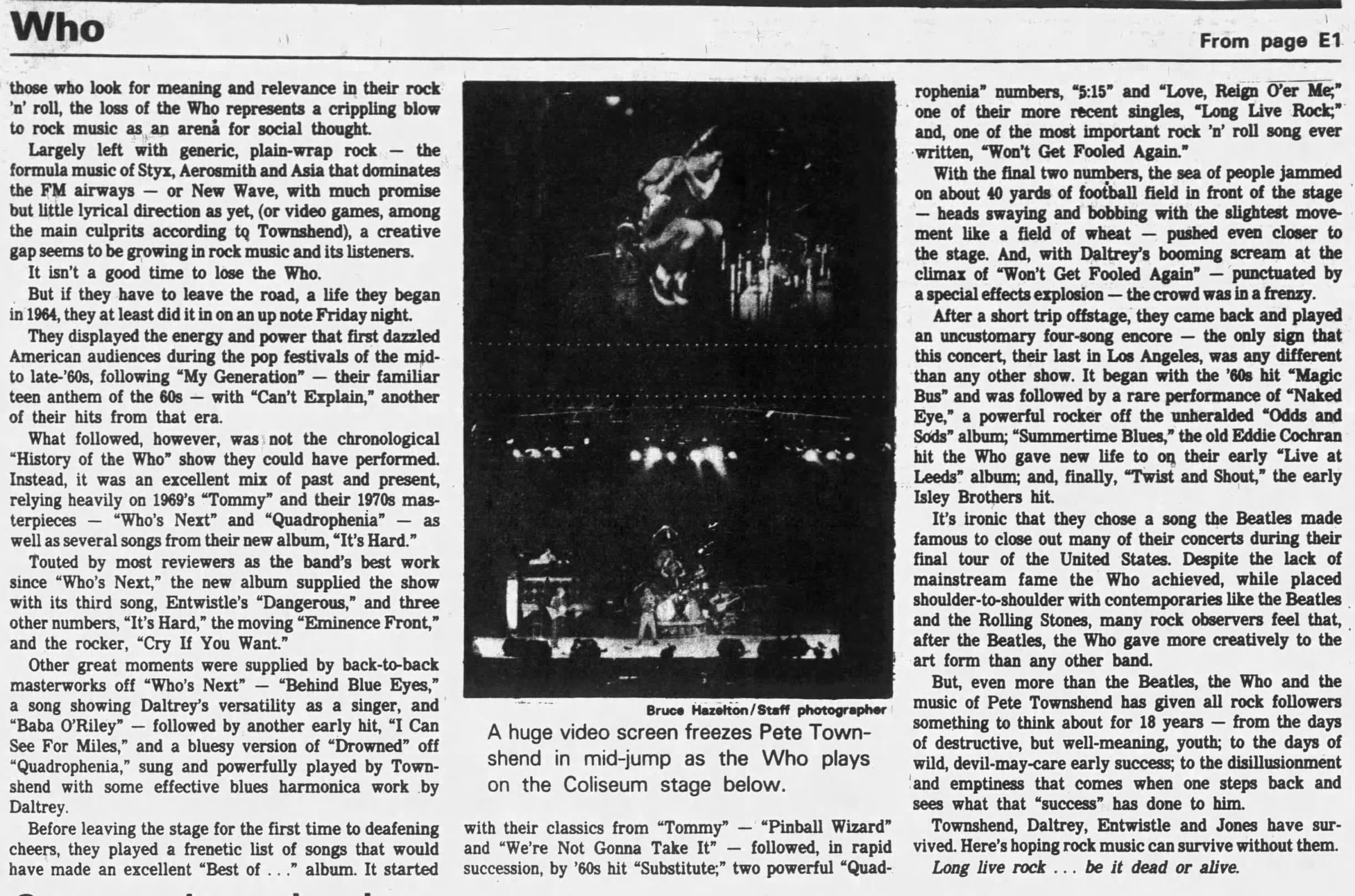
Bruce Hazelton/Staff photographer
A huge video screen freezes Pete Townshend in mid-jump as the Who plays on the Coliseum stage below.
with their classics from “Tommy” — “Pinball Wizard” and “We’re Not Gonna Take It” — followed, in rapid succession, by ’60s hit “Substitute,” two powerful “Quadrophenia” numbers, “5:15” and “Love, Reign O’er Me,” one of their more recent singles, “Long Live Rock,” and, one of the most important rock ’n’ roll songs ever written, “Won’t Get Fooled Again.”
With the final two numbers, the sea of people jammed on about 40 yards of football field in front of the stage — heads swaying and bobbing with the slightest movement like a field of wheat — pushed even closer to the stage. And, with Daltrey’s booming scream at the climax of “Won’t Get Fooled Again” — punctuated by a special effects explosion — the crowd was in a frenzy.
After a short trip offstage, they came back and played an uncustomary four-song encore — the only sign that this concert, their last in Los Angeles, was any different than any other show. It began with the ’60s hit “Magic Bus” and was followed by a rare performance of “Naked Eye,” a powerful rocker off the unheralded “Odds and Sods” album; “Summertime Blues,” the old Eddie Cochran hit the Who gave new life to on their early “Live at Leeds” album; and, finally, “Twist and Shout,” the early Isley Brothers hit.
It’s ironic that they chose a song the Beatles made famous to close out many of their concerts during their final tour of the United States. Despite the lack of mainstream fame the Who achieved, while placed shoulder-to-shoulder with contemporaries like the Beatles and the Rolling Stones, many rock observers feel that, after the Beatles, the Who gave more creatively to the art form than any other band.
But, even more than the Beatles, the Who and the music of Pete Townshend has given all rock followers something to think about for 18 years — from the days of destructive, but well-meaning, youth; to the days of wild, devil-may-care early success; to the disillusionment and emptiness that comes when one steps back and sees what that “success” has done to him.
Townshend, Daltrey, Entwistle and Jones have survived. Here’s hoping rock music can survive without them.
Long live rock . . . be it dead or alive.