1989-07-26-The_Grand_Rapids_Press_2
WHO CONTINUED FROM D1
Found just enough playfulness in his maturing tenor to describe the wonder of the “deaf, dumb, and blind kid” who “sure plays a mean pinball.”
After the “Tommy” music, progressing through the next series of songs — relatively recent material like “Eminence Front,” “Give Love,” and “Face to Face” — should have been something of a lark.
None of the songs is as musically esoteric as the “Tommy” material, or as conclusive as the band’s earlier work.
Nevertheless, the group delivered some highly perfected performances of the songs, especially Entwistle, with his reverberating bass on “Eminence Front,” and Townshend, who infused the ineffectual bop of “Face to Face” with importance by stridently barking the lyrics, dancing wildly while the five-piece horn section cooked up a boisterous jazz stew, and throwing in a few of his trademark windmill guitar strums.
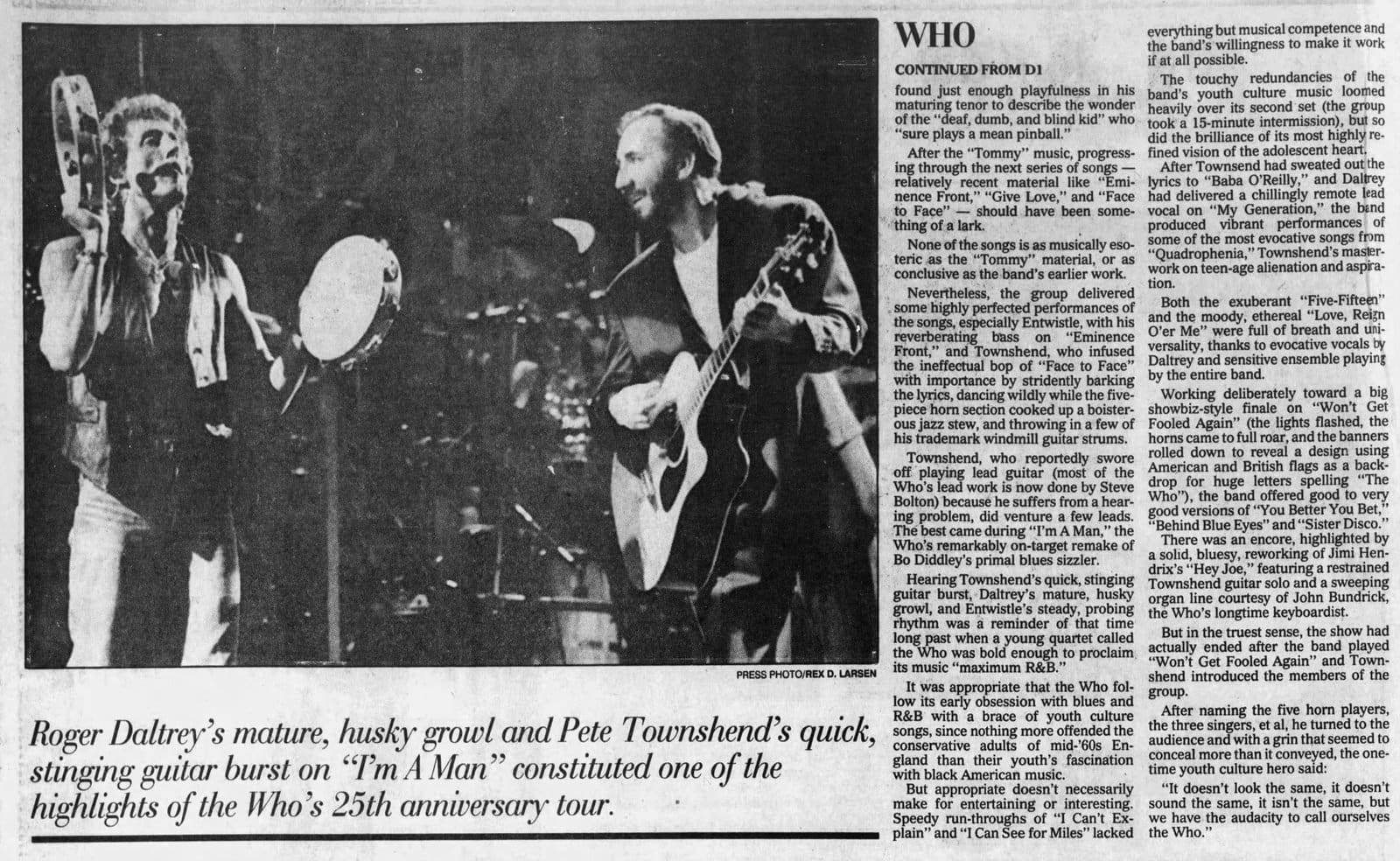
Townshend, who reportedly swore off playing lead guitar (most of the Who’s lead work is now done by Steve Bolton) because he suffers from a hearing problem, did venture a few leads. The best came during “I’m A Man,” the Who’s remarkably on-target remake of Bo Diddley’s primal blues sizzler.
Hearing Townshend’s quick, stinging guitar burst, Daltrey’s mature, husky growl, and Entwistle’s steady, probing rhythm was a reminder of that time long past when a young quartet called the Who was bold enough to proclaim its music “maximum R&B.”
It was appropriate that the Who follow its early obsession with blues and R&B with a brace of youth culture songs, since nothing more offended the conservative adults of mid-’60s England than their youth’s fascination with black American music.
But appropriate doesn’t necessarily make for entertaining or interesting. Speedy run-throughs of “I Can’t Explain” and “I Can See for Miles” lacked everything but musical competence and the band’s willingness to make it work if at all possible.
The touchy redundancies of the band’s youth culture music loomed heavily over its second set (the group took a 15-minute intermission), but so did the brilliance of its most highly refined vision of the adolescent heart.
After Townshend had sweated out the lyrics to “Baba O’Reilly,” and Daltrey had delivered a chillingly remote lead vocal on “My Generation,” the band produced vibrant performances of some of the most evocative songs from “Quadrophenia,” Townshend’s masterwork on teen-age alienation and aspiration.
Both the exuberant “Five-Fifteen” and the moody, ethereal “Love, Reign O’er Me” were full of breath and universality, thanks to evocative vocals by Daltrey and sensitive ensemble playing by the entire band.
Working deliberately toward a big showbiz-style finale on “Won’t Get Fooled Again” (the lights flashed, the horns came to full roar, and the banners rolled down to reveal a design using American and British flags as a backdrop for huge letters spelling “The Who”), the band offered good to very good versions of “You Better You Bet,” “Behind Blue Eyes” and “Sister Disco.”
There was an encore, highlighted by a solid, bluesy, reworking of Jimi Hendrix’s “Hey Joe,” featuring a restrained Townshend guitar solo and a sweeping organ line courtesy of John Bundrick, the Who’s longtime keyboardist.
But in the truest sense, the show had actually ended after the band played “Won’t Get Fooled Again” and Townshend introduced the members of the group.
After naming the five horn players, the three singers, et al, he turned to the audience and with a grin that seemed to conceal more than it conveyed, the onetime youth culture hero said:
“It doesn’t look the same, it doesn’t sound the same, it isn’t the same, but we have the audacity to call ourselves the Who.”