1989-08-30-The_San_Francisco_Examiner_4
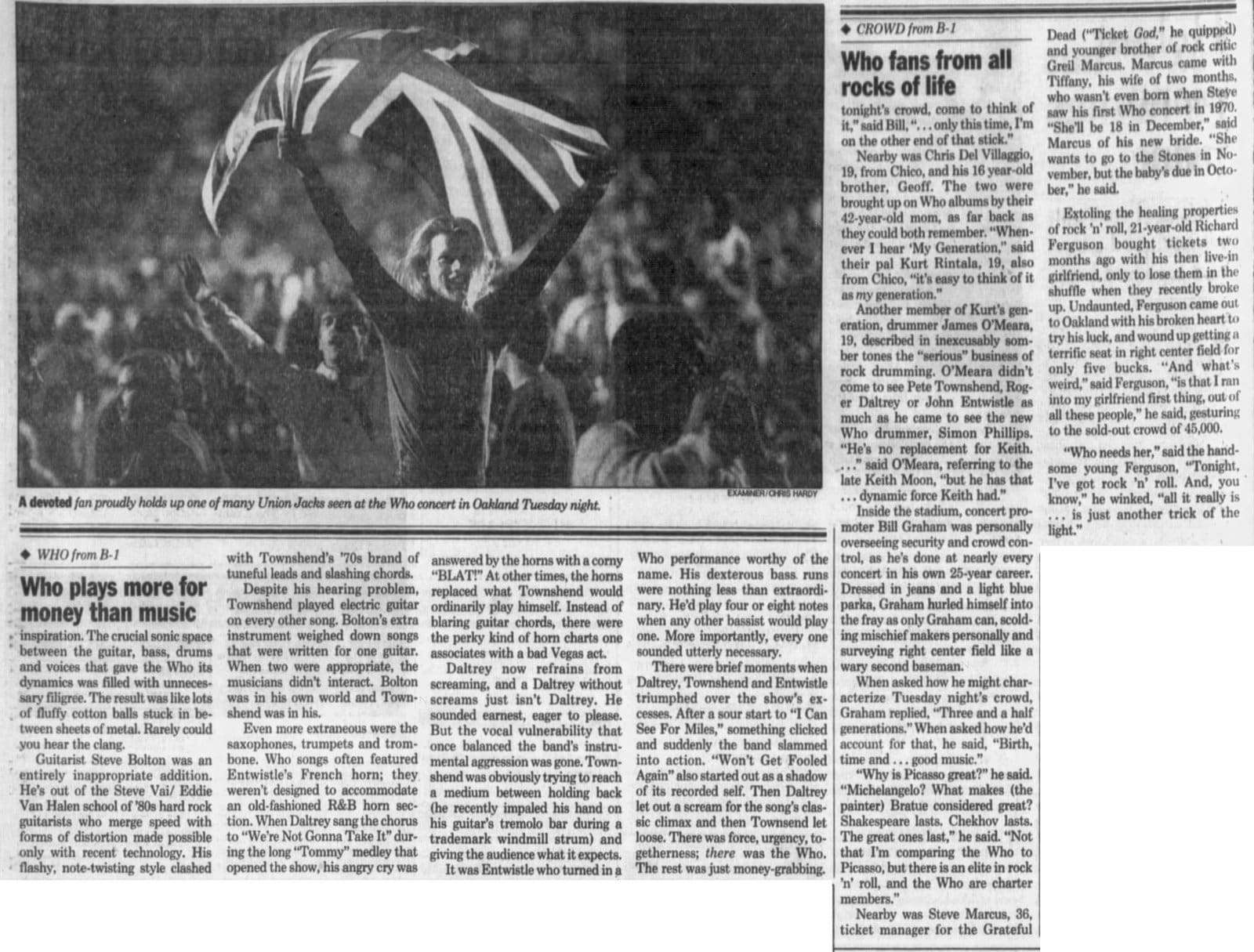
A devoted fan proudly holds up one of many Union Jacks seen at the Who concert in Oakland Tuesday night.
EXAMINER/CHRIS HARDY
Who plays more for money than music inspiration. The crucial sonic space between the guitar, bass, drums and voices that gave the Who its dynamics was filled with unnecessary filigree. The result was like lots of fluffy cotton balls stuck in between sheets of metal. Rarely could you hear the clang.
Guitarist Steve Bolton was an entirely inappropriate addition. He's out of the Steve Vai/Eddie Van Halen school of '80s hard rock guitarists who merge speed with forms of distortion made possible only with recent technology. His flashy, note-twisting style clashed with Townshend's '70s brand of tuneful leads and slashing chords.
Despite his hearing problem, Townshend played electric guitar on every other song. Bolton's extra instrument weighed down songs that were written for one guitar. When two were appropriate, the musicians didn't interact. Bolton was in his own world and Townshend was in his.
Even more extraneous were the saxophones, trumpets and trombone. Who songs often featured Entwistle's French horn; they weren't designed to accommodate an old-fashioned R&B horn section. When Daltrey sang the chorus to "We're Not Gonna Take It" during the long "Tommy" medley that opened the show, his angry cry was answered by the horns with a corny "BLAT!" At other times, the horns replaced what Townshend would ordinarily play himself. Instead of blaring guitar chords, there were the perky kind of horn charts one associates with a bad Vegas act.
Daltrey now refrains from screaming, and a Daltrey without screams just isn't Daltrey. He sounded earnest, eager to please. But the vocal vulnerability that once balanced the band's instrumental aggression was gone. Townshend was obviously trying to reach a medium between holding back (he recently impaled his hand on his guitar's tremolo bar during a trademark windmill strum) and giving the audience what it expects.
It was Entwistle who turned in a Who performance worthy of the name. His dexterous bass runs were nothing less than extraordinary. He'd play four or eight notes when any other bassist would play one. More importantly, every one sounded utterly necessary.
There were brief moments when Daltrey, Townshend and Entwistle triumphed over the show's excesses. After a sour start to "I Can See For Miles," something clicked and suddenly the band slammed into action. "Won't Get Fooled Again" also started out as a shadow of its recorded self. Then Daltrey let out a scream for the song's classic climax and then Townshend let loose. There was force, urgency, togetherness; there was the Who. The rest was just money-grabbing.
Who fans from all rocks of life tonight's crowd, come to think of it," said Bill, "…only this time, I'm on the other end of that stick."
Nearby was Chris Del Villaggio, 19, from Chico, and his 16 year-old brother, Geoff. The two were brought up on Who albums by their 42-year-old mom, as far back as they could both remember. "Whenever I hear "My Generation," said their pal Kurt Rintala, 19, also from Chico, "it's easy to think of it as my generation."
Another member of Kurt's generation, drummer James O'Meara, 19, described in inexcusably somber tones the “serious" business of rock drumming. O'Meara didn't come to see Pete Townshend, Roger Daltrey or John Entwistle as much as he came to see the new Who drummer, Simon Phillips. "He's no replacement for Keith . . ." said O'Meara, referring to the late Keith Moon, "but he has that … dynamic force Keith had."
Inside the stadium, concert promoter Bill Graham was personally overseeing security and crowd control, as he's done at nearly every concert in his own 25-year career. Dressed in jeans and a light blue parka, Graham hurled himself into the fray as only Graham can, scolding mischief makers personally and surveying right center field like a wary second baseman.
When asked how he might characterize Tuesday night's crowd, Graham replied, "Three and a half generations." When asked how he'd account for that, he said, "Birth, time and … good music."
"Why is Picasso great?" he said. "Michelangelo? What makes (the painter) Bratue considered great? Shakespeare lasts. Chekhov lasts. The great ones last," he said. "Not that I'm comparing the Who to Picasso, but there is an elite in rock ’n’ roll, and the Who are charter members."
Nearby was Steve Marcus, 36, ticket manager for the Grateful Dead ("Ticket God," he quipped) and younger brother of rock critic Greil Marcus. Marcus came with Tiffany, his wife of two months, who wasn't even born when Steve saw his first Who concert in 1970. "She'll be 18 in December," said Marcus of his new bride. "She wants to go to the Stones in November, but the baby's due in October," he said.
Extoling the healing properties of rock 'n’ roll, 21-year-old Richard Ferguson bought tickets two months ago with his then live-in girlfriend, only to lose them in the shuffle when they recently broke up. Undaunted, Ferguson came out to Oakland with his broken heart to try his luck, and wound up getting a terrific seat in right center field for only five bucks. "And what's weird," said Ferguson, "is that I ran into my girlfriend first thing, out of all these people," he said, gesturing to the sold-out crowd of 45,000.
"Who needs her," said the handsome young Ferguson, "Tonight, I've got rock ’n’ roll. And, you know," he winked, "all it really is … is just another trick of the light."