1989-08-31-San_Francisco_Chronicle
PHOTOS BY ERIC LIUSE / THE CHRONICLE
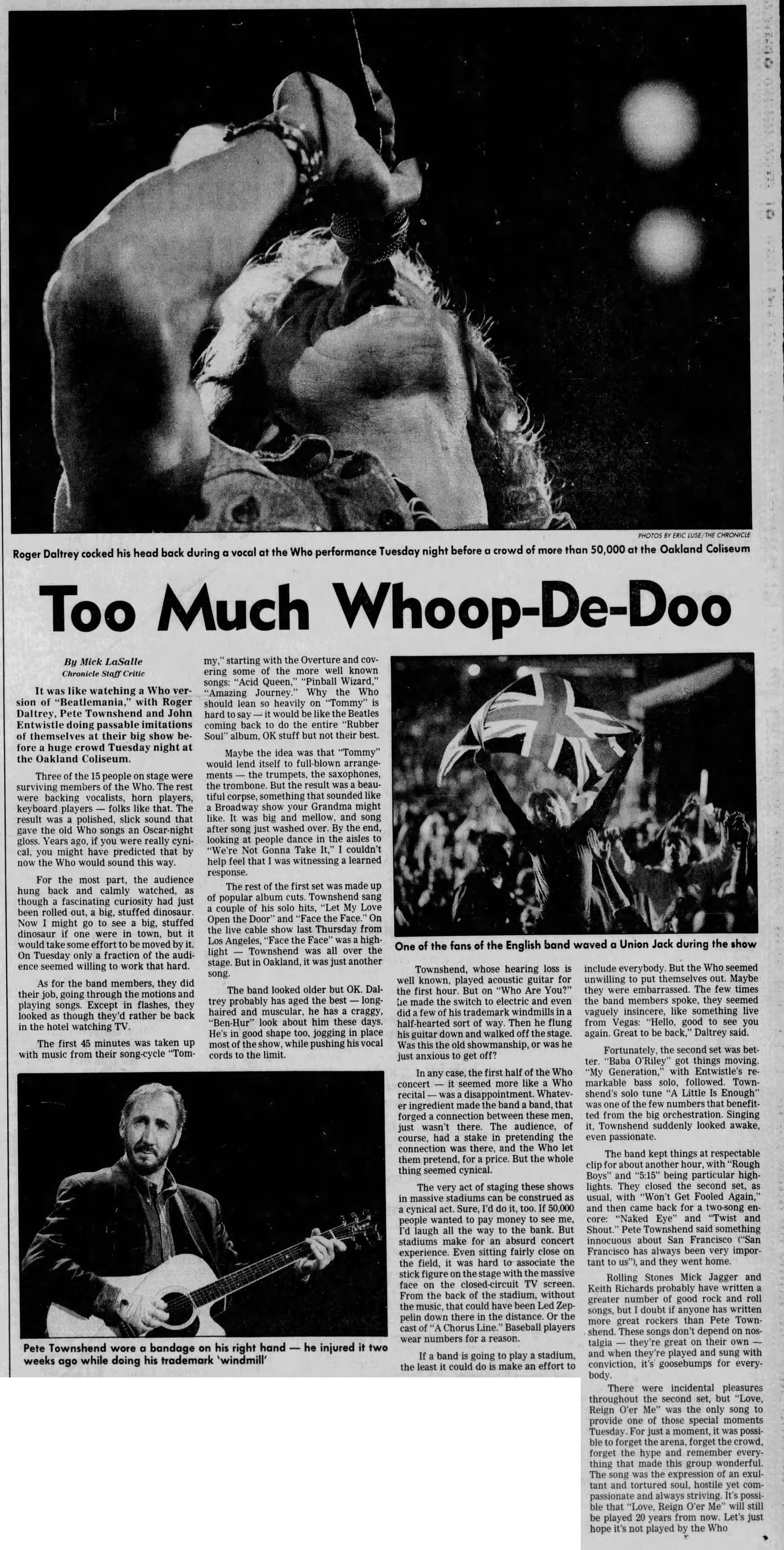
Roger Daltrey cocked his head back during a vocal at the Who performance Tuesday night before a crowd of more than 50,000 at the Oakland Coliseum
Too Much Whoop-De-Doo
Chronicle Staff Critic
It was like watching a Who version of "Beatlemania," with Roger Daltrey, Pete Townshend and John Entwistle doing passable imitations of themselves at their big show before a huge crowd Tuesday night at the Oakland Coliseum.
Three of the 15 people on stage were surviving members of the Who. The rest were backing vocalists, horn players, keyboard players — folks like that. The result was a polished, slick sound that gave the old Who songs an Oscar-night gloss. Years ago, if you were really cynical, you might have predicted that by now the Who would sound this way.
For the most part, the audience hung back and calmly watched, as though a fascinating curiosity had just been rolled out, a big, stuffed dinosaur. Now I might go to see a big, stuffed dinosaur if one were in town, but it would take some effort to be moved by it. On Tuesday only a fraction of the audience seemed willing to work that hard.
As for the band members, they did their job, going through the motions and playing songs. Except in flashes, they looked as though they'd rather be back in the hotel waiting TV.
The first 45 minutes was taken up with music from their song-cycle "Tom-
my," starting with the Overture and covering some of the more well known songs: "Acid Queen," "Pinball Wizard," "Amazing Journey." Why the Who should lean so heavily on "Tommy" is hard to say — it would be like the Beatles coming back to do the entire "Rubber Soul" album, OK stuff but not their best.
Maybe the idea was that "Tommy" would lend itself to full-blown arrangements — the trumpets, the saxophones, the trombone. But the result was a beautiful corpse, something that sounded like a Broadway show your Grandma might like. It was big and mellow, and song after song just washed over. By the end, looking at people dance in the aisles to "We're Not Gonna Take It," I couldn't help feel that I was witnessing a learned response.
The rest of the first set was made up of popular album cuts. Townshend sang a couple of his solo hits, "Let My Love Open the Door" and "Face the Face." On the live cable show last Thursday from Los Angeles, "Face the Face" was a highlight — Townshend was all over the stage. But in Oakland, it was just another song.
The band looked older but OK. Daltrey probably has aged the best — long-haired and muscular, he has a craggy, "Ben-Hur" look about him these days. He's in good shape too, jogging in place most of the show, while pushing his vocal cords to the limit.
One of the fans of the English band waved a Union Jack during the show
Townshend, whose hearing loss is well known, played acoustic guitar for the first hour. But on "Who Are You?" he made the switch to electric and even did a few of his trademark windmills in a half-hearted sort of way. Then he flung his guitar down and walked off the stage. Was this the old showmanship, or was he just anxious to get off?
In any case, the first half of the Who concert — it seemed more like a Who recital — was a disappointment. Whatever ingredient made the band a band, that forged a connection between these men, just wasn't there. The audience, of course, had a stake in pretending the connection was there, and the Who let them pretend, for a price. But the whole thing seemed cynical.
The very act of staging these shows in massive stadiums can be construed as a cynical act. Sure, I'd do it, too. If 50,000 people wanted to pay money to see me, I'd laugh all the way to the bank. But stadiums make for an absurd concert experience. Even sitting fairly close on the field, it was hard to associate the stick figure on the stage with the massive face on the closed-circuit TV screen. From the back of the stadium, without the music, that could have been Led Zeppelin down there in the distance. Or the cast of "A Chorus Line." Baseball players wear numbers for a reason.
If a band is going to play a stadium, the least it could do is make an effort to
include everybody. But the Who seemed unwilling to put themselves out. Maybe they were embarrassed. The few times the band members spoke, they seemed vaguely insincere, like something live from Vegas: "Hello, good to see you again. Great to be back," Daltrey said.
Fortunately, the second set was better. "Baba O'Riley" got things moving. "My Generation," with Entwistle's remarkable bass solo, followed. Townshend's solo tune "A Little Is Enough" was one of the few numbers that benefited from the big orchestration. Singing it, Townshend suddenly looked awake, even passionate.
The band kept things at respectable clip for about another hour, with "Rough Boys" and "5:15" being particular highlights. They closed the second set, as usual, with "Won't Get Fooled Again," and then came back for a two-song encore: "Naked Eye" and "Twist and Shout." Pete Townshend said something innocuous about San Francisco ("San Francisco has always been very important to us"), and they went home.
Rolling Stones Mick Jagger and Keith Richards probably have written a greater number of good rock and roll songs, but I doubt if anyone has written more great rockers than Pete Townshend. These songs don't depend on nostalgia — they're great on their own — and when they're played and sung with conviction, it's goosebumps for everybody.
There were incidental pleasures throughout the second set, but "Love, Reign O'er Me" was the only song to provide one of those special moments Tuesday. For just a moment, it was possible to forget the arena, forget the crowd, forget the hype and remember everything that made this group wonderful. The song was the expression of an exultant and tortured soul, hostile yet compassionate and always striving. It's possible that "Love, Reign O'er Me" will still be played 20 years from now. Let's just hope it's not played by the Who
Pete Townshend wore a bandage on his right hand — he injured it two weeks ago while doing his trademark 'windmill'