1993-03-28-New York Times_2
Continued From Page 5
“Mini-operas”: “A Quick One” on the Who’s “Happy Jack” album in 1966, and “Rael” on “The Who Sell Out” in 1967. For “Tommy,” he decided to push even further. “Psychedelic drugs were changing everything. All of the old craftsmanlike values of pop songwriting were disposable. People like Syd Barrett of Pink Floyd were coming along, stringing up 14 echo chambers, taking a tab of acid and playing! I thought, ‘What I’ll do is I’ll string numbers of three- and four- minute singles together, and hopefully it will create a long enough, sinuous enough, seamless enough wash of music for these new audiences to flow with.”
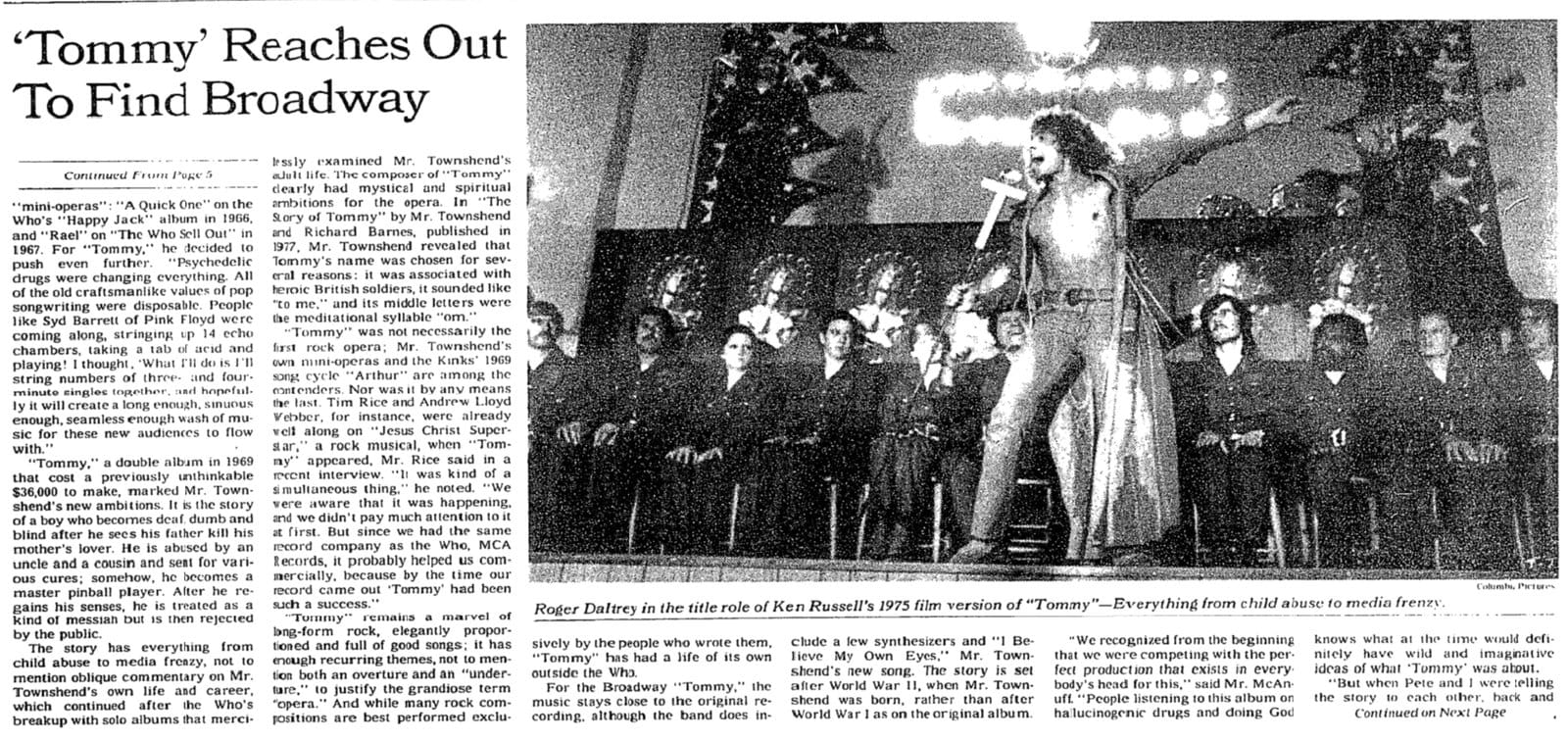
“Tommy,” a double album in 1969 that cost a previously unthinkable $36,000 to make, marked Mr. Townshend’s new ambitions. It is the story of a boy who becomes deaf, dumb and blind after he sees his father kill his mother’s lover. He is abused by an uncle and a cousin and sent for various cures; somehow, he becomes a master pinball player. After he regains his senses, he is treated as a kind of messiah but is then rejected by the public.
The story has everything from child abuse to media frenzy, not to mention oblique commentary on Mr. Townshend’s own life and career, which continued after the Who’s breakup with solo albums that mercilessly examined Mr. Townshend’s adult life. The composer of “Tommy” clearly had mystical and spiritual ambitions for the opera. In “The Story of Tommy” by Mr. Townshend and Richard Barnes, published in 1977, Mr. Townshend revealed that Tommy’s name was chosen for several reasons: it was associated with heroic British soldiers, it sounded like “to me,” and its middle letters were the meditational syllable “om.”
“Tommy” was not necessarily the first rock opera; Mr. Townshend’s own mini-operas and the Kinks’ 1969 song cycle “Arthur” are among the contenders. Nor was it by any means the last. Tim Rice and Andrew Lloyd Webber, for instance, were already well along on “Jesus Christ Superstar,” a rock musical, when “Tommy” appeared, Mr. Rice said in a recent interview. “It was kind of a simultaneous thing,” he noted. “We were aware that it was happening, and we didn’t pay much attention to it at first. But since we had the same record company as the Who, MCA Records, it probably helped us commercially, because by the time our record came out ‘Tommy’ had been such a success.”
“Tommy” remains a marvel of long-form rock, elegantly proportioned and full of good songs; it has enough recurring themes, not to mention both an overture and an “underture,” to justify the grandiose term “opera.” And while many rock compositions are best performed exclusively by the people who wrote them, “Tommy” has had a life of its own outside the Who.
For the Broadway “Tommy,” the music stays close to the original recording, although the band does include a few synthesizers and “I Believe My Own Eyes,” Mr. Townshend’s new song. The story is set after World War II, when Mr. Townshend was born, rather than after World War I as on the original album.
“We recognized from the beginning that we were competing with the perfect production that exists in everybody’s head for this,” said Mr. McAnuff. “People listening to this album on hallucinogenic drugs and doing God knows what at the time would definitely have wild and imaginative ideas of what ‘Tommy’ was about.
“But when Pete and I were telling the story to each other, back and