1996-07-18-Newsday
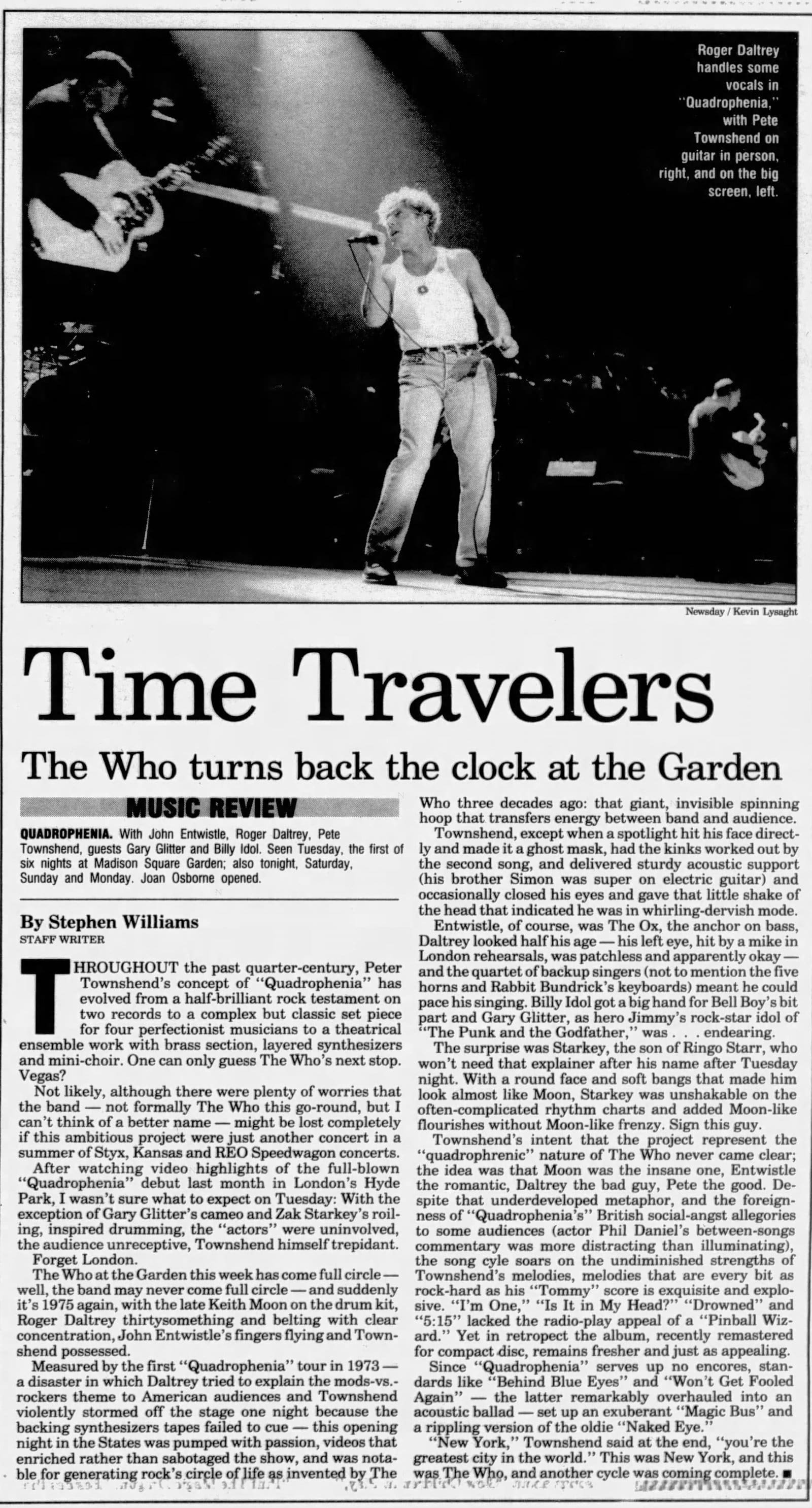
Roger Daltrey handles some vocals in "Quadrophenia," with Pete Townshend on guitar in person, right, and on the big screen, left.
Newsday / Kevin Lysight
Time Travelers
The Who turns back the clock at the Garden
MUSIC REVIEW
QUADROPHENIA. With John Entwistle, Roger Daltrey, Pete Townshend, guests Gary Glitter and Billy Idol. Seen Tuesday, the first of six nights at Madison Square Garden; also tonight, Saturday, Sunday and Monday. Joan Osborne opened.
Staff Writer
THROUGHOUT the past quarter-century, Peter Townshend's concept of "Quadrophenia" has evolved from a half-brilliant rock testament on two records to a complex but classic set piece for four perfectionist musicians to a theatrical ensemble work with brass section, layered synthesizers and mini-choir. One can only guess The Who's next stop. Vegas?
Not likely, although there were plenty of worries that the band — not formally The Who this go-round, but I can't think of a better name — might be lost completely if this ambitious project were just another concert in a summer of Styx, Kansas and REO Speedwagon concerts.
After watching video highlights of the full-blown "Quadrophenia" debut last month in London's Hyde Park, I wasn't sure what to expect on Tuesday: With the exception of Gary Glitter's cameo and Zak Starkey's roiling, inspired drumming, the "actors" were uninvolved, the audience unreceptive, Townshend himself trepidant.
Forget London.
The Who at the Garden this week has come full circle — well, the band may never come full circle — and suddenly it's 1975 again, with the late Keith Moon on the drum kit, Roger Daltrey thirtysomething and belting with clear concentration, John Entwistle's fingers flying and Townshend possessed.
Measured by the first "Quadrophenia" tour in 1973 — a disaster in which Daltrey tried to explain the mods-vs.-rockers theme to American audiences and Townshend violently stormed off the stage one night because the backing synthesizers tapes failed to cue — this opening night in the States was pumped with passion, videos that enriched rather than sabotaged the show, and was notable for generating rock's circle of life as invented by The
Who three decades ago: that giant, invisible spinning hoop that transfers energy between band and audience.
Townshend, except when a spotlight hit his face directly and made it a ghost mask, had the kinks worked out by the second song, and delivered sturdy acoustic support (his brother Simon was super on electric guitar) and occasionally closed his eyes and gave that little shake of the head that indicated he was in whirling-dervish mode.
Entwistle, of course, was The Ox, the anchor on bass, Daltrey looked half his age — his left eye, hit by a mike in London rehearsals, was patchless and apparently okay — and the quartet of backup singers (not to mention the five horns and Rabbit Bundrick's keyboards) meant he could pace his singing. Billy Idol got a big hand for Bell Boy's bit part and Gary Glitter, as hero Jimmy's rock-star idol of "The Punk and the Godfather," was . . . endearing.
The surprise was Starkey, the son of Ringo Starr, who won't need that explainer after his name after Tuesday night. With a round face and soft bangs that made him look almost like Moon, Starkey was unshakable on the often-complicated rhythm charts and added Moon-like flourishes without Moon-like frenzy. Sign this guy.
Townshend's intent that the project represent the "quadrophrenic" nature of The Who never came clear; the idea was that Moon was the insane one, Entwistle the romantic, Daltrey the bad guy, Pete the good. Despite that underdeveloped metaphor, and the foreignness of "Quadrophenia's" British social-angst allegories to some audiences (actor Phil Daniel's between-song commentary was more distracting than illuminating), the song cyle soars on the undiminished strengths of Townshend's melodies, melodies that are every bit as rock-hard as his "Tommy" score is exquisite and explosive. "I'm One," "Is It in My Head?" "Drowned" and "5:15" lacked the radio-play appeal of a "Pinball Wizard." Yet in retropect the album, recently remastered for compact disc, remains fresher and just as appealing.
Since "Quadrophenia" serves up no encores, standards like "Behind Blue Eyes" and "Won't Get Fooled Again" — the latter remarkably overhauled into an acoustic ballad — set up an exuberant "Magic Bus" and a rippling version of the oldie "Naked Eye."
"New York," Townshend said at the end, "you're the greatest city in the world." This was New York, and this was The Who, and another cycle was coming complete.