1997-08-05-Asbury_Park_Press
Who fans expecting a string of oldies and a few windmill guitar chords from the band’s Pete Townshend did not see what they came for at the sold-out PNC Bank Arts Center in Holmdel Township Sunday night.
Instead, The Who performed a dynamic, riveting version of its 1973 rock opera “Quadrophenia” that used actors, film and a 12-piece band. The performance exceeded all expectations for a band whose creative heyday was well into the 1970s.
“Quadrophenia” is The Who’s 1973 less-successful follow-up to its 1969 smash rock opera “Tommy.” Although not as well known, “Quadrophenia” marked quite a development for The Who at the time with its use of orchestral elements and a meatier hard-rock sound. The story follows the adventure of Jimmy, an archetype of a confused, desperate 1960s English youth. Like all good rock ’n’ roll, the plot hinges much on themes of rebellion, alienation and yearning.
For Sunday’s concert, a narrative was provided via film interludes and actors, such as singer P.J. Proby as the Godfather, played roles to sublimely illustrate the action.
However, all the show business flash would amount to little if the musicians were going through the motions, and they weren’t. Townshend was active, switching from electric to acoustic guitar, and his vocals were especially emotive on “I’m One.”
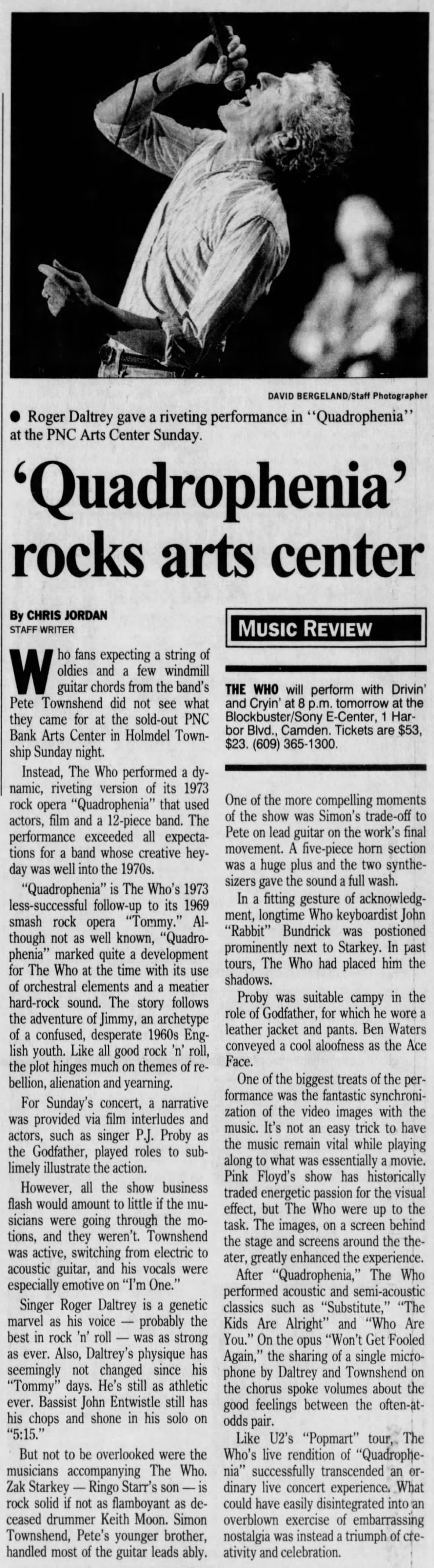
Singer Roger Daltrey is a genetic marvel as his voice — probably the best in rock ’n’ roll — was as strong as ever. Also, Daltrey’s physique has seemingly not changed since his “Tommy” days. He’s still as athletic ever. Bassist John Entwistle still has his chops and shone in his solo on “5:15.”
But not to be overlooked were the musicians accompanying The Who. Zak Starkey — Ringo Starr’s son — is rock solid if not as flamboyant as deceased drummer Keith Moon. Simon Townshend, Pete’s younger brother, handled most of the guitar leads ably.
One of the more compelling moments of the show was Simon’s trade-off to Pete on lead guitar on the work’s final movement. A five-piece horn section was a huge plus and the two synthesizers gave the sound a full wash.
In a fitting gesture of acknowledgment, longtime Who keyboardist John “Rabbit” Bundrick was positioned prominently next to Starkey. In past tours, The Who had placed him in the shadows.
Proby was suitably campy in the role of Godfather, for which he wore a leather jacket and pants. Ben Waters conveyed a cool aloofness as the Ace Face.
One of the biggest treats of the performance was the fantastic synchronization of the video images with the music. It’s not an easy trick to have the music remain vital while playing along to what was essentially a movie. Pink Floyd’s show has historically traded energetic passion for the visual effect, but The Who were up to the task. The images, on a screen behind the stage and screens around the theater, greatly enhanced the experience.
After “Quadrophenia,” The Who performed acoustic and semi-acoustic classics such as “Substitute,” “The Kids Are Alright” and “Who Are You.” On the opus “Won’t Get Fooled Again,” the sharing of a single microphone by Daltrey and Townshend on the chorus spoke volumes about the good feelings between the often-at-odds pair.
Like U2’s “Popmart” tour, The Who’s live rendition of “Quadrophenia” successfully transcended an ordinary live concert experience. What could have easily disintegrated into an overblown exercise of embarrassing nostalgia was instead a triumph of creativity and celebration.