2000-05-10-Evening_Standard
FUNNY, isn’t it, how memory plays tricks? I don’t remember George Best playing football wearing a comedy nose, but apparently he did. Well, he did according to the film Best, which is being released on Friday and shown on Sky the same night.
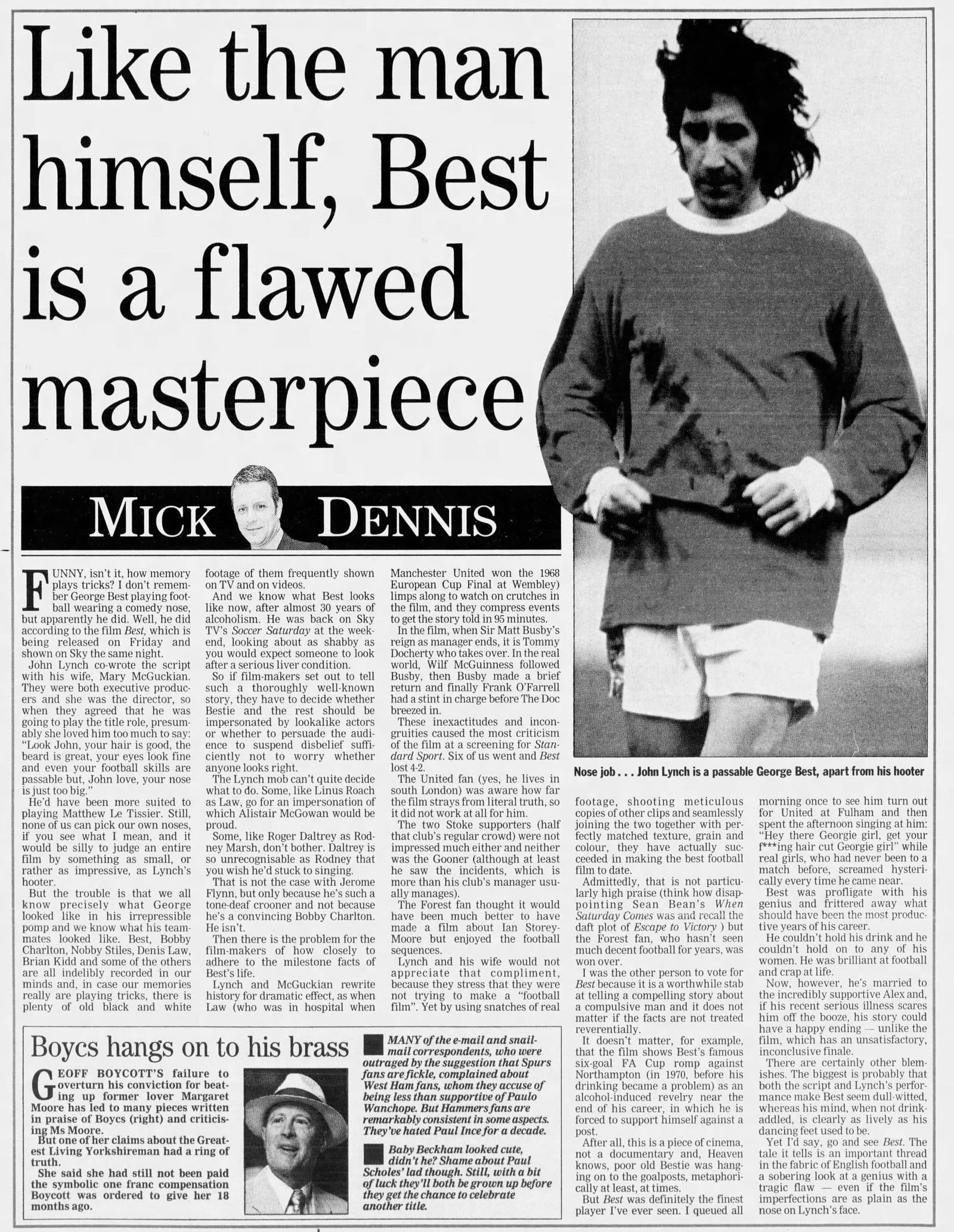
John Lynch co-wrote the script with his wife, Mary McGuckian. They were both executive producers and she was the director, so when they agreed that he was going to play the title role, presumably she loved him too much to say: “Look John, your hair is good, the beard is great, your eyes look fine and even your football skills are passable but, John love, your nose is just too big.”
He’d have been more suited to playing Matthew Le Tissier. Still, none of us can pick our own noses, if you see what I mean, and it would be silly to judge an entire film by something as small, or rather as impressive, as Lynch’s hooter.
But the trouble is that we all know precisely what George looked like in his irrepressible pomp and we know what his teammates looked like. Best, Bobby Charlton, Nobby Stiles, Denis Law, Brian Kidd and some of the others are all indelibly recorded in our minds and, in case our memories really are playing tricks, there is plenty of old black and white footage of them frequently shown on TV and on videos.
And we know what Best looks like now, after almost 30 years of alcoholism. He was back on Sky TV’s Soccer Saturday at the weekend, looking about as shabby as you would expect someone to look after a serious liver condition.
So if film-makers set out to tell such a thoroughly well-known story, they have to decide whether Bestie and the rest should be impersonated by lookalike actors or whether to persuade the audience to suspend disbelief sufficiently and not to worry whether anyone looks right.
The Lynch mob can’t quite decide what to do. Some, like Linus Roach as Law, go for an impersonation of which Alistair McGowan would be proud.
Some, like Roger Daltrey as Rodney Marsh, don’t bother. Daltrey is so unrecognisable as Rodney that you wish he’d stuck to singing.
That is not the case with Jerome Flynn, but only because he’s such a tone-deaf crooner and not because he’s a convincing Bobby Charlton. He isn’t.
Then there is the problem for the film-makers of how closely to adhere to the milestone facts of Best’s life.
Lynch and McGuckian rewrite history for dramatic effect, as when Law (who was in hospital when Manchester United won the 1968 European Cup Final at Wembley) limps along to watch on crutches in the film, and they compress events to get the story told in 95 minutes.
In the film, when Sir Matt Busby’s reign as manager ends, it is Tommy Docherty who takes over. In the real world, Wilf McGuinness followed Busby, then Busby made a brief return and finally Frank O’Farrell had a stint in charge before The Doc breezed in.
These inexactitudes and incongruities caused the most criticism of the film at a screening for Standard Sport. Six of us went and Best lost 4-2.
The United fan (yes, he lives in south London) was aware how far the film strays from literal truth, so it did not work at all for him.
The two Stoke supporters (half that club’s regular crowd) were not impressed much either and neither was the Gooner (although at least he saw the incidents, which is more than his club’s manager usually manages).
The Forest fan thought it would have been better to have made a film about Ian Storey-Moore but enjoyed the football sequences.
Lynch and his wife would not appreciate that compliment, because they stress that they were not trying to make a “football film”. Yet by using snatches of real footage, shooting meticulous copies of other clips and seamlessly joining the two together with perfectly matched texture, grain and colour, they have actually succeeded in making the best football film to date.
Admittedly, that is not particularly high praise (think how disappointing Sean Bean’s When Saturday Comes was and recall the daft plot of Escape to Victory) but the Forest fan, who hasn’t seen much decent football for years, was won over.
I was the other person to vote for Best because it is a worthwhile stab at telling a compelling story about a compulsive man and it does not matter if the facts are not treated reverentially.
It doesn’t matter, for example, that the film shows Best’s famous six-goal FA Cup romp against Northampton (in 1970, before his drinking became a problem) as an alcohol-induced revelry near the end of his career, in which he is forced to support himself against a post.
After all, this is a piece of cinema, not a documentary and, Heaven knows, poor old Bestie was hanging on to the goalposts, metaphorically at least, at times.
But Best was definitely the finest player I’ve ever seen. I queued all morning once to see him turn out for United at Fulham and then spent the afternoon singing at him: “Hey there Georgie girl, get your f***ing hair cut Georgie girl” while real girls, who had never been to a match before, screamed hysterically every time he came near.
Best was profligate with his genius and frittered away what should have been the most productive years of his career.
He couldn’t hold his drink and he couldn’t hold on to any of his women. He was brilliant at football and crap at life.
Now, however, he’s married to the incredibly supportive Alex and, if his recent serious illness scares him off the booze, his story could have a happy ending — unlike the film, which has an unsatisfactory, inconclusive finale.
There are certainly other blemishes. The biggest is probably that both the script and Lynch’s performance make Best seem dull-witted, whereas his mind, when not drink-addled, is clearly as lively as his dancing feet used to be.
Yet I’d say, go and see Best. The tale it tells is an important thread in the fabric of English football and a sobering look at a genius with a tragic flaw — even if the film’s imperfections are as plain as the nose on Lynch’s face.
—
Boycs hangs on to his brass
GEOFF BOYCOTT'S failure to overturn his conviction for beating up former lover Margaret Moore has led to many pieces written in praise of Boycs (right) and criticising Ms Moore.
But one of her claims about the Greatest Living Yorkshireman had a ring of truth.
She said she had still not been paid the symbolic one franc compensation Boycott was ordered to give her 18 months ago.
—
MANY of the e-mail and snail-mail correspondents, who were outraged by the suggestion that Spurs fans are fickle, complained about West Ham fans, whom they accuse of being less than supportive of Paulo Wanchope. But Hammers fans are remarkably consistent in some aspects. They’ve hated Paul Ince for a decade.
Baby Beckham looked cute, didn’t he? Shame about Paul Scholes’ lad though. Still, with a bit of luck they’ll both be grown up before they get the chance to celebrate another title.
—
Nose job… John Lynch is a passable George Best, apart from his hooter