2001-06-02-The_Daily_Telegraph
A Lifetime Achievement award is silly – there’s still so much to do, Pete Townshend tells Neil McCormick
Ten days ago, on a hot, sun-drenched May afternoon, many of the leading lights of the British music business could be found assembled in a gloomy, windowless, basement ballroom of a hotel in central London. The occasion was the Ivor Novello Awards, an annual event in which the achievements of British songwriters are celebrated over a three-course lunch.
Contemporary stars such as Craig David, Sonique, All Saints and Neil Morrissey (on behalf of his plastic alter ego, Bob the Builder) had all made copious expressions of gratitude for their recognition and the ceremony was dragging on into its third hour when Pete Townshend was summoned to the stage to accept a Lifetime Achievement award.
Despite enthusiastic applause, I think it is fair to say the rock legend was not particularly overwhelmed. Casually attired in short-sleeved shirt and jeans, Townshend announced to the designer-clad assembly: “I did all this crap so I could have my own swimming pool. And I’m not in it.” He suggested that if they speeded proceedings up a bit, he might still catch a few precious rays of sunshine.
You could be forgiven for thinking the one-time angry young man had turned out to be a rather grumpy old one. Townshend was joking, of course, but there was a tangible edge to his remarks. As soon as the last speech was made and the lights in the ballroom went up, Townshend could be spotted pulling on his denim jacket, brushing off the attentions of well-wishers as he made a beeline for the exit, with his beautiful young girlfriend clinging to his arm.
“I am happy to get an old-lads’ award,” he told me the next day, though adding that it was sales that really mattered because “Craig David and Bob the Builder pay the party bill”. The note of sarcasm adds to the impression that Townshend is reluctant to accept the designated role of respectable elder statesman. “The problem is they seem to have forgotten they gave me a very similar award at the end of my career 20 years ago,” he added, referring to a 1981 award for Outstanding Services to British Music. “As for Lifetime Achievement – I’m far from dead.”
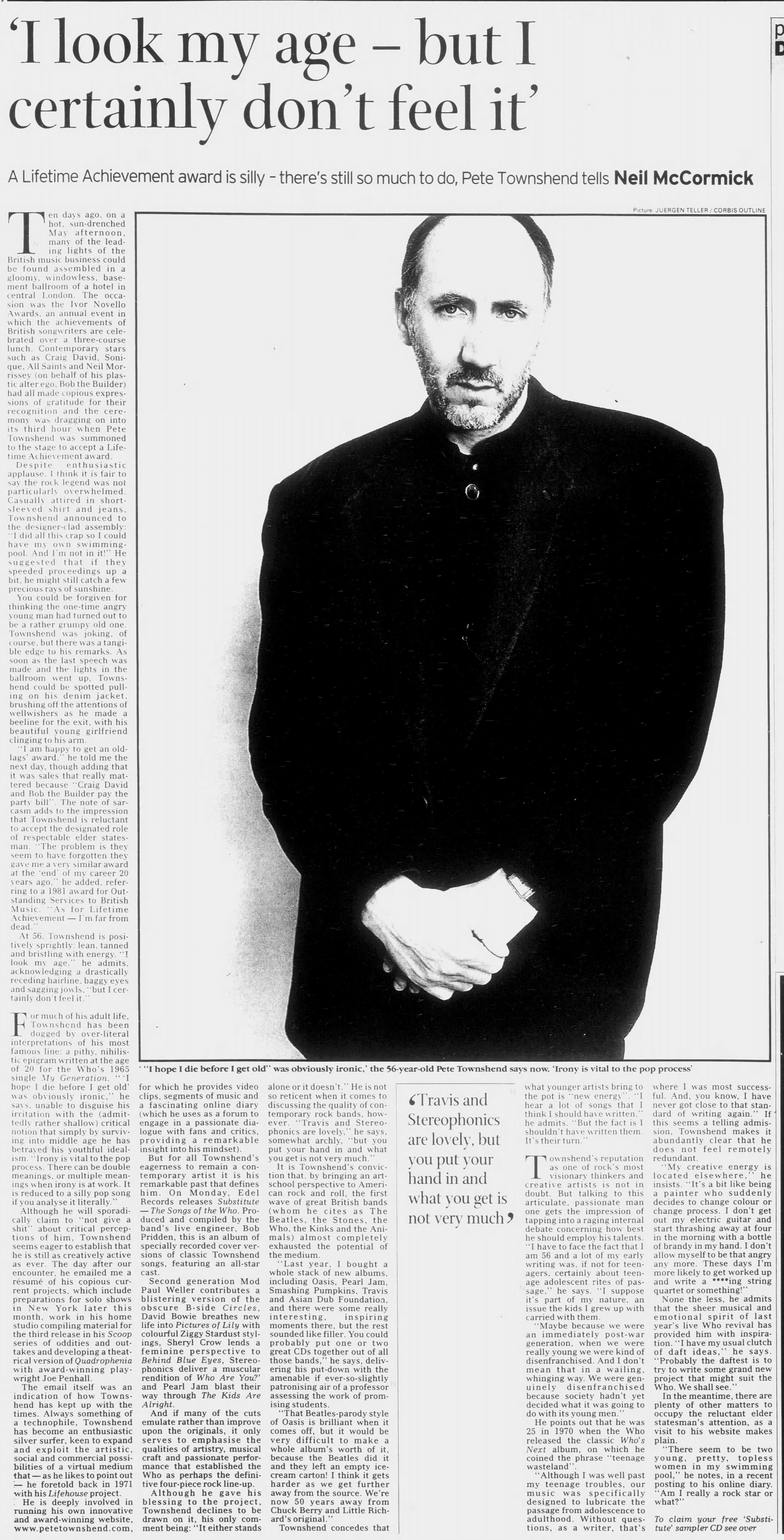
At 56, Townshend is positively sprightly lean, tanned and bristling with energy. “I look my age,” he admits, acknowledging a drastically receding hairline, baggy eyes and sagging jowls, “but I certainly don’t feel it.”
For much of his adult life, Townshend has been dogged by over-literal interpretations of his most famous line, a pithy, nihilistic epigram written at the age of 20 for the Who’s 1965 single My Generation. “I hope I die before I get old” was obviously ironic,” he says, unable to disguise his irritation with the (admittedly rather shallow) critical notion that simply by surviving into middle age he has betrayed his youthful idealism. “Irony is vital to the pop process. There can be double meanings, or multiple meanings when irony is at work. It is reduced to a silly pop song if you analyse it literally.”
Although he will sporadically claim to “not give a shit” about critical perceptions of him, Townshend seems eager to establish that he is still as creatively active as ever. The day after our encounter, he emailed me a résumé of his copious current projects, which include preparations for solo shows in New York later this month, work in his home studio compiling material for the third release in his Scoop series of oddities and outtakes and developing a theatrical version of Quadrophenia with award-winning playwright Joe Penhall.
The email itself was an indication of how Townshend has kept up with the times. Always something of a technophile, Townshend has become an enthusiastic silver surfer, keen to expand and exploit the artistic, social and commercial possibilities of a virtual medium that — as he likes to point out — he foretold back in 1971 with his Lifehouse project.
He is deeply involved in running his own innovative and award-winning website, www.petetownshend.com, for which he provides video clips, segments of music and a fascinating online diary (which he uses as a forum to engage in a passionate dialogue with fans and critics, providing a remarkable insight into his mindset).
But for all Townshend’s eagerness to remain a contemporary artist it is his remarkable past that defines him. On Monday, Edel Records releases Substitute — The Songs of the Who. Produced and compiled by the band’s live engineer, Bob Pridden, this is an album of specially recorded cover versions of classic Townshend songs, featuring an all-star cast.
Second generation Mod Paul Weller contributes a blistering version of the obscure B-side Circles, David Bowie breathes new life into Pictures of Lily with colourful Ziggy Stardust stylings. Sheryl Crow lends a feminine perspective to Behind Blue Eyes, Stereophonics deliver a muscular rendition of Who Are You? and Pearl Jam blast their way through The Kids Are Alright.
And if many of the cuts emulate rather than improve upon the originals, it only serves to emphasise the qualities of artistry, musical craft and passionate performance that established the Who as perhaps the definitive four-piece rock line-up.
Although he gave his blessing to the project, Townshend declines to be drawn on it, his only comment being: “It either stands alone or it doesn’t.” He is not so reticent when it comes to discussing the quality of contemporary rock bands, however. “Travis and Stereophonics are lovely,” he says, somewhat archly, “but you put your hand in and what you get is not very much.”
It is Townshend’s conviction that, by bringing an art-school perspective to American rock and roll, the first wave of great British bands (whom he cites as The Beatles, The Stones, The Who, the Kinks and the Animals) almost completely exhausted the potential of the medium.
“Last year, I bought a whole stack of new albums, including Oasis, Pearl Jam, Smashing Pumpkins, Travis and Asian Dub Foundation, and there were some really interesting, inspiring moments there, but the rest sounded like filler. You could probably put one or two great CDs together out of all those bands,” he says, delivering his put-down with the amenable if ever-so-slightly patronising air of a professor assessing the work of promising students.
“That Beatles-probably style of Oasis is brilliant when it comes off, but it would be very difficult to make a whole album’s worth of it because the Beatles did it and they left an empty ice-cream carton! I think it gets harder as we get further away from the source. We’re now 50 years away from Chuck Berry and Little Richard’s original.”
Townshend concedes that what younger artists bring to the post is “new energy’, a hear a lot of songs that I think I should have written… he admits. “But the fact is I shouldn’t have written them. It’s their turn.”
Townshend’s reputation as one of rock’s most visionary thinkers and creative artists is not in doubt. But talking to this articulate, passionate man one gets the impression of tapping into a raging internal debate concerning how best he should employ his talents.
“I have to face the fact that I am 56 and a lot of my early writing was, if not for teenagers, certainly about teenage adolescent rites of passage,” he says. “I suppose it’s part of my nature, an issue the kids I grew up with carried with them.
“Maybe because we were an immediately post-war generation, when we were really young we were kind of disenfranchised. And I don’t mean that in a wailing, whinging way. We were genuinely disenfranchised because society hadn’t yet decided what it was going to do with its young men.”
He points out that he was 25 in 1970 when the Who released their classic Who’s Next album, on which he coined the phrase “teenage wasteland”.
“Although I was well past my teenage troubles, our music was specifically designed to lubricate the passage from adolescence to adulthood. Without ques-
where I was most successful. And, you know, I have never got close to that standard of writing again.” If this seems a telling admission, Townshend makes it abundantly clear that he does not feel remotely redundant.
“My creative energy is located elsewhere,” he insists. “It’s a bit like being a painter who suddenly decides to change colour or change process. I don’t get out my electric guitar and start thrashing away at four in the morning with a bottle of brandy in my hand. I don’t allow myself to be that angry any more. These days I’m more likely to get worked up and write a “swing string quartet or something!!!”
None the less, he admits that the sheer musical and emotional spirit of last year’s live Who revival has provided him with inspiration. “I have my usual clutch of daft ideas,” he says. “Probably the daftest is to try to write some grand new project that might suit the Who. We shall see.”
In the meantime, there are plenty of other matters to occupy the reluctant elder statesman’s attention, as a visit to his website makes plain.
“There seem to be two young, pretty, topless women in my swimming pool,” he notes, in a recent posting to his online diary. “Am I really a rock star or what?”
To claim your free ‘Substitute’ album go to www.petetownshend.com
“I hope I die before I get old” was obviously ironic,” the 56-year-old Pete Townshend says now. “Irony is vital to the pop process.”
“Travis and Stereophonics are lovely, but you put your hand in and what you get is not very much.”