2002-07-29-The_Patriot_Ledger
CONCERT REVIEW THE WHO, with Robert Plant at Tweeter Center, Mansfield, Friday night.
The Who just another oldies band? Not on your life.
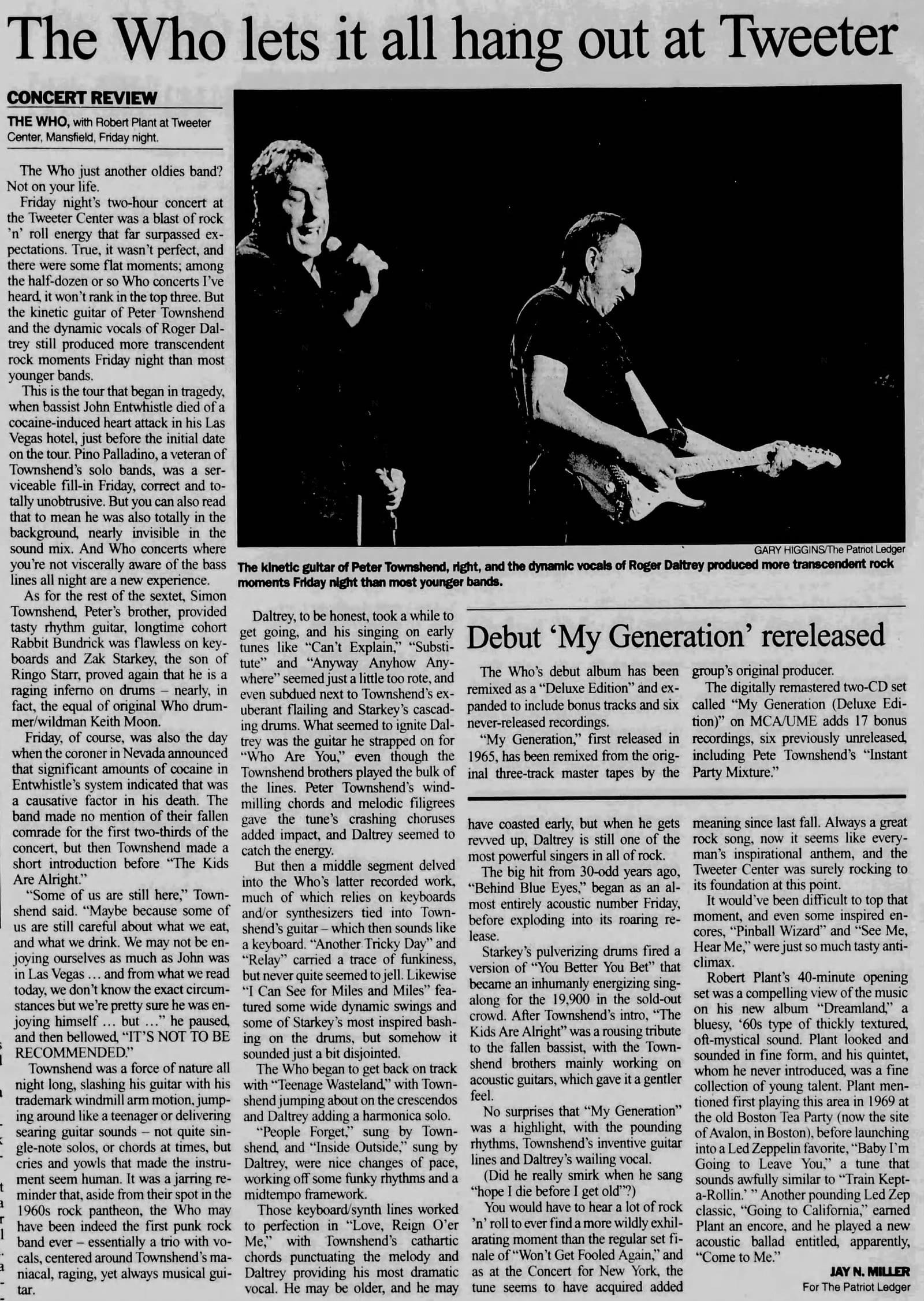
Friday night’s two-hour concert at the Tweeter Center was a blast of rock ’n’ roll energy that far surpassed expectations. True, it wasn’t perfect, and there were some flat moments; among the half-dozen or so Who concerts I’ve heard, it won’t rank in the top three. But the kinetic guitar of Peter Townshend and the dynamic vocals of Roger Daltrey still produced more transcendent rock moments Friday night than most younger bands.
This is the tour that began in tragedy, when bassist John Entwhistle died of a cocaine-induced heart attack in his Las Vegas hotel, just before the initial date on the tour. Pino Palladino, a veteran of Townshend’s solo bands, was a serviceable fill-in Friday, correct and totally unobtrusive. But you can also read that to mean he was also totally in the background, nearly invisible in the sound mix. And Who concerts where you’re not viscerally aware of the bass lines all night are a new experience.
As for the rest of the sextet, Simon Townshend, Peter’s brother, provided tasty rhythm guitar, longtime cohort Rabbit Bundrick was flawless on keyboards and Zak Starkey, the son of Ringo Starr, proved again that he is a raging inferno on drums – nearly, in fact, the equal of original Who drummer/wildman Keith Moon.
Friday, of course, was also the day when the coroner in Nevada announced that significant amounts of cocaine in Entwhistle’s system indicated that was a causative factor in his death. The band made no mention of their fallen comrade for the first two-thirds of the concert, but then Townshend made a short introduction before “The Kids Are Alright.”
“Some of us are still here,” Townshend said. “Maybe because some of us are still careful about what we eat, and what we drink. We may not be enjoying ourselves as much as John was in Las Vegas . . . and from what we read today, we don’t know the exact circumstances but we’re pretty sure he was enjoying himself . . . but . . .” he paused, and then bellowed, “IT’S NOT TO BE RECOMMENDED.”
Townshend was a force of nature all night long, slashing his guitar with his trademark windmill arm motion, jumping around like a teenager or delivering searing guitar sounds – not quite single-note solos, or chords at times, but cries and yowls that made the instrument seem human. It was a jarring reminder that, aside from their spot in the 1960s rock pantheon, the Who may have been indeed the first punk rock band ever – essentially a trio with vocals, centered around Townshend’s maniacal, raging, yet always musical guitar.
Daltrey, to be honest, took a while to get going, and his singing on early tunes like “Can’t Explain,” “Substitute” and “Anyway Anyhow Anywhere” seemed just a little too rote, and even subdued next to Townshend’s exuberant flailing and Starkey’s cascading drums. What seemed to ignite Daltrey was the guitar he strapped on for “Who Are You,” even though the Townshend brothers played the bulk of the lines. Peter Townshend’s windmilling chords and melodic filigrees gave the tune’s crashing choruses added impact, and Daltrey seemed to catch the energy.
But then a middle segment delved into the Who’s latter recorded work, much of which relies on keyboards and/or synthesizers tied into Townshend’s guitar – which then sounds like a keyboard. “Another Tricky Day” and “Relay” carried a trace of funkiness, but never quite seemed to jell. Likewise “I Can See for Miles and Miles” featured some wide dynamic swings and some of Starkey’s most inspired bashing on the drums, but somehow it sounded just a bit disjointed.
The Who began to get back on track with “Teenage Wasteland,” with Townshend jumping about on the crescendos and Daltrey adding a harmonica solo.
“People Forget,” sung by Townshend, and “Inside Outside,” sung by Daltrey, were nice changes of pace, working off some funky rhythms and a midtempo framework.
Those keyboard/synth lines worked to perfection in “Love, Reign O’er Me,” with Townshend’s cathartic chords punctuating the melody and Daltrey providing his most dramatic vocal. He may be older, and he may
Debut ‘My Generation’ rereleased
The Who’s debut album has been remixed as a “Deluxe Edition” and expanded to include bonus tracks and six never-released recordings.
“My Generation,” first released in 1965, has been remixed from the original three-track master tapes by the group’s original producer.
The digitally remastered two-CD set called “My Generation (Deluxe Edition)” on MCA/UME adds 17 bonus recordings, six previously unreleased, including Pete Townshend’s “Instant Party Mixture.”
have coasted early, but when he gets revved up, Daltrey is still one of the most powerful singers in all of rock.
The big hit from 30-odd years ago, “Behind Blue Eyes,” began as an almost entirely acoustic number Friday, before exploding into its roaring release.
Starkey’s pulverizing drums fired a version of “You Better You Bet” that became an inhumanly energizing singalong for the 19,900 in the sold-out crowd. After Townshend’s intro, “The Kids Are Alright” was a rousing tribute to the fallen bassist, with the Townshend brothers mainly working on acoustic guitars, which gave it a gentler feel.
No surprises that “My Generation” was a highlight, with the pounding rhythms, Townshend’s inventive guitar lines and Daltrey’s wailing vocal.
(Did he really smirk when he sang “hope I die before I get old”? )
You would have to hear a lot of rock ’n’ roll to ever find a more wildly exhilarating moment than the regular set finale of “Won’t Get Fooled Again,” and as at the Concert for New York, the tune seems to have already settled meaning since last fall. Always a great rock song, now it seems like everyman’s inspirational anthem, and the Tweeter Center was surely rocking to its foundation at this point.
It would’ve been difficult to top that moment, and even some inspired encores, “Pinball Wizard” and “See Me, Hear Me,” were just so much tasty anti-climax.
Robert Plant’s 40-minute opening set was a compelling view of the music on his new album “Dreamland,” a bluesy, ’60s type of thickly textured, oft-mystical sound. Plant looked and sounded in fine form, and his quintet, whom he never introduced, was a fine collection of young talent. Plant mentioned first playing this area in 1969 at the old Boston Tea Party (now the site of Avalon, in Boston), before launching into a Led Zeppelin favorite, “Baby I’m Going to Leave You,” a tune that sounds awfully similar to “Train Kepta-Rollin.’” Another pounding Led Zep classic, “Going to California,” earned Plant an encore, and he played a new acoustic ballad entitled, apparently “Come to Me.”