2002-09-20-Fort_Worth_Star_Telegram
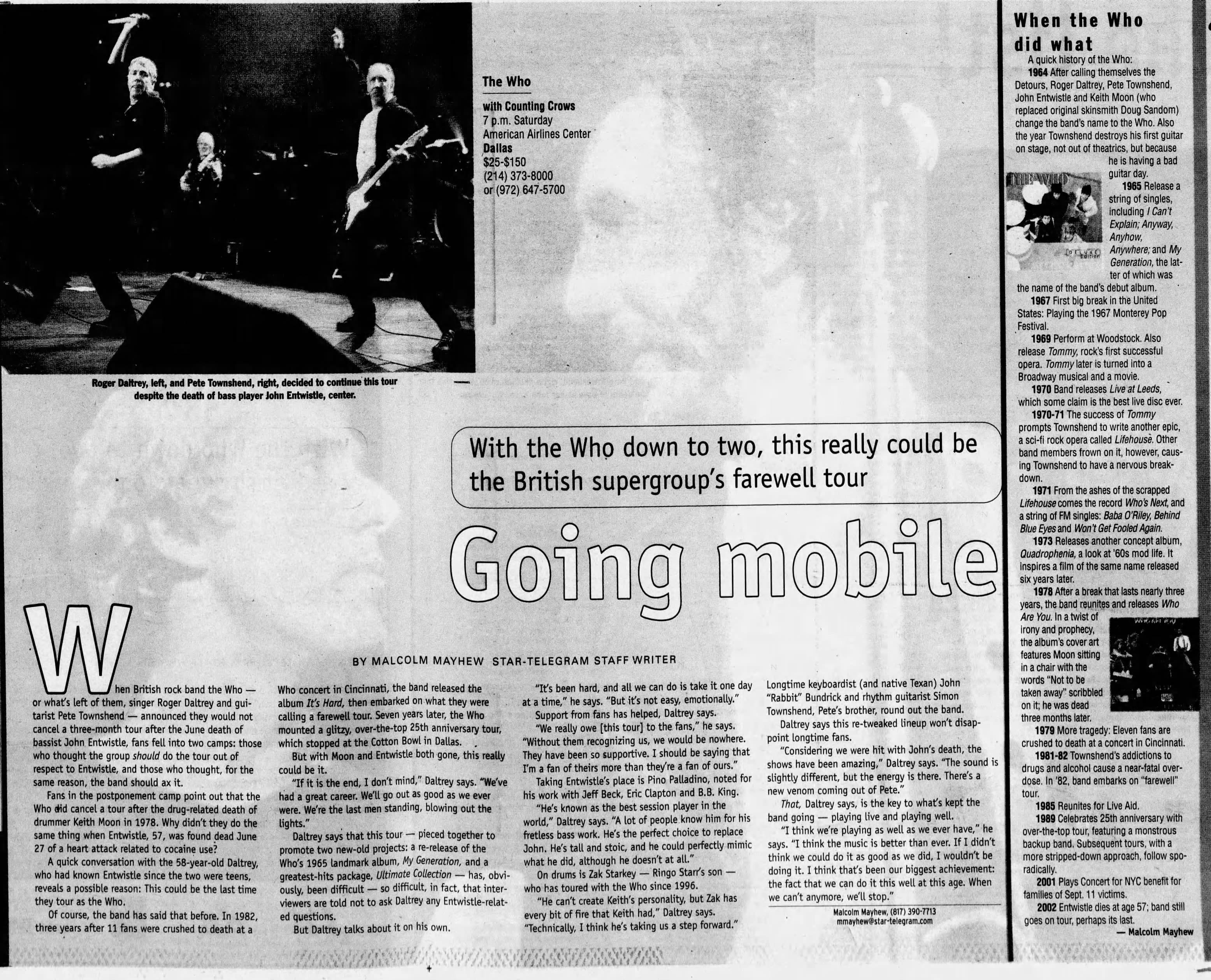
Roger Daltrey, left, and Pete Townshend, right, decided to continue this tour despite the death of bass player John Entwistle, center.
The Who with Counting Crows 7 p.m. Saturday American Airlines Center Dallas $25-$150 (214) 373-8000 or (972) 647-5700
When British rock band the Who — or what’s left of them, singer Roger Daltrey and guitarist Pete Townshend — announced they would not cancel a three-month tour after the June death of bassist John Entwistle, fans fell into two camps: those who thought the group should do the tour out of respect to Entwistle, and those who thought, for the same reason, the band should ax it.
Fans in the postponement camp point out that the Who did cancel a tour after the drug-related death of drummer Keith Moon in 1978. Why didn’t they do the same thing when Entwistle, 57, was found dead June 27 of a heart attack related to cocaine use?
A quick conversation with the 58-year-old Daltrey, who had known Entwistle since the two were teens, reveals a possible reason: This could be the last time they tour as the Who.
Of course, the band has said that before. In 1982, three years after 11 fans were crushed to death at a
Who concert in Cincinnati, the band released the album It’s Hard, then embarked on what they were calling a farewell tour. Seven years later, the Who mounted a glitzy, over-the-top 25th anniversary tour, which stopped at the Cotton Bowl in Dallas.
But with Moon and Entwistle both gone, this really could be it.
“If it is the end, I don’t mind,” Daltrey says. “We’ve had a great career. We’ll go out as good as we ever were. We’re the last men standing, blowing out the lights.”
Daltrey says that this tour — pieced together to promote two new-old projects: a re-release of the Who’s 1965 landmark album, My Generation, and a greatest-hits package, Ultimate Collection — has, obviously, been difficult — so difficult, in fact, that interviewers are told not to ask Daltrey any Entwistle-related questions.
But Daltrey talks about it on his own.
“It’s been hard, and all we can do is take it one day at a time,” he says. “But it’s not easy, emotionally.”
Support from fans has helped, Daltrey says.
“We really owe [this tour] to the fans,” he says. “Without them recognizing us, we would be nowhere. They have been so supportive. I should be saying that I’m a fan of theirs more than they’re a fan of ours.”
Taking Entwistle’s place is Pino Palladino, noted for his work with Jeff Beck, Eric Clapton and B.B. King.
“He’s known as the best session player in the world,” Daltrey says. “A lot of people know him for his fretless bass work. He’s the perfect choice to replace John. He’s tall and stoic, and he could perfectly mimic what he did, although he doesn’t at all.”
On drums is Zak Starkey — Ringo Starr’s son — who has toured with the Who since 1996.
“He can’t create Keith’s personality, but Zak has every bit of fire that Keith had,” Daltrey says. “Technically, I think he’s taking us a step forward.”
Longtime keyboardist (and native Texan) John “Rabbit” Bundrick and rhythm guitarist Simon Townshend, Pete’s brother, round out the band.
Daltrey says this re-tweaked lineup won’t disappoint longtime fans.
“Considering we were hit with John’s death, the shows have been amazing,” Daltrey says. “The sound is slightly different, but the energy is there. There’s a new venom coming out of Pete.”
That, Daltrey says, is the key to what’s kept the band going — playing live and playing well.
“I think we’re playing as well as we ever have,” he says. “I think the music is better than ever. If I didn’t think we could do it as good as we did, I wouldn’t be doing it. I think that’s been our biggest achievement: the fact that we can do it this well at this age. When we can’t anymore, we’ll stop.”
Malcolm Mayhew, (817) 390-7713 mmayhew@star-telegram.com
When the Who did what A quick history of the Who: 1964 After calling themselves the Detours, Roger Daltrey, Pete Townshend, John Entwistle and Keith Moon (who replaced original skinsmith Doug Sandom) change the band’s name to the Who. Also the year Townshend destroys his first guitar on stage, not out of theatrics, but because he is having a bad guitar day.
1965 Release a string of singles, including I Can’t Explain; Anyway, Anyhow, Anywhere; and My Generation, the latter of which was the name of the band’s debut album.
1967 First big break in the United States: Playing the 1967 Monterey Pop Festival.
1969 Perform at Woodstock. Also release Tommy, rock’s first successful opera. Tommy later is turned into a Broadway musical and a movie.
1970 Band releases Live at Leeds, which some claim is the best live disc ever.
1970-71 The success of Tommy prompts Townshend to write another epic, a sci-fi rock opera called Lifehouse. Other band members frown on it, however, causing Townshend to have a nervous breakdown.
1971 From the ashes of the scrapped Lifehouse comes the record Who’s Next; and a string of FM singles: Baba O’Riley, Behind Blue Eyes and Won’t Get Fooled Again.
1973 Releases another concept album, Quadrophenia, a look at ’60s mod life. It inspires a film of the same name released six years later.
1978 After a break that lasts nearly three years, the band reunites and releases Who Are You. In a twist of irony and prophecy, the album’s cover art features Moon sitting in a chair with the words “Not to be taken away” scribbled on it; he was dead three months later.
1979 More tragedy: Eleven fans are crushed to death at a concert in Cincinnati.
1981-82 Townshend’s addictions to drugs and alcohol cause a near-fatal overdose. In ’82, band embarks on “farewell” tour.
1985 Reunites for Live Aid.
1989 Celebrates 25th anniversary with over-the-top tour, featuring a monstrous backup band. Subsequent tours, with a more stripped-down approach, follow sporadically.
2001 Plays Concert for NYC benefit for families of Sept. 11 victims.
2002 Entwistle dies at age 57; band still goes on tour, perhaps its last.