2004-07-13-Calgary_Herald
Look Who's Squabbling with Michael Moore
OPINION
Judging by the film receipts, a fair number of people apparently get their views on world affairs, Iraq, and the morally and strategically complex war on terror from the simplistic portrayals churned out by Michael Moore. That’s unfortunate; those subjects are worth deeper thought than Moore’s chronic personal attacks, deliberately warped contexts and misleading linkages. His work does little to deepen an understanding about the responsibilities and perils of power, or the lesser-of-two-evil-choices that most often exist in international politics.
Instead, Moore’s propaganda merely stirs up visual emotional responses.
One British reviewer called him “the most ideological and emotive film editor since Sergei Eisenstein, the Soviet propagandist.” He meant it as a compliment; I don’t.
But Moore’s offerings are thin analytically for another reason: sometimes he just makes stuff up. The latest example of this, depending on who you believe, is when he recently claimed that The Who’s Pete Townshend first refused, but then asked for his 1971 song, Won’t Get Fooled Again, to be included in Moore’s latest film, Fahrenheit 9/11.
In an interview with Film Comment, Moore claims he originally wanted Townshend’s song (instead of the Neil Young tune eventually used).
But said Moore, speaking about himself, “Word came to us that (Townshend) is not a fan of Michael Moore and in fact supports the war and supports Tony Blair and doesn’t want the song used in any way that would make Blair look bad.”
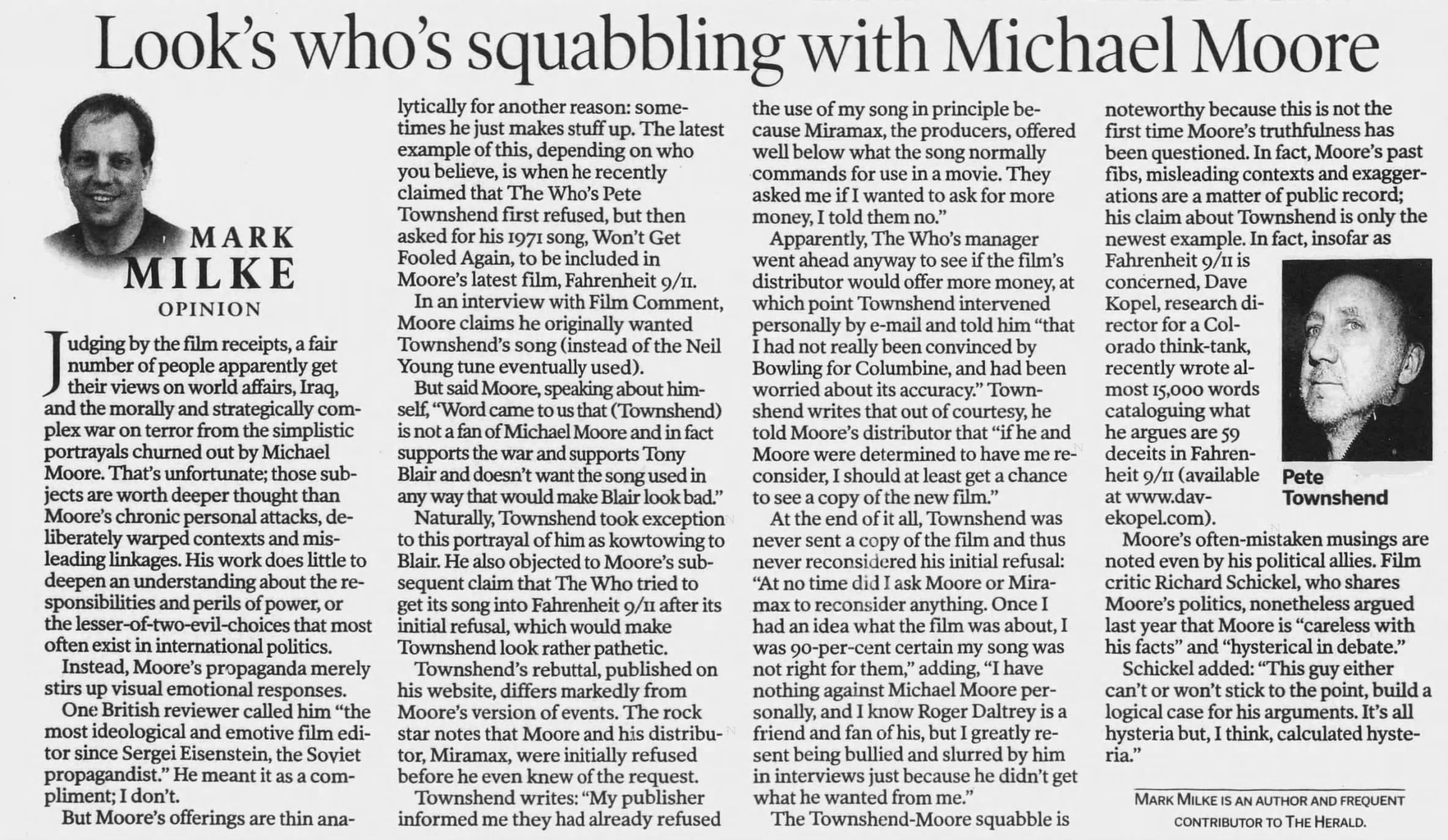
Naturally, Townshend took exception to this portrayal of him as kowtowing to Blair. He also objected to Moore’s subsequent claim that The Who tried to get its song into Fahrenheit 9/11 after its initial refusal, which would make Townshend look rather pathetic.
Townshend’s rebuttal, published on his website, differs markedly from Moore’s version of events. The rock star notes that Moore and his distributor, Miramax, were initially refused before he even knew of the request.
Townshend writes: “My publisher informed me they had already refused the use of my song in principle because Miramax, the producers, offered well below what the song normally commands for use in a movie. They asked me if I wanted to ask for more money, I told them no.”
Apparently, The Who’s manager went ahead anyway to see if the film’s distributor would offer more money, at which point Townshend intervened personally by e-mail and told him “that I had not really been convinced by Bowling for Columbine, and had been worried about its accuracy.” Townshend writes that out of courtesy, he told Moore’s distributor that “if he and Moore were determined to have me reconsider, I should at least get a chance to see a copy of the new film.”
At the end of it all, Townshend was never sent a copy of the film and thus never reconsidered his initial refusal: “At no time did I ask Moore or Miramax to reconsider anything. Once I had an idea what the film was about, I was 90-per-cent certain my song was not right for them,” adding, “I have nothing against Michael Moore personally, and I know Roger Daltrey is a friend and fan of his, but I greatly resent being bullied and slurred by him in interviews just because he didn’t get what he wanted from me.”
The Townshend-Moore squabble is noteworthy because this is not the first time Moore’s truthfulness has been questioned. In fact, Moore’s past fibs, misleading contexts and exaggerations are a matter of public record; his claim about Townshend is only the newest example. In fact, insofar as Fahrenheit 9/11 is concerned, Dave Kopel, research director for a Colorado think-tank, recently wrote almost 15,000 words cataloguing what he argues are 59 deceits in Fahrenheit 9/11 (available at www.davekopel.com).
Moore’s often-mistaken musings are noted even by his political allies. Film critic Richard Schickel, who shares Moore’s politics, nonetheless argued last year that Moore is “careless with his facts” and “hysterical in debate.”
Schickel added: “This guy either can’t or won’t stick to the point, build a logical case for his arguments. It’s all hysteria but, I think, calculated hysteria.”
MARK MILKE IS AN AUTHOR AND FREQUENT CONTRIBUTOR TO THE HERALD.