2006-09-27-Chicago_Tribune_1
CONCERT REVIEW
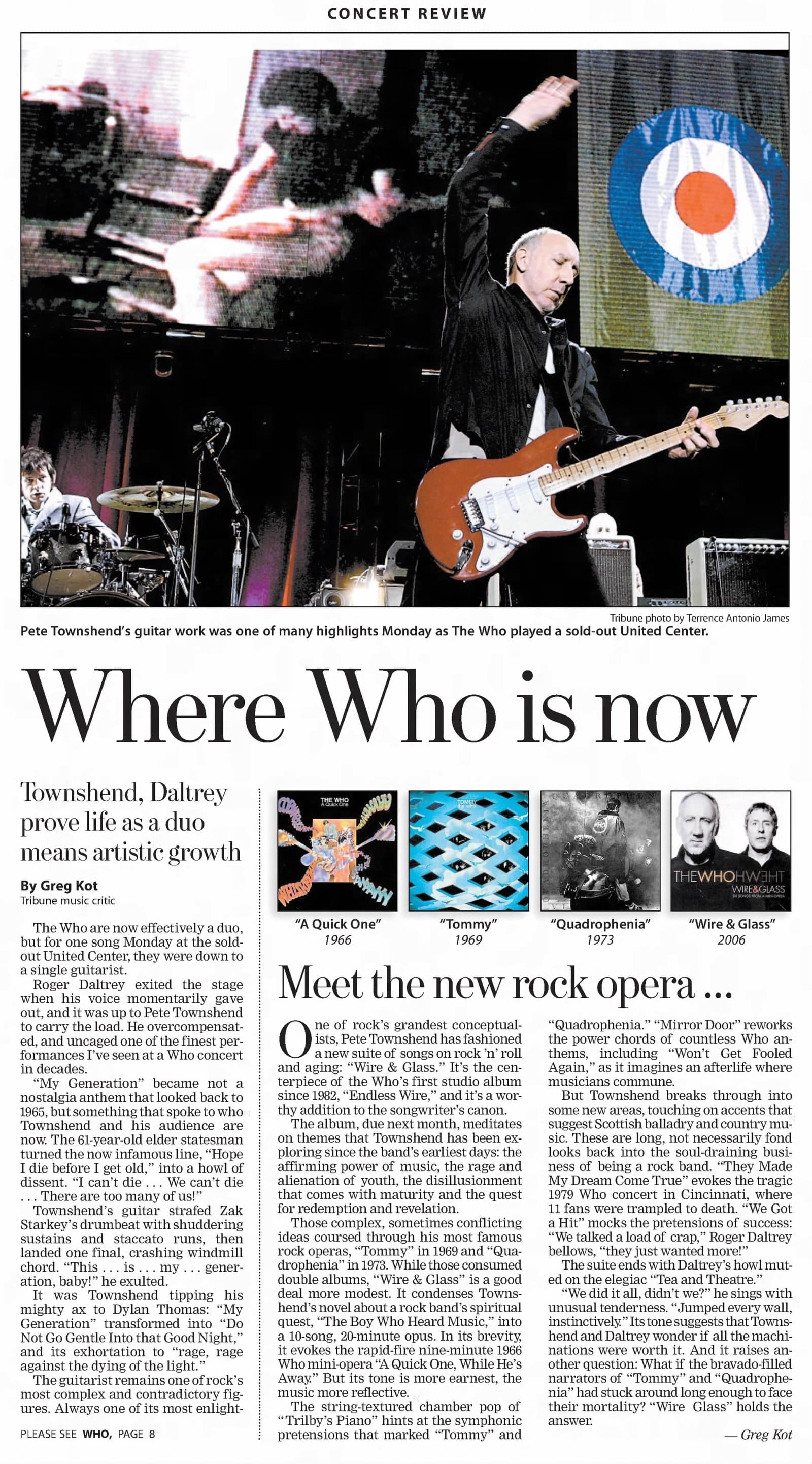
Tribune photo by Terrence Antonio James Pete Townshend’s guitar work was one of many highlights Monday as The Who played a sold-out United Center.
Where Who Is Now
Townshend, Daltrey prove life as a duo means artistic growth
Tribune Music Critic
The Who are now effectively a duo, but for one song Monday at the sold-out United Center, they were down to a single guitarist.
Roger Daltrey exited the stage when his voice momentarily gave out, and it was up to Pete Townshend to carry the load. He overcompensated, and uncaged one of the finest performances I’ve seen at a Who concert in decades.
“My Generation” became not a nostalgia anthem that looked back to 1965, but something that spoke to who Townshend and his audience are now. The 61-year-old elder statesman turned the now infamous line, “Hope I die before I get old,” into a howl of dissent. “I can’t die . . We can’t die . . . There are too many of us!”
Townshend’s guitar strafed Zak Starkey’s drumbeat with shuddering sustains and staccato runs, then landed one final, crashing windmill chord. “This . . . is . . . my . . . generation, baby!” he exulted.
It was Townshend tipping his mighty ax to Dylan Thomas: “My Generation” transformed into “Do Not Go Gentle Into that Good Night,” and its exhortation to “rage, rage against the dying of the light.”
The guitarist remains one of rock’s most complex and contradictory figures. Always one of its most enlight-
PLEASE SEE WHO, PAGE 8
“A Quick One” 1966
“Tommy” 1969
“Quadrophenia” 1973
“Wire & Glass” 2006
Meet the new rock opera . . .
One of rock’s grandest conceptualists, Pete Townshend has fashioned a new suite of songs on rock ’n’ roll and aging: “Wire & Glass.” It’s the centerpiece of the Who’s first studio album since 1982, “Endless Wire,” and it’s a worthy addition to the songwriter’s canon.
The album, due next month, meditates on themes that Townshend has been exploring since the band’s earliest days: the affirming power of music, the rage and alienation of youth, the disillusionment that comes with maturity and the quest for redemption and revelation.
Those complex, sometimes conflicting ideas coursed through his most famous rock operas, “Tommy” in 1969 and “Quadrophenia” in 1973. While those consumed double albums, “Wire & Glass” is a good deal more modest. It condenses Townshend’s novel about a rock band’s spiritual quest, “The Boy Who Heard Music,” into a 10-song, 20-minute opus. In its brevity, it evokes the rapid-fire nine-minute 1966 Who mini-opera “A Quick One, While He’s Away.” But its tone is more earnest, the music more reflective.
The string-textured chamber pop of “Trilby’s Piano” hints at the symphonic pretensions that marked “Tommy” and “Quadrophenia.” “Mirror Door” reworks the power chords of countless Who anthems, including “Won’t Get Fooled Again,” as it imagines an afterlife where musicians commune.
But Townshend breaks through into some new areas, touching on accents that suggest Scottish balladry and country music. These are long, not necessarily fond looks back into the soul-draining business of being a rock band. “They Made My Dream Come True” evokes the tragic 1979 Who concert in Cincinnati, where 11 fans were trampled to death. “We Got a Hit” mocks the pretensions of success: “We talked a load of crap,” Roger Daltrey bellows, “they just wanted more!”
The suite ends with Daltrey’s howl/muted on the elegiac “Tea and Theatre.”
“We did it all, didn’t we?” he sings with unusual tenderness. “Jumped every wall, instinctively” Its tone suggests that Townshend and Daltrey wonder if all the machinations were worth it. And it raises another question: What if the bravado-filled narrators of “Tommy” and “Quadrophenia” had stuck around long enough to face their mortality? “Wire Glass” holds the answer.
— Greg Kot