2006-10-04-Calgary_Herald_2
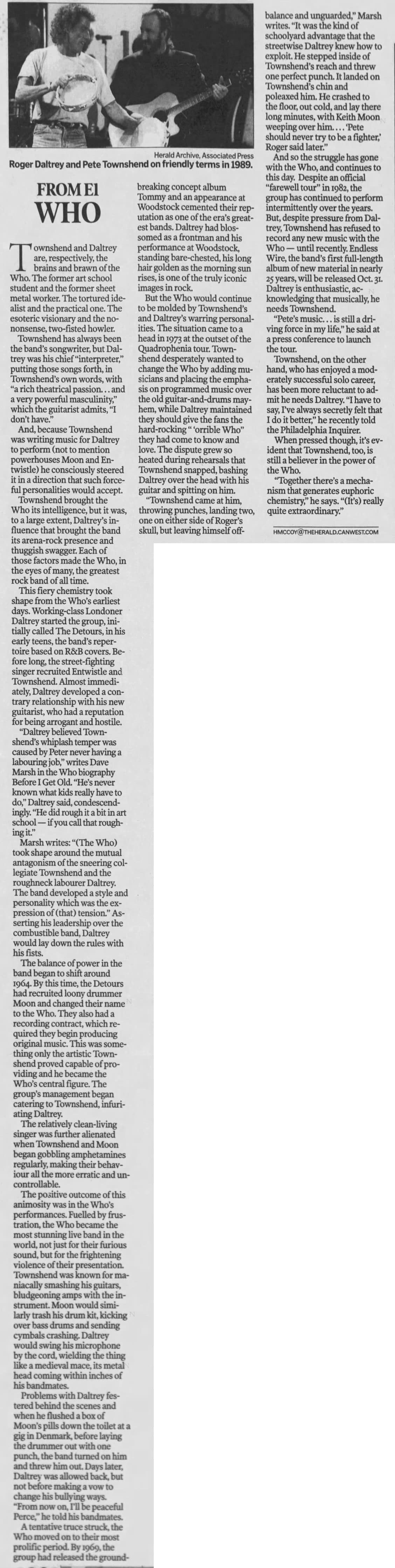
Herald Archive, Associated Press Roger Daltrey and Pete Townshend on friendly terms in 1989.
FROM EL WHO
Townshend and Daltrey are, respectively, the brains and brawn of the Who. The former art school student and the former sheet metal worker. The tortured idealist and the practical one. The esoteric visionary and the no-nonsense, two-fisted howler.
Townshend has always been the band's songwriter, but Daltrey was his chief "interpreter," putting those songs forth, in Townshend's own words, with "a rich theatrical passion… and a very powerful masculinity," which the guitarist admits, "I don't have."
And, because Townshend was writing music for Daltrey to perform (not to mention powerhouses Moon and Entwistle) he consciously steered it in a direction that such forceful personalities would accept.
Townshend brought the Who its intelligence, but it was, to a large extent, Daltrey's influence that brought the band its arena-rock presence and thuggish swagger. Each of those factors made the Who, in the eyes of many, the greatest rock band of all time.
This fiery chemistry took shape from the Who's earliest days. Working-class Londoner Daltrey started the group, initially called The Detours, in his early teens, the band's repertoire based on R&B covers. Before long, the street-fighting singer recruited Entwistle and Townshend. Almost immediately, Daltrey developed a contrary relationship with his new guitarist, who had a reputation for being arrogant and hostile.
"Daltrey believed Townshend's whiplash temper was caused by Peter never having a labouring job," writes Dave Marsh in the Who biography Before I Get Old. "He's never known what kids really have to do," Daltrey said, condescendingly. "He did rough it a bit in art school — if you call that roughing it."
Marsh writes: "(The Who) took shape around the mutual antagonism of the sneering collegiate Townshend and the roughneck labourer Daltrey. The band developed a style and personality which was the expression of (that) tension." Asserting his leadership over the combustible band, Daltrey would lay down the rules with his fists.
The balance of power in the band began to shift around 1964. By this time, the Detours had recruited loony drummer Moon and changed their name to the Who. They also had a recording contract, which required they begin producing original music. This was something only the artistic Townshend proved capable of providing and he became the Who's central figure. The group's management began catering to Townshend, infuriating Daltrey.
The relatively clean-living singer was further alienated when Townshend and Moon began gobbling amphetamines regularly, making their behaviour all the more erratic and uncontrollable.
The positive outcome of this animosity was in the Who's performances. Fuelled by frustration, the Who became the most stunning live band in the world, not just for their furious sound, but for the frightening violence of their presentation. Townshend was known for maniacally smashing his guitars, bludgeoning amps with the instrument. Moon would similarly trash his drum kit, kicking over bass drums and sending cymbals crashing. Daltrey would swing his microphone by the cord, wielding the thing like a medieval mace, its metal head coming within inches of his bandmates.
Problems with Daltrey festered behind the scenes and when he flushed a box of Moon's pills down the toilet at a gig in Denmark, before laying the drummer out with one punch, the band turned on him and threw him out. Days later, Daltrey was allowed back, but not before making a vow to change his bullying ways. "From now on, I'll be peaceful Percy," he told his bandmates.
A tentative truce struck, the Who moved on to their most prolific period. By 1969, the group had released the groundbreaking concept album Tommy and an appearance at Woodstock cemented their reputation as one of the era's greatest bands. Daltrey had blossomed as a frontman and his performance at Woodstock, standing bare-chested, his long hair golden as the morning sun rises, is one of the truly iconic images in rock.
But the Who would continue to be molded by Townshend's and Daltrey's warring personalities. The situation came to a head in 1973 at the outset of the Quadrophenia tour. Townshend desperately wanted to change the Who by adding musicians and placing the emphasis on programmed music over the old guitar-and-drums mayhem, while Daltrey maintained they should give the fans the hard-rocking "orible Who" they had come to know and love. The dispute grew so heated during rehearsals that Townshend snapped, bashing Daltrey over the head with his guitar and spitting on him.
"Townshend came at him, throwing punches, landing two, one on either side of Roger's skull, but leaving himself off-balance and unguarded," Marsh writes. "It was the kind of schoolyard advantage that the streetwise Daltrey knew how to exploit. He stepped inside of Townshend's reach and threw one perfect punch. It landed on Townshend's chin and poleaxed him. He crashed to the floor, out cold, and lay there long minutes, with Keith Moon weeping over him… 'Pete should never try to be a fighter,' Roger said later."
And so the struggle has gone with the Who, and continues to this day. Despite an official "farewell tour" in 1982, the group has continued to perform intermittently over the years. But, despite pressure from Daltrey, Townshend has refused to record any new music with the Who — until recently. Endless Wire, the band's first full-length album of new material in nearly 25 years, will be released Oct. 31. Daltrey is enthusiastic, acknowledging that musically, he needs Townshend.
"Pete's music… is still a driving force in my life," he said at a press conference to launch the tour.
Townshend, on the other hand, who has enjoyed a moderately successful solo career, has been more reluctant to admit he needs Daltrey. "I have to say, I've always secretly felt that I do it better," he recently told the Philadelphia Inquirer.
When pressed though, it's evident that Townshend, too, is still a believer in the power of the Who.
"Together there's a mechanism that generates euphoric chemistry," he says. "(It's) really quite extraordinary."