2006-11-10-The_Desert_Sun_2006_1
The Who didn’t invent the concept album — Frank Sinatra and Gordon Jenkins were making those in the ’40s and ’50s.
But Pete Townshend took the concept album advanced by The Beatles’ “Sergeant Pepper’s Lonely Hearts Club” and turned it into something that could be adapted to Broadway, film, even the Metropolitan Opera.
Townshend called it “Tommy.” Critics called it rock opera.
Now, 24 years after his last album of new material for The Who, Townshend has reunited with singer Roger Daltrey to create a new concept CD with its own “mini-opera.” The album is “Endless Wire.” The mini-opera is “Wire & Glass,” and it’s based on a novella Townshend wrote titled, “The Boy Who Heard Music.”
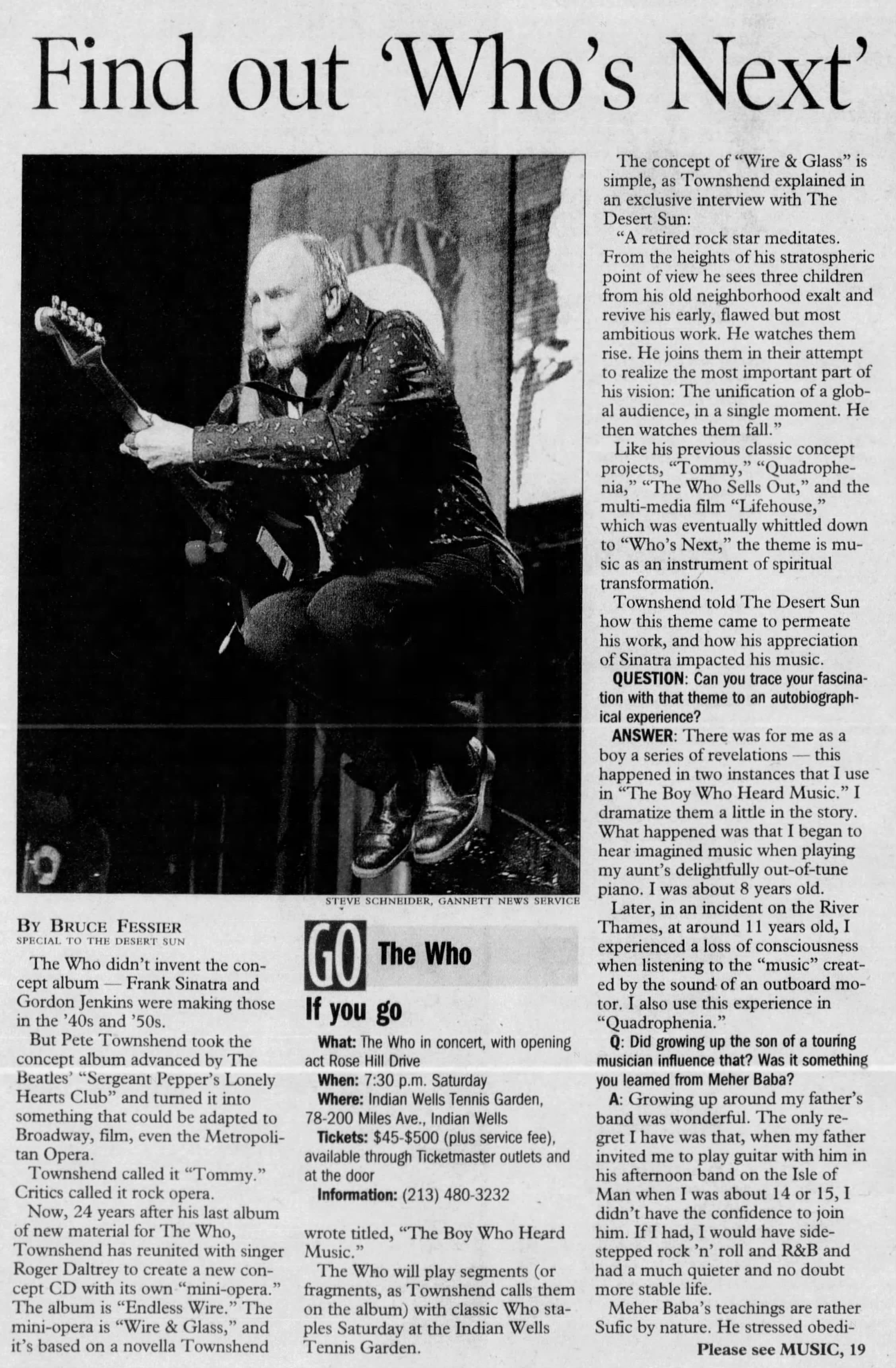
The Who will play segments (or fragments, as Townshend calls them on the album) with classic Who staples Saturday at the Indian Wells Tennis Garden.
The concept of “Wire & Glass” is simple, as Townshend explained in an exclusive interview with The Desert Sun:
“A retired rock star meditates. From the heights of his stratospheric point of view he sees three children from his old neighborhood exalt and revive his early, flawed but most ambitious work. He watches them rise. He joins them in their attempt to realize the most important part of his vision: The unification of a global audience, in a single moment. He then watches them fall.”
Like his previous classic concept projects, “Tommy,” “Quadrophenia,” “The Who Sells Out,” and the multi-media film “Lifehouse,” which was eventually whittled down to “Who’s Next,” the theme is music as an instrument of spiritual transformation.
Townshend told The Desert Sun how this theme came to permeate his work, and how his appreciation of Sinatra impacted his music.
QUESTION: Can you trace your fascination with that theme to an autobiographical experience?
ANSWER: There was for me as a boy a series of revelations — this happened in two instances that I use in “The Boy Who Heard Music.” I dramatize them a little in the story. What happened was that I began to hear imagined music when playing my aunt’s delightfully out-of-tune piano. I was about 8 years old.
Later, in an incident on the River Thames, at around 11 years old, I experienced a loss of consciousness when listening to the “music” created by the sound of an outboard motor. I also use this experience in “Quadrophenia.”
Q: Did growing up the son of a touring musician influence that? Was it something you learned from Meher Baba?
A: Growing up around my father’s band was wonderful. The only regret I have was that, when my father invited me to play guitar with him in his afternoon band on the Isle of Man when I was about 14 or 15, I didn’t have the confidence to join him. If I had, I would have sidestepped rock ’n’ roll and R&B and had a much quieter and no doubt more stable life.
Meher Baba’s teachings are rather Sufic by nature. He stressed obedi-