2006-11-13-The_Daily_Herald_2
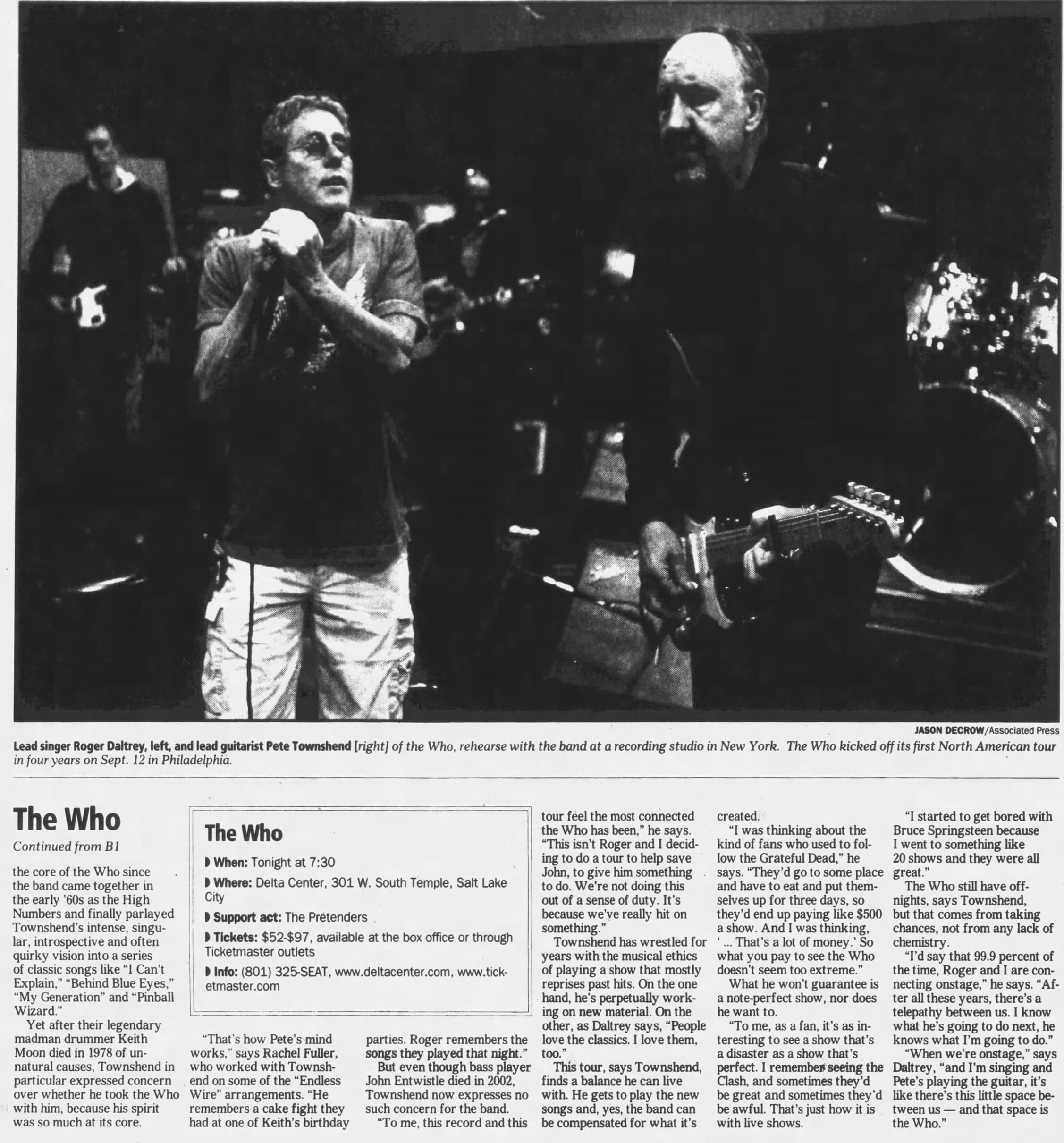
Lead singer Roger Daltrey, left, and lead guitarist Pete Townshend [right] of the Who, rehearse with the band at a recording studio in New York. The Who kicked off its first North American tour in four years on Sept. 12 in Philadelphia.
The core of the Who since the band came together in the early ‘60s as the High Numbers and finally parlayed Townshend’s intense, singular, introspective and often quirky vision into a series of classic songs like “I Can’t Explain,” “Behind Blue Eyes,” “My Generation” and “Pinball Wizard.”
Yet after their legendary madman drummer Keith Moon died in 1978 of unnatural causes, Townshend in particular expressed concern over whether he took the Who with him, because his spirit was so much at its core.
The Who When: Tonight at 7:30 Where: Delta Center, 301 W. South Temple, Salt Lake City Support act: The Pretenders Tickets: $52-$97, available at the box office or through Ticketmaster outlets Info: (801) 325-SEAT, www.deltacenter.com, www.ticketmaster.com
“That’s how Pete’s mind works,” says Rachel Fuller, who worked with Townshend on some of the “Endless Wire” arrangements. “He remembers a cake fight they had at one of Keith’s birthday parties. Roger remembers the songs they played that night.”
But even though bass player John Entwistle died in 2002, Townshend now expresses no such concern for the band.
“To me, this record and this tour feel the most connected the Who has been,” he says. “This isn’t Roger and I deciding to do a tour to help save John, to give him something to do. We’re not doing this out of a sense of duty. It’s because we’ve really hit on something.”
Townshend has wrestled for years with the musical ethics of playing a show that mostly reprises past hits. On the one hand, he’s perpetually working on new material. On the other, as Daltrey says, “People love the classics. I love them, too.”
This tour, says Townshend, finds a balance he can live with. He gets to play the new songs and, yes, the band can be compensated for what it’s created.
“I was thinking about the kind of fans who used to follow the Grateful Dead,” he says. “They’d go to some place and have to eat and put themselves up for three days, so they’d end up paying like $500 a show. And I was thinking, ‘… That’s a lot of money.’ So what you pay to see the Who doesn’t seem too extreme.”
What he won’t guarantee is a note-perfect show, nor does he want to.
“To me, as a fan, it’s as interesting to see a show that’s a disaster as a show that’s perfect. I remember seeing the Clash, and sometimes they’d be great and sometimes they’d be awful. That’s just how it is with live shows.
“I started to get bored with Bruce Springsteen because I went to something like 20 shows and they were all great.”
The Who still have off-nights, says Townshend, but that comes from taking chances, not from any lack of chemistry.
“I’d say that 99.9 percent of the time, Roger and I are connecting onstage,” he says. “After all these years, there’s a telepathy between us. I know what he’s going to do next, he knows what I’m going to do.”
“When we’re onstage,” says Daltrey, “and I’m singing and Pete’s playing the guitar, it’s like there’s this little space between us — and that space is the Who.”