Thursday, July 15th, 1965

In Beat Instrumental, John Emery reviews an acetate of nine new Who tracks played for him by producer Shel Talmy. The songs are intended for The Who's first album slated for release in the U.S. and France that autumn. Emery gives the titles to eight of the tracks, "I'm A Man," "Heatwave," I Don't Mind," "Lubie," "You're Gonna Know Me," "Please Please Please," "Leaving Here," and "Motoring." Only one, "You're Gonna Know Me," is a band original which leads Emery to remark, "one thing hit me slap in the face just looking at the titles -- the lack of originality in choice of material."
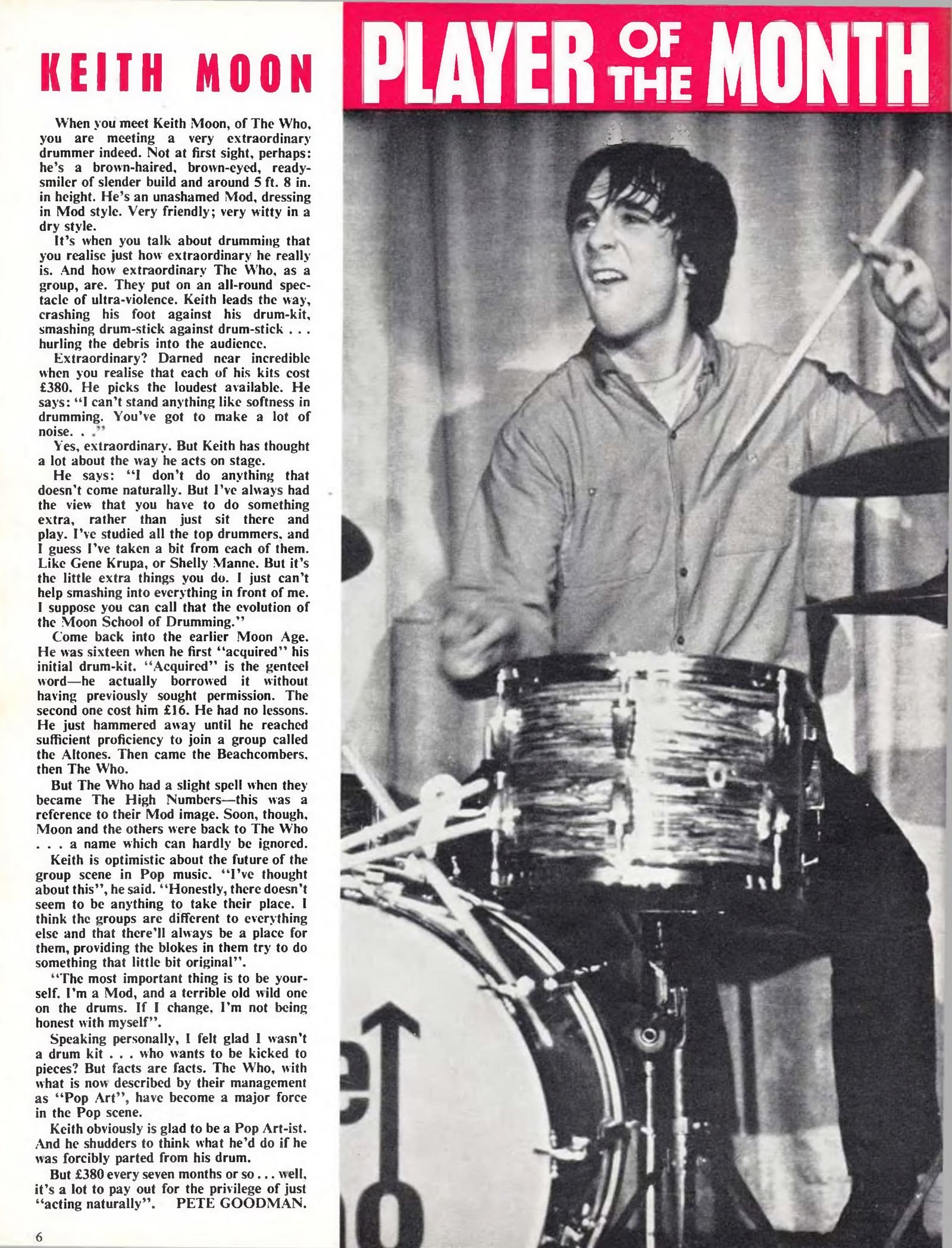
Keith is also featured as Player of the Month, and its mentioned that Roger also played guitar when they were starting out.
Transcript:
THE WHO
FIRST ALBUM COMPLETED
By JOHN EMERY
The Who—the group you either “Love Or Hate!”.
The group who put presentation first and music second, and whose off-beat stage act and ideas in dynamics have attracted just what they wanted, something that is vital in show business these days, publicity.
“I Can’t Explain” or “Anyway, Anyhow, Anywhere” haven’t hit the high spots but they have certainly established The Who—and aroused interest in their first long player.
There is no definite release date for it yet, but it has been completed, although the actual titles and running order have still to be sorted out by Brunswick.
TALMY AGAIN
Shel Talmy, who also records The Kinks, A and R’d the album which was entirely recorded at the I.B.C. Studios in Portland Place, W.1, and was assisted by engineer Glyn Johns.
Shel played me an acetate of nine of the tracks, but before I even heard them, one thing hit me slap in the face just looking at the titles—the lack of originality in choice of material.
Of the nine songs, eight were revived American items, originally recorded by such artists as James Brown, Martha and the Vandellas and Bo Diddley.
True, they are given that distinctive Who treatment but that might not be enough if they want to make a big impression with the album.
Their sound was supplemented throughout by piano played by session man Nick Hopkins, who once played with Screamin’ Lord Sutch.
LESS EFFECTS
Another interesting point is the fact that they have not used their electronic effects as extensively as one might have expected.
The only track in which this “sound” really stands out is on “I’m A Man”, a Bo Diddley number that is given a completely original Who treatment.
The Bo Diddley version tends to become monotonous, but The Who have worked out certain climaxes at different points. This number lasts all of ten minutes when they perform it on stage but they had to trim it down for their album to just under half that time.
They make a good job of Martha and the Vandellas’ “Heatwave”, a number attempted by few groups. It is similar to the original and has some very notable vocal backings from Peter Townshend and bass player John Entwistle.
JAMES BROWN NUMBER
“I Don’t Mind” might be chosen to open side one. It’s a James Brown number sung well by Roger Daltrey, and a song that might well be popularised by this LP, as was “Walking The Dog” and “Route 66” by The Rolling Stones.
“Lubie”, another American item, has a persistent beat with chants of “Lubie Come Back Home” from Peter and John in the background.
Climax is used again in this one with a pause in the middle of the song where Roger slows the number down with spoken lyrics—then it is built up again to a crescendo.
“Lubie” is a particularly long track, stretching to about four minutes.
“You’re Going To Know Me” was written by Peter Townshend and is opened with guitar strumming and bursts into an up-tempo raver. There is some feedback used here.
“Please, Please, Please” is another James Brown song and is recognised among the deeper R ‘n’ B groups as a “standard”. The Who perform this well, and Peter Townshend stands out with a catchy solo.
ONE OF THE BEST
“Leaving Here”, in my opinion, is one of the best tracks. It is an American number recorded a short time ago as a single by The Birds. Drummers should listen closely to this one—Keith Moon uses some great bass pedal work.
“Motoring” is on the flipside of Martha and the Vandellas’ “Nowhere To Run” and has to be heard several times before it is appreciated.
There you are—nine tracks—the nucleus of their first album. A very important step in their career. Remember it was The Beatles’ first long player “Please, Please Me” that illustrated their true talents to the pop world, and after a couple of hit singles really clinched their claim to fame.
Will The Who’s first LP do the same?
Only the record buyers can tell us the answer to that!!
KEITH MOON
PLAYER OF THE MONTH
When you meet Keith Moon, of The Who, you are meeting a very extraordinary drummer indeed. Not at first sight, perhaps: he’s a brown-haired, brown-eyed, ready-smiler of slender build and around 5 ft. 8 in. in height. He’s an unashamed Mod, dressing in Mod style. Very friendly; very witty in a dry style.
It’s when you talk about drumming that you realise just how extraordinary he really is. And how extraordinary The Who, as a group, are. They put on an all-round spectacle of ultra-violence. Keith leads the way, crashing his foot against his drum-kit, smashing drum-stick against drum-stick… hurling the debris into the audience.
Extraordinary? Darned near incredible when you realise that each of his kits cost £380. He picks the loudest available. He says: “I can’t stand anything like softness in drumming. You’ve got to make a lot of noise…”
Yes, extraordinary. But Keith has thought a lot about the way he acts on stage.
He says: “I don’t do anything that doesn’t come naturally. But I’ve always had the view that you have to do something extra, rather than just sit there and play. I’ve studied all the top drummers, and I guess I’ve taken a bit from each of them. Like Gene Krupa, or Shelly Manne. But it’s the little extra things you do. I just can’t help smashing into everything in front of me. I suppose you can call that the evolution of the ‘Moon School of Drumming’.”
Come back into the earlier Moon Age. He was sixteen when he first “acquired” his initial drum-kit. “Acquired” is the genteel word—he actually borrowed it without having previously sought permission. The second one cost him £16. He had no lessons. He just hammered away until he reached sufficient proficiency to join a group called the Altones. Then came the Beachcombers, then The Who.
But The Who had a slight spell when they became The High Numbers—this was a reference to their Mod image. Soon, though, Moon and the others were back to The Who… a name which can hardly be ignored.
Keith is optimistic about the future of the group scene in Pop music. “I’ve thought about this”, he said. “Honestly, there doesn’t seem to be anything to take their place. I think the groups are different to everything else and that there’ll always be a place for them, providing the blokes in them try to do something that little bit original.”
“The most important thing is to be yourself. I’m a Mod, and a terrible old wild one on the drums. If I change, I’m not being honest with myself.”
Speaking personally, I felt glad I wasn’t a drum kit… who wants to be kicked to pieces? But facts are facts. The Who, with what is now described by their management as “Pop Art”, have become a major force in the Pop scene.
Keith obviously is glad to be a Pop Art-ist. And he shudders to think what he’d do if he was forcibly parted from his drum.
But £380 every seven months or so… well, it’s a lot to pay out for the privilege of just “acting naturally”.
PETE GOODMAN
Photos