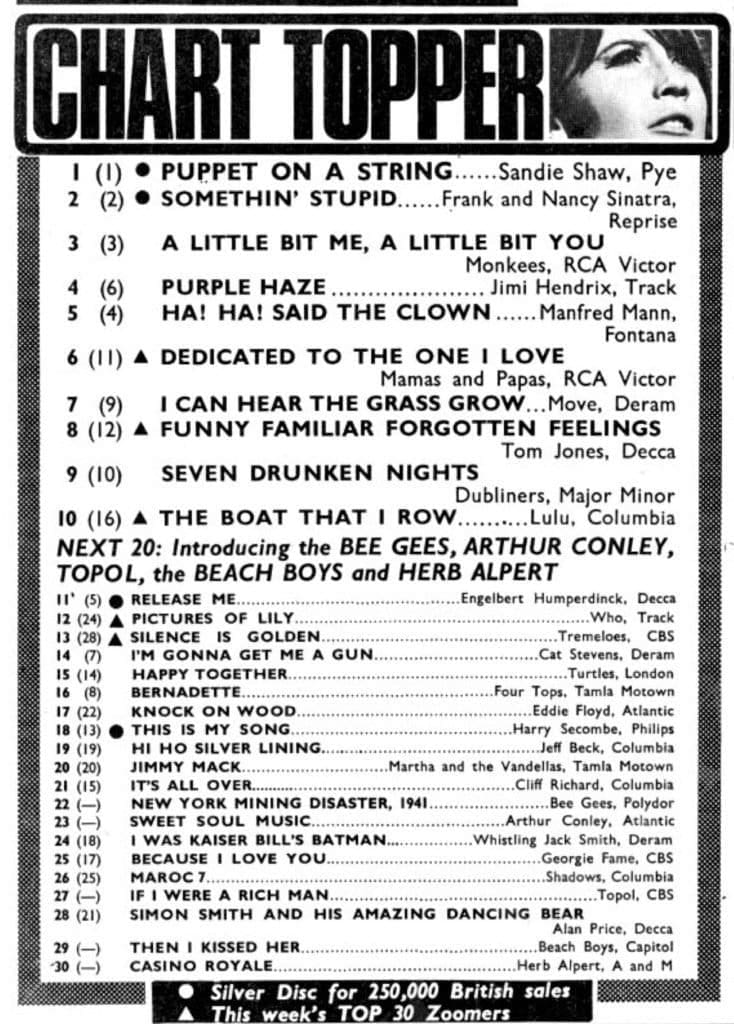
Saturday, May 6th, 1967
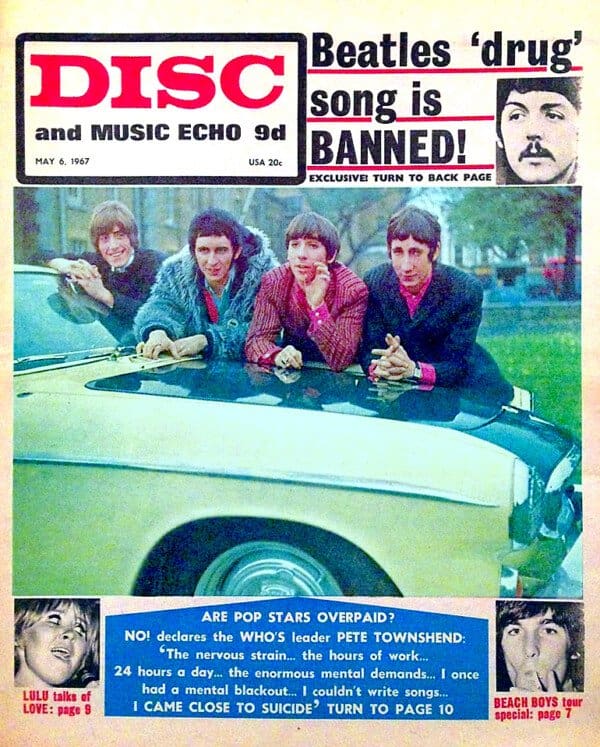
Disc and Music Echo features a picture of The Who on the cover with an article entitled "Are Pop Stars Overpaid?". "Samantha's Scene" also has a brief mention of The Who.
Transcript:
PETE—I could have committed suicide!
● Much more mental and physical demand on a pop star ●
SIR WILLIAM Carron, president of the million-member Amalgamated Engineering Union, thinks pop stars are non-productive workers and get paid too much.
Mr. Peter Townshend, as unmentioned in the Honours List but, as leader of the Who, a gentleman with acute awareness of the pop scene, thinks Sir William is undoubtedly “misguided.”
Sir William said, in a speech at Scarborough last week: “Whether it is a seven-inch disc, a reel of television film, or a pocketful of tickets from the Tote, Bingo or a betting shop, the remuneration to the individual per hour, per effort must give the average industrial or agricultural worker much food for thought.”
Pete Townshend says: “He wants to try it. He wants to work in a group and learn what hours of work, thought and nervous strain are involved.
“Any job of responsibility in industry is highly paid. And pop stars have a job of responsibility as well. We have a responsibility to our fans, to our general image, to our behaviour abroad on tour and we bring a lot of money into Britain—probably more than this man does.”
SCOPE
a series in which stars comment on news topics of the day
Just what is life like for a pop star? “For a start, it’s a 24-hour-a-day existence for perhaps three years or longer. It’s a job with no promise of future earnings. It’s a job in which you have to present a good image—like having cars, clothes, a smart house—and in which you have to pay for publicists and road managers and all manner of extras that involve you in fantastic expenses.
“To stay successful, you have to be in touch with what the fans want. So you have, therefore, to throw in a bit of psychotherapy and philosophy.
“There is much more mental and physical demand on a pop star than any ordinary worker. Here’s an example. We went to the States for nine days and worked solid each day from breakfast time till past 1 a.m. It was a promotional visit which meant we weren’t paid anything for all this.
“But we had to do photo sessions and interviews and sign autographs and smile all the time lest the fans felt cheated.
“We’ve just come back from Germany. We were there eight days but we did 14 jobs in that time.
“This man must be really snooty to put us down. Just because we’re not churning out something row of radio parts or something we’re classed as non-workers.
“Fans know plenty of the work in hours of always-on-show pop stars. They may not possibly appreciate the mental exhaustion involved. Says Pete: ‘Working at our pace, you can lose your physical stamina, which means that your energy has got to come from somewhere else. It’s something like when you go on stage and feel ready to drop. But you see the kids happy and ready to go with you and you get a feeling that you can’t let them down. Then everything becomes all right and you do a good show.’
“But I know I did have a complete mental blackout once. I just couldn’t sort out anything. I couldn’t write songs; I had a thoroughly miserable 24 hours and came close to the point of suicide. Truthfully. Luckily that only lasted for a day, but it’s something that doesn’t normally happen in the average job.”
GRIM
“I bet Paul Jones is going through a pretty grim period right now. He’s just finished a tour and before that he was working solidly on his film. Now ‘Privilege’ is out and he’s got to carry the full weight of it because he’s the star. He deserves his pocketful of money.
“And what if the film was panned? This is something your average worker doesn’t have to face. If the Who get booed off a stage, for example, I’m sure it’s much better getting a ticking off from a bloke in a boiler suit than having a full hall shouting abuse at you.”
That payments to pop stars have been defended, Pete also has his own opinions about AEU workers: “The average AEU man doesn’t produce a tenth of his Continental counterpart. He doesn’t work hard, he dreams, he’s lazy, he sits back and thinks ‘We’ve won two world wars so I’ll have a rest.’
“The British worker should take a look at the industry of his counterpart abroad. In Germany and Japan particularly.
“And the AEU leader has the nerve to turn round and criticise us!” — BOB FARMER
Photos