Tuesday, August 1st, 1967
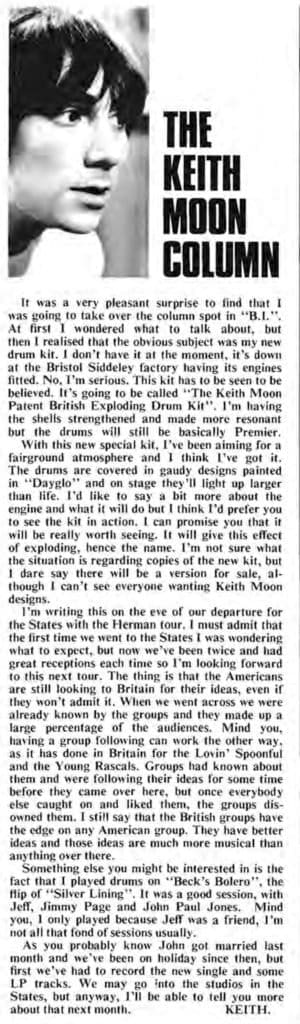
The August issue of Beat Instrumental features an article titled "Townshend on America". This issue also carries the first "The Keith Moon Column". You can read all of "The Keith Moon Column" articles here
Transcript:
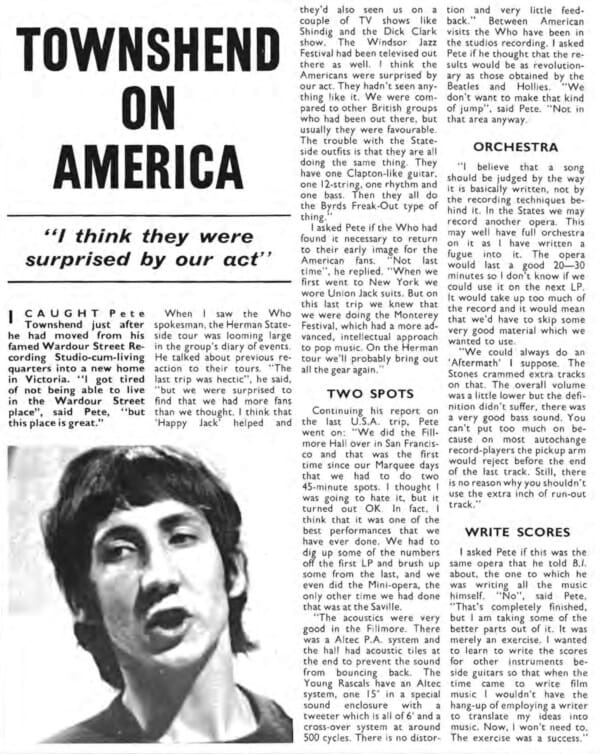
TOWNSHEND ON AMERICA
“I think they were surprised by our act”
I CAUGHT Pete Townshend just after he had moved from his side of the famed Wardour Street Recording Studios-cum-living quarters into a new home in Victoria. “I got tired of not being able to live in the Wardour Street place”, said Pete, “but this place is great.”
When I saw the Who spokesman, the Herman State-side tour was looming large in the group's diary of events. He talked about previous reaction to their tours. “The last trip was hectic”, he said, “but we were surprised to find that we had more fans than we thought. I think that ‘Happy Jack’ helped and they'd also seen us on a couple of TV shows like Shindig and the Dick Clark show. The Windsor Jazz Festival had been televised out there as well. I think the Americans were surprised by our act. They hadn't seen anything like it. We were compared to other British groups who had been out there, but usually they were favourable. The trouble with the Stateside outfits is that they are all doing the same thing. They have one Clapton-like guitar, one 12-string, one rhythm and one bass. Then they all do the Byrds Freak-Out type of thing.”
I asked Pete if the Who had found it necessary to return to their early image for the American fans. “Not last time”, he replied. “When we first went to New York we wore Union Jack suits. But on this last trip we knew that we were doing the Monterey Festival, which had a more advanced, intellectual approach to pop music. On the Herman tour we'll probably bring out all the gear again.”
TWO SPOTS
Continuing his report on the last U.S.A. trip, Pete went on: “We did the Fillmore Hall over in San Francisco and that was the first time since our Marquee days that we had to do two 45-minute spots. I thought I was going to hate it, but it turned out OK. In fact, I think that it was one of the best performances that we have ever done. We had to dig up some of the numbers off the first LP and brush up some from the last, and we even did the Mini-opera, the only other time we had done that was at the Saville.
“The acoustics were very good in the Fillmore. There was a Altec P.A. system and the hall had acoustic tiles at the end to prevent the sound from bouncing back. The Young Rascals have an Altec system, one 15" in a special sound enclosure with a tweeter which is all of 6" and a cross-over system at around 500 cycles. There is no distortion and very little feedback.”
Between American visits the Who have been in the studios recording. I asked Pete if he thought that the results would be as revolutionary as those obtained by the Beatles and Hollies. “We don't want to make that kind of jump”, said Pete. “Not in that area anyway.”
ORCHESTRA
“I believe that a song should be judged by the way it is basically written, not by the recording techniques behind it. In the States we may record another opera. This may well have full orchestra on it as I have written a fugue into it. The opera would last a good 20—30 minutes so I don't know if we could use it on the next LP. It would take up too much of the record and it would mean that we'd have to skip some very good material which we wanted to use.
“We could always do an ‘Aftermath’ I suppose. The Stones crammed extra tracks on that. The overall volume was a little lower but the definition didn't suffer, there was very good bass sound. You can't put too much on because on most autochange record-players the pickup arm would reject before the end of the last track. Still, there is no reason why you shouldn't use the extra inch of run-out track.”
WRITE SCORES
I asked Pete if this was the same opera that he told B.I. about, the one to which he was writing all the music himself. “No”, said Pete. “That's completely finished, but I am taking some of the better parts out of it. It was merely an exercise. I wanted to learn to write the scores for other instruments beside guitars so that when the time came to write film music I wouldn't have the hang-up of employing a writer to translate my ideas into music. Now, I won't need to. The exercise was a success.”
Photos