Sunday, June 2nd, 1968
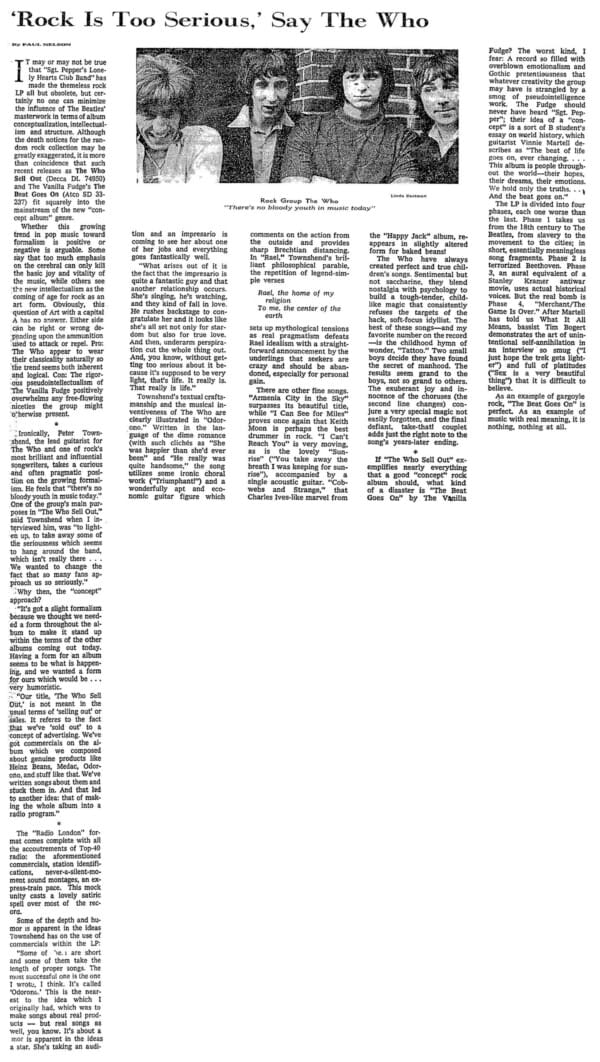
Paul Nelson writes a long rave review of The Who Sell Out in The New York Times.
Transcript:
‘Rock Is Too Serious,’ Say The Who
By Paul Nelson
It may or may not be true that “Sgt. Pepper's Lonely Hearts Club Band” has made the themeless rock LP all but obsolete, but certainly no one can minimize the influence of The Beatles’ masterwork in terms of album conceptualization, intellectualism and structure. Although the death notices for the random rock collection may be greatly exaggerated, it is more than coincidence that such recent releases as The Who Sell Out (Decca DL 74950) and The Vanilla Fudge’s The Beat Goes On (Atco SD 33237) fit squarely into the mainstream of the new “concept album" genre.
Whether this growing trend in pop music toward formalism is positive or negative is arguable. Some say that too much emphasis on the cerebral can only kill the basic joy and vitality of the music, while others see the new intellectualism as the coming of age for rock as an art form. Obviously, this question of Art with a capital A has no answer. Either side can be right or wrong depending upon the ammunition used to attack or repel. Pro: The Who appear to wear their classicality naturally so the trend seems both inherent and logical. Con: The rigorous pseudointellectualism of The Vanilla Fudge positively overwhelms any free-flowing niceties the group might otherwise present.
Ironically, Peter Townshend, the lead guitarist for The Who and one of rock's most brilliant and influential songwriters, takes a curious and often pragmatic position on the growing formalism. He feels that “there's no bloody youth in music today.” One of the group’s main purposes in “The Who Sell Out,” said Townshend when I interviewed him, was “to lighten up, to take away some of the seriousness which seems to hang around the band, which isn’t really there . . . We wanted to change the fact that so many fans approach us so seriously.”
Why then, the “concept” approach?
“It's got a slight formalism because we thought we needed a form throughout the album to make it stand up within the terms of the other albums coming out today. Having a form for an album seems to be what is happening, and we wanted a form for ours which would be . . . very humoristic.
“Our title, 'The Who Sell Out,' is not meant in the usual terms of ‘selling out’ or sales. It referees to the fact that we’ve ‘sold out’ to a concept of advertising. We’ve got commercials on the album which we composed about genuine products like Heinz Beans, Medac, Odorono, and stuff like that. We’ve written songs about them and stuck them in. And that led to another idea: that of making the whole album into a radio program.”
*
The “Radio London" format comes complete with all the accoutrements of Top-40 radio: the aforementioned commercials, station identifications, never-a-silent-moment sound montages, an express-train pace. This mock unity casts a lovely satiric spell over most of the record.
Some of the depth and humor is apparent in the ideas Townshend has on the use of commercials within the LP:
“Some of ’em are short and some of them take the length of proper songs. The must successful one is the one I wrote, I think. It's called ‘Odorono.’ This is the nearest to the idea which I originally had, which was to make songs about real products — but real songs as well, you know. It’s about a mor is apparent in the ideas a star. She’s taking an audition and an impresario is coming to see her about one of her jobs and everything goes fantastically well.
“What arises out of it is the fact that the impresario is quite a fantastic guy and that another relationship occurs. She's singing, he’s watching, and they kind of fall in love. He rushes backstage to congratulate her and it looks like she’s all set not only for stardom but also for true love. And then, underarm perspiration cut the whole thing out. And, you know, without getting too serious about it because it’s supposed to be very light, that’s life. It really is. That really is life.”
Townshend’s textual craftsmanship and the musical inventiveness of The Who are clearly illustrated in “Odorono.” Written in the language of the dime romance (with such clichés as “She was happier than she’d ever been” and “He really was quite handsome,” the song utilizes some ironic choral work (“Triumphant!”) and a wonderfully apt and economic guitar figure which comments on the action from the outside and provides sharp Brechtian distancing. In “Rael,” Townshend’s brilliant philosophical parable, the repetition of legend-simple verses
Rael, the home of my religion
To me, the center of the earth
sets up mythological tensions as real pragmatism defeats Rael idealism with a straightforward announcement by the underlings that seekers are crazy and should be abandoned, especially for personal gain.
There are other fine songs. “Armenia City in the Sky” surpasses its beautiful title, while “I Can See for Miles” proves once again that Keith Moon is perhaps the best drummer in rock. “I Can’t Reach You” is very moving, as is the lovely “Sunrise” (“You take away the breath I was keeping for sunrise”), accompanied by a single acoustic guitar. “Cobwebs and Strange,” that Charles Ives-like marvel from the “Happy Jack” album, reappears in slightly altered form for baked beans!
The Who have always created perfect and true children’s songs. Sentimental but not saccharine, they blend nostalgia with psychology to build a tough-tender, childlike magic that consistently refuses the targets of the hack, soft-focus idyllist. The best of these songs — and my favorite number on the record — is the childhood hymn of wonder, “Tattoo.” Two small boys decide they have found the secret of manhood. The results seem grand to the boys, not so grand to others. The exuberant joy and innocence of the choruses (the second line changes) conjure a very special magic not easily forgotten, and the final defiant, take-that! couplet adds just the right note to the song’s years-later ending.
If “The Who Sell Out” exemplifies nearly everything that a good “concept” rock album should, what kind of a disaster is “The Beat Goes On” by The Vanilla
Fudge? The worst kind, I fear: A record so filled with overblown emotionalism and Gothic pretentiousness that whatever creativity the group may have is strangled by a smog of pseudointelligence work. The Fudge should never have heard “Sgt. Pepper”; their idea of a “concept” is a sort of B student’s essay on world history, which guitarist Vinnie Martell describes as “The beat of life goes on, ever changing. . . This album is people throughout the world — their hopes, their dreams, their emotions. We hold only the truths. . .” And the beat goes on.”
The LP is divided into four phases, each one worse than the last. Phase 1 takes us from the 18th century to The Beatles, from slavery to the movement to the cities; in short, essentially meaningless song fragments. Phase 2 is terrorized Beethoven. Phase 3, an aural equivalent of a Stanley Kramer antiwar movie, uses actual historical voices. But the real bomb is Phase 4, “Merchant/The Game Is Over.” After Martell has told us What It All Means, bassist Tim Bogert demonstrates the art of unintentional self-annihilation in an interview so smug (“I just hope the trek gets lighter”) and full of platitudes (“Sex is a very beautiful thing”) that it is difficult to believe.
As an example of gargoyle rock, “The Beat Goes On” is perfect. As an example of music with real meaning, it is nothing, nothing at all.