Thursday, May 14th, 1970
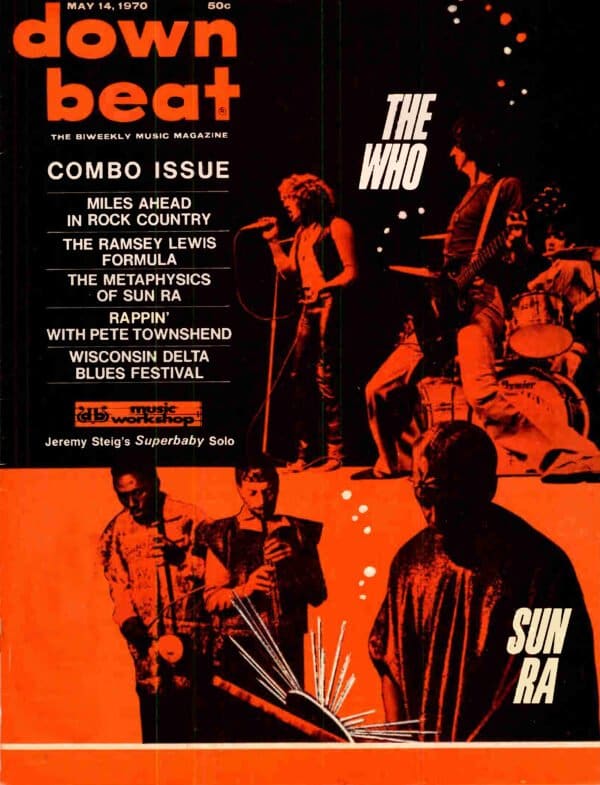
Down Beat carries an interview with Pete in which he discusses his love of The James Gang and declares that the best rock music is neither revolutionary nor political.
Transcript:
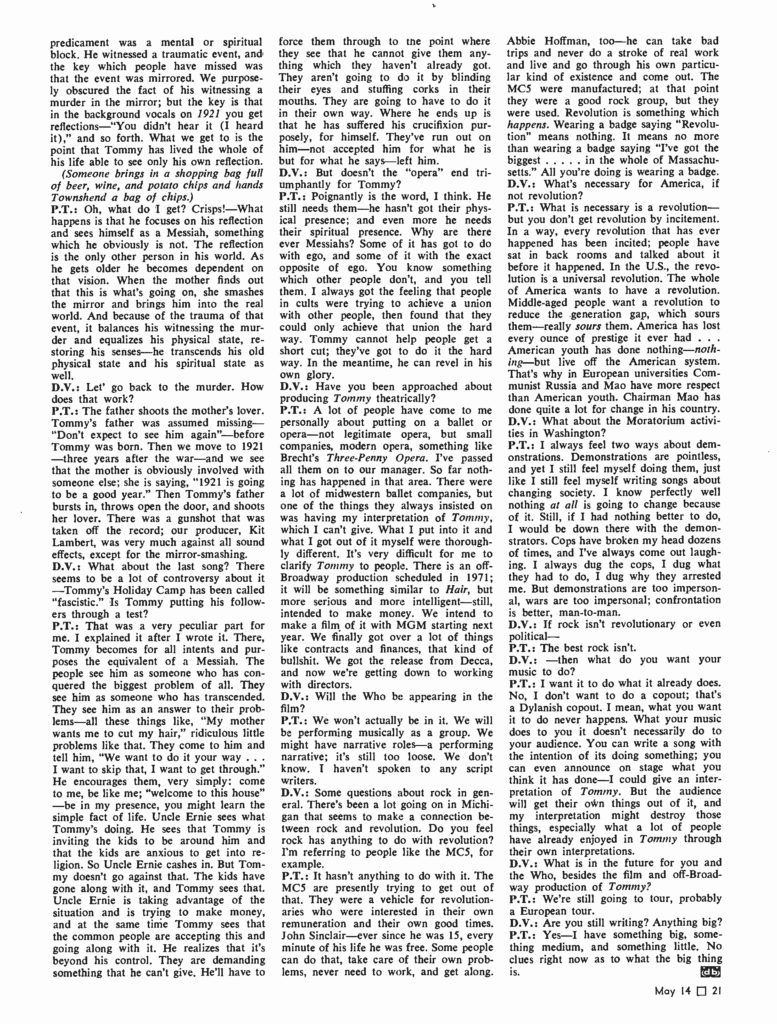
Who’s Who: An Interview with Peter Townshend
by Derek Van Pelt
WHEN THIS INTERVIEW took place, the Who had just finished a two-and-a-half hour performance at Cleveland’s Music Hall, which included their full-length rock composition, Tommy. They had played without a break, doing short sets of hard rock before and after their “opera”, yet they were radiating as much pure physical energy and elan in their final number as they had at the start of the evening.
Peter Townshend, the Who’s guitarist and composer of Tommy, was perched atop a little sink in a dressing room full of people, talking enthusiastically and articulately, fixing me with his eyes, extending a huge hand to make a point, playing with the faucets, and showing great imagination in arranging his giraffe-like frame on his precarious roost.
D.V.: Thanks for the show. I haven’t seen that kind of energy and joy in performing in a long time. Aren’t you getting a little tired? You seem to be doing about a concert a night on this tour.
P.T.: We’ve only got two more concerts to go. If we had another week or two to go, perhaps it would be different; but through the last couple of gigs you’re going to do, there’s a psychological thing that builds up. You think, “Wow, we’re only doing two more gigs.” You want to squeeze that last bit of energy out. Also, it’s been a well-organized tour . . . we’ve never lost a night’s sleep, I’ll put it that way.
D.V.: I hear you said some good things about a Cleveland group, the James Gang, and Joe Walsh, their guitarist.
P.T.: Oh, absolutely. I don’t want to sound ridiculous, but he really is one of those guys I kind of go nuts—rapturous—about. I like the group, too; they’re a tight group. Let me explain—I don’t know anything about them. They’re handled by Mike Belkin, a good promoter. We were in Pittsburgh. The guy at the door didn’t let us in; the dressing room was full of dippy kids—they bring you presents and they want photos—some of them are real schizophrenics, you know? But you go along with them.
D.V.: You’d shatter them otherwise.
P.T.: Yes, they build their whole evening around it. So we went through all that, and all of a sudden we heard the music drifting through to the dressing room. Well, it sounds fair, I said. And if it sounds fair in the dressing room, it has got to sound incredible from the stage, you know what I mean? From the side of the stage they were blowing my mind, and I jumped down into the front of the audience. I listened to their last four numbers, and I thought they were really a musical group—not visually exciting. I went up and complimented them all, and they were flattered; it was all rather stiff. So they knew a couple of friends of ours, and they laid their album on us—they said, “It’s our first album, it’s crap.” So I put it into my suitcase along with some other albums I’d collected along the way.
D.V.: It’s pretty good, really.
P.T.: Yes, I’m getting to that. You see, for four days we went on a holiday in Florida—we lived on an island in the Everglades. I started to play this album, and every note just had basic freshness. What was so nice was that I felt in a lot of ways that they said a lot of things about their first album that we said about ours. It took me two years to get into the Who’s first album, you know what I mean? I think they’re going to be a big group.
D.V.: Some people say no, because Cream killed the trio commercially.
P.T.: Oh, there’s no precedent at all; none. Nothing’s sacred in rock. On our tour, I’ve played the album even if I had to lose four hours of sleep to do it—drive five hours to a record player to play it.
D.V.: To what extent can we talk about Tommy?
P.T.: Well, ask me some questions and we’ll see.
D.V.: Is Tommy totally fictional, as opposed to being based on your personal experience?
P.T.: Mostly fictional, in that it’s about ideas which are intellectually worked out, intellectually realized; but they’re ideas which I hope I could one day physically and spiritually realize. They have to do with my spiritual aims. It’s nothing to do with where I’m at. Well, it does have something to do with where I’m at, and where I’m at has a lot to do with where the Who is at. It’s kind of a circle, really, a spiral—the Who are one of those bands which are going to progress upward in a spiral.
D.V.: I had the sense near the end of the performance that Tommy’s awakening from the loss of his senses might be something to do with Peter Townshend’s awakening, or desire to awaken, from another kind of sleep—becoming aware. It struck me that your association with Meher Baba might have a lot to do with it.
P.T.: What Baba has to do with it is that I was writing Tommy while I was following him. Some people might call that coincidence, but I don’t. As far as the intentional concept of the opera goes, it’s difficult to find likenesses between what Baba said and what I said. What I’m good at is living for him—and loving him—but I’m not good at explaining him.
D.V.: I’d like to ask about a couple of specific episodes from Tommy. First of all, the mirror-smashing episode.
P.T.: The mirror sequence was one which was in mystical terms, and even in chronological terms, if we explain that Tommy’s predicament was a mental or spiritual block. He witnessed a traumatic event, and the key which people have missed was that the event was mirrored. We purposely obscured the fact of his witnessing a murder in the mirror; but the key is that in the background vocals on 1921 you get reflections—“You didn’t hear it (I heard it),” and so forth. What we get to is the point that Tommy has lived the whole of his life able to see only his own reflection.
(Someone brings in a shopping bag full of beer, wine, and potato chips and hands Townshend a bag of chips.)
P.T.: Oh, what do I get? Crisps!—What happens is that he focuses on his reflection and sees himself as a Messiah, something which he obviously is not. The reflection is the only other person in his world. As he gets older he becomes dependent on that vision. When the mother finds out that this is what’s going on, she smashes the mirror and brings him into the real world. And because of the trauma of that event, it balances his witnessing the murder and equalizes his physical state, restoring his senses—he transcends his old physical state and his spiritual state as well.
D.V.: Let’ go back to the murder. How does that work?
P.T.: The father shoots the mother’s lover. Tommy’s father was assumed missing—“Don’t expect to see him again”—before Tommy was born. Then we move to 1921—three years after the war—and we see that the mother is obviously involved with someone else; she is saying, “1921 is going to be a good year.” Then Tommy’s father bursts in, throws open the door, and shoots her lover. There was a gunshot that was taken off the record; our producer, Kit Lambert, was very much against all sound effects, except for the mirror-smashing.
D.V.: What about the last song? There seems to be a lot of controversy about it—Tommy’s Holiday Camp has been called “fascistic.” Is Tommy putting his followers through a test?
P.T.: That was a very peculiar part for me. I explained it after I wrote it. There, Tommy becomes for all intents and purposes the equivalent of a Messiah. The people see him as someone who has conquered the biggest problem of all. They see him as someone who has transcended. They see him as an answer to their problems—all these things like, “My mother wants me to cut my hair,” ridiculous little problems like that. They come to him and tell him, “We want to do it your way . . . I want to skip that, I want to get through.” He encourages them, very simply: come to me, be like me; “welcome to this house”—be in my presence, you might learn the simple fact of life. Uncle Ernie sees what Tommy’s doing. He sees that Tommy is inviting the kids to be around him and that the kids are anxious to get into religion. So Uncle Ernie chases in. But Tommy doesn’t go against that. The kids have gone along with it, and Tommy sees that. Uncle Ernie is taking advantage of the situation and is trying to make money, and at the same time Tommy sees that the common people are accepting this and going along with it. He realizes that it’s beyond his control. They are demanding something that he can’t give. He’ll have to force them through to the point where they see that he cannot give them anything which they haven’t already got. They aren’t going to do it by blinding their eyes and stuffing corks in their mouths. They are going to have to do it in their own way. Where he ends up is that he has suffered his crucifixion purposely, for himself. They’ve run out on him—not accepted him for what he is but for what he says—left him.
D.V.: But doesn’t the “opera” end triumphantly for Tommy?
P.T.: Poignantly is the word, I think. He still needs them—he hasn’t got their physical presence; and even more he needs their spiritual presence. Why are there ever Messiahs? Some of it has got to do with ego, and some of it with the exact opposite of ego. You know something which other people don’t, and you tell them. I always got the feeling that people in cults were trying to achieve a union with other people, then found that they could only achieve that union the hard way. Tommy cannot help people get a short cut; they’ve got to do it the hard way. In the meantime, he can revel in his own glory.
D.V.: Have you been approached about producing Tommy theatrically?
P.T.: A lot of people have come to me personally about putting on a ballet or opera—not legitimate opera, but small companies, modern opera, something like Brecht’s Three-Penny Opera. I’ve passed all them on to our manager. So far nothing has happened in that area. There were a lot of midwestern ballet companies, but one of the things they always insisted on was having my interpretation of Tommy, which I can’t give. What I put into it and what I got out of it myself were thoroughly different. It’s very difficult for me to clarify Tommy to people. There is an off-Broadway production scheduled in 1971; it will be something similar to Hair, but more serious and more intelligent—still, intended to make money. We intend to make a film of it with MGM starting next year. We finally got over a lot of things like contracts and finances, that kind of bullshit. We got the release from Decca, and now we’re getting down to working with directors.
D.V.: Will the Who be appearing in the film?
P.T.: We won’t actually be in it. We will be performing musically as a group. We might have narrative roles—a performing narrative; it’s still too loose. We don’t know. I haven’t spoken to any script writers.
D.V.: Some questions about rock in general. There’s been a lot going on in Michigan that seems to make a connection between rock and revolution. Do you feel rock has anything to do with revolution? I’m referring to people like the MC5, for example.
P.T.: It hasn’t anything to do with it. The MC5 are presently trying to get out of that. They were a vehicle for revolutionaries who were interested in their own remuneration and their own good times. John Sinclair—ever since he was 15, every minute of his life he was free. Some people can do that, take care of their own problems, never need to work, and get along. Abbie Hoffman, too—he can take bad trips and never do a stroke of real work and live and go through his own particular kind of existence and come out. The MC5 were manufactured; at that point they were a good rock group, but they were used. Revolution is something which happens. Wearing a badge saying “Revolution” means nothing. It means no more than wearing a badge saying “I’ve got the biggest . . . in the whole of Massachusetts.” All you’re doing is wearing a badge.
D.V.: What’s necessary for America, if not revolution?
P.T.: What is necessary is a revolution—but you don’t get revolution by incitement. In a way, every revolution that has ever happened has been incited; people have sat in back rooms and talked about it before it happened. In the U.S., the revolution is a universal revolution. The whole of America wants to have a revolution. Middle-aged people want a revolution to reduce the generation gap, which sours them—really sours them. America has lost every ounce of prestige it ever had . . . American youth has done nothing—nothing—but live off the American system. That’s why in European universities Communist Russia and Mao have more respect than American youth. Chairman Mao has done quite a lot for change in his country.
D.V.: What about the Moratorium activities in Washington?
P.T.: I always feel two ways about demonstrations. Demonstrations are pointless, and yet I still feel myself doing them, just like I still feel myself writing songs about changing society. I know perfectly well nothing at all is going to change because of it. Still, if I had nothing better to do, I would be down there with the demonstrators. Cops have broken my head dozens of times, and I’ve always come out laughing. I always dug the cops, I dug what they had to do, I dug why they arrested me. But demonstrations are too impersonal, wars are too impersonal; confrontation is better, man-to-man.
D.V.: If rock isn’t revolutionary or even political—
P.T.: The best rock isn’t.
D.V.: —then what do you want your music to do?
P.T.: I want it to do what it already does. No, I don’t want to do a copout; that’s a Dylanish copout. I mean, what you want it to do never happens. What your music does to you it doesn’t necessarily do to your audience. You can write a song with the intention of its doing something; you can even announce on stage what you think it has done—I could give an interpretation of Tommy. But the audience will get their own things out of it, and my interpretation might destroy those things, especially what a lot of people have already enjoyed in Tommy through their own interpretations.
D.V.: What is in the future for you and the Who, besides the film and off-Broadway production of Tommy?
P.T.: We’re still going to tour, probably a European tour.
D.V.: Are you still writing? Anything big?
P.T.: Yes—I have something big, something medium, and something little. No clues right now as to what the big thing is.
Photos