Thursday, July 1st, 1993
Musician magazine carries an interview with Pete
Transcript:
BY THOM DUFFY
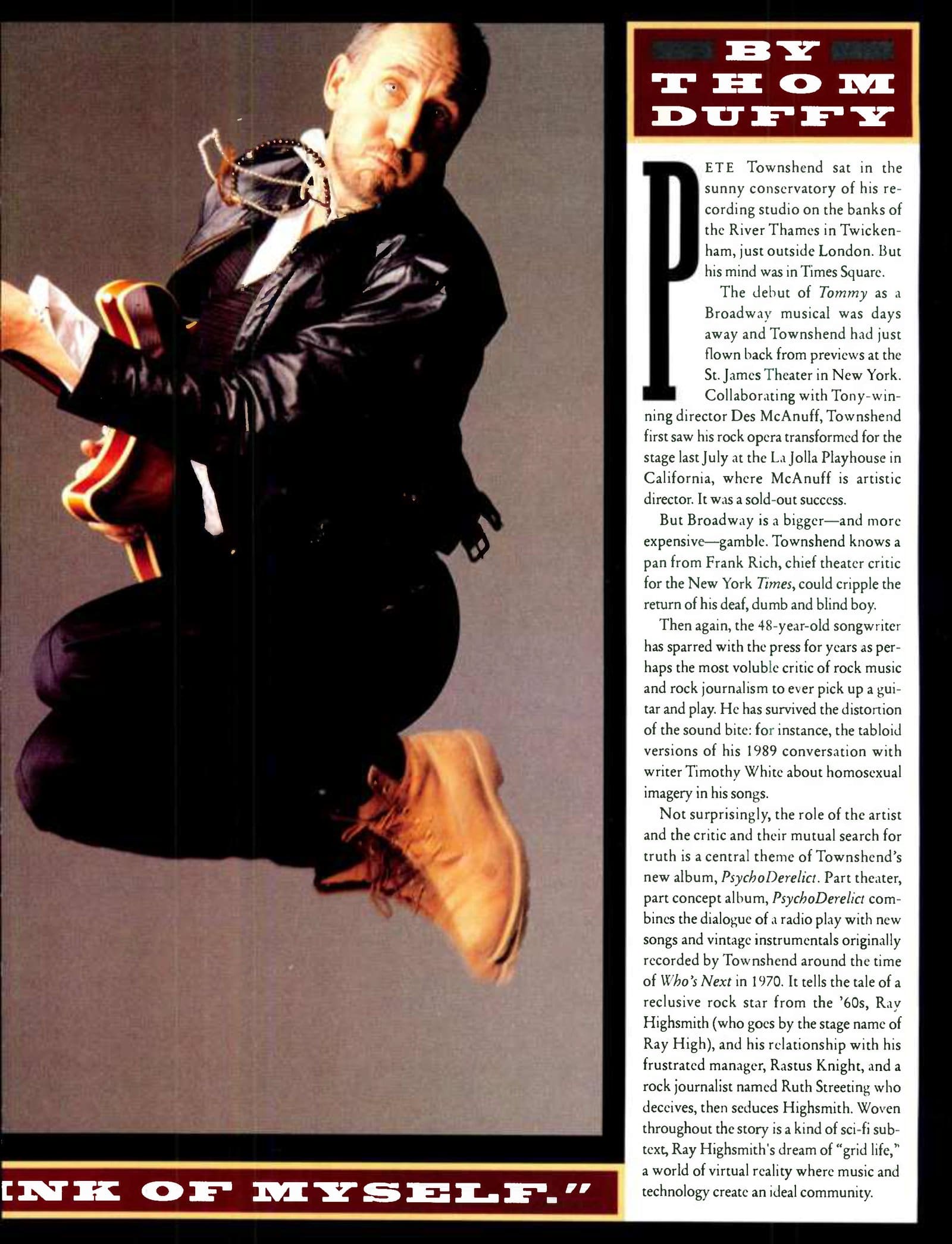
PETE Townshend sat in the sunny conservatory of his recording studio on the banks of the River Thames in Twickenham, just outside London. But his mind was in Times Square.
The debut of Tommy as a Broadway musical was days away and Townshend had just flown back from previews at the St. James Theater in New York.
Collaborating with Tony-winning director Des McAnuff, Townshend first saw his rock opera transformed for the stage last July at the La Jolla Playhouse in California, where McAnuff is artistic director. It was a sold-out success.
But Broadway is a bigger—and more expensive—gamble. Townshend knows a pan from Frank Rich, chief theater critic for the New York Times, could cripple the return of his deaf, dumb and blind boy.
Then again, the 48-year-old songwriter has sparred with the press for years as perhaps the most voluble critic of rock music and rock journalism to ever pick up a guitar and play. He has survived the distortion of the sound bite: for instance, the tabloid versions of his 1989 conversation with writer Timothy White about homosexual imagery in his songs.
Not surprisingly, the role of the artist and the critic and their mutual search for truth is a central theme of Townshend’s new album, PsychoDerelict. Part theater, part concept album, PsychoDerelict combines the dialogue of a radio play with new songs and vintage instrumentals originally recorded by Townshend around the time of Who’s Next in 1970. It tells the tale of a reclusive rock star from the ‘60s, Ray Highsmith (who goes by the stage name of Ray High), and his relationship with his frustrated manager, Rastus Knight, and a rock journalist named Ruth Streeting who deceives, then seduces Highsmith. Woven throughout the story is a kind of sci-fi subtext, Ray Highsmith’s dream of “grid life,” a world of virtual reality where music and technology create an ideal community.
MUSICIAN: I’ve been immersed in PsychoDerelict but I want to start with Tommy. As you look at this debut, what is your feeling?
TOWNSHEND: I’m excited about the excitement. I’m excited about being in a theater with Des McAnuff, who is a great intellectual and a great director. I’m excited about seeing him like a boy in a sandbox, and it’s great to be working on something as aged as Tommy with young people. I’m not afraid of Frank Rich or Virginia Woolf or any of these characters. You know, I’m an editor at Faber & Faber. And without sounding pompous, I know about critics and criticism and journalism and I know how it works and I know that one can’t really control how it works. I’ve heard some awful stories about people like Clive Barnes. The other thing that I know, which I don’t think the producers necessarily confronted, is that the Who have a strong New York following who will, I think, make Tommy feel like a great success for a couple of months. But then I think there will be serious national audiences to go on from there. A two- or three- or five-month run by a rock band in any town is considered to be a great success, but for a Broadway show, that’s a failure. We want to be there for at least three years.
MUSICIAN: Frank Rich does not rule the world.
TOWNSHEND: Frank’s actual response to the show in La Jolla was in Time magazine. He gave it a two-page rave and I think it was one of the engines that got us to Broadway. But of course now he’ll be feeling proprietary, be wanting to see the show live up to his expectations. I think that’s something that with the big critics you can sometimes suffer from: if you fail to give the show the due that they think it deserves, they sometimes say so.
MUSICIAN: It’s such a well-known work. What did you want to have the book add to Tommy?
TOWNSHEND: I think what I really wanted was an ending. I know that sounds very trite, but that’s what I wanted. I still want an ending for Quadrophenia. I want an ending for all of the work that I’ve been involved in. You know, I did go through a brief period around the time of the solo album called Chinese Eyes of severe self-analysis, which was a catharsis. But I think that actually did kind of tar me. People think that the only subject that I ever write about is me.
MUSICIAN: Ray High’s manager says, “If you’re going to be introspective, at least do it in public.”
TOWNSHEND: Yeah, that’s right. Thank you. But in actual fact, I’ve actually been quite a dispassionate and I think quite objective writer, because what started me writing was duty. I was having such fun in the band in the ‘60s but I saw my career really, my hard career, in graphics or journalism or a combination of both, in magazines, I suppose. That’s what I was studying in college. But when “I Can’t Explain” emerged, a bunch of kids from the Goldhawk Club in Shepherd’s Bush came up and stuttered at me, “Th-th-this is our song. You’ve said what it is that we’ve been trying to say.”
And I said, “Well, what have I said?” They said, “You’ve said that we can’t explain how we feel.” So I said, “Well, what I’ve actually said is that you can’t explain how you feel.” They said, “Well, that’s it. And we want you to do more, write some more, write some more straight away.”
Then I wrote “Anyway, Anyhow, Anywhere” and “My Generation” and I think that’s where I found that voice. I think I’m still writing for that same voice, that same group of people, who weren’t all boys by any means. And I think I wrote Tommy for the same voice. It’s only in the last six months that I’ve realized that.
MUSICIAN: Is it an ending or a completion?
TOWNSHEND: No. I mean, maybe the piece has been completed because of the work that Des and I have done to fill in the holes, but I think the real task was deciding what the ending was going to be. I think stories need indications of endings even if you don’t wrap up, if you want to leave people to draw their own conclusions, at least give them some way to go. I was reading The Painted Veil by Somerset Maugham the other day. At the end of that, a girl who’s been quite errant in her life, and has given her husband and her family a hard time, goes back home and decides to commit the rest of her life to her father. That’s where you’re left in the story. It’s both an end and a beginning. That’s the kind of ending I’ve always striven for.
MUSICIAN: What was the ending that was missing from Tommy?
TOWNSHEND: You didn’t know what it was that you were supposed to think. You didn’t know whether you were supposed to side with the audience who had been used and abused and were obviously by-products of organized religion, or with the benefactor, Tommy, who was the engine of it all.
I had to answer that question. I think that in the end it came down to a very simple device. When Tommy, for whatever reason, has gone along with all this stuff that’s been happening around him, when Tommy is disowned or cast aside by his fans or acolytes, what does he do? On the record, of course, he fades out. And I think that by the time you hear the last “Listening to you, I get the music,” you as the listener have probably made a decision.
But that’s not good enough. It didn’t work in the film. In the film Ken [Russell] had Roger climb a mountain literally and stand at the top and address the sun. And it was kind of bizarre, corny, the beginning of a movie but not the end of a movie. At La Jolla, we decided that what Tommy should do is go back to his family. I think now in the Broadway production, the ending has a slightly different edge and I don’t really want to get into it.
MUSICIAN: I’m intrigued by your suggestion that you were awaiting a time when people would be ready to go to the theater for your work, rather than to sheds for the Who.
TOWNSHEND: I was waiting for the time when the people who used to go to the shed for the Who were ready to go to Broadway. It’s not one or the other at all. I don’t like sheds. I don’t like the idea of going and doing world tours with the Who, and maybe those opportunities have passed anyway. Some of the bigger bands are really getting burned as they go out and try to tap these audiences who have always been there. The next band to test it are going to be the Stones. And it just might be that, like Dire Straits, they find that
…was a great humiliation for Dire Straits to put aside 18 months for international touring and then find that they were only required for eight-and-a-half weeks. Because they’re as vital as they ever were.
MUSICIAN: But the needs of the audience have changed.
TOWNSHEND: I think that’s right. And I think what I was waiting for was the theater-going audience to be as generous in spirit as the audiences of the ‘60s were. I think that’s where Tommy was born and where it grew. It grew with generous, forgiving and contributing audiences. In other words, they were out of their brains on psychedelic drugs, I suppose. But it meant that you could experiment. It meant that you could take chances and it meant that you could say, “Listen, I’ll string three ideas together and you know what I mean, don’t you?” And they would go, “Yeah, I know what you mean.” You could speak in abstracts and be unspecific.
When I came to struggle with my first theatrical piece, which was Iron Man in ’86, I found that what is so distinctive about theatrical presentation is detail, the obsession with detail, the requirement for detail at the highest possible order. The requirement was to work with someone who understood theater. So that the music of Tommy, which has always been a certain entity of its own, could jump off from a very solid platform instead of trying to build the platform as it went.
MUSICIAN: You also needed someone who saw a continuum of the audiences.
TOWNSHEND: That’s part of the thing that I’ve tried to address in PsychoDerelict. What has come out of my experiences with
…Tommy, the thing that I feel very much now is that we’re past the point of worrying about how and whether and what the consequences are of aging as part of the rock ‘n’ roll process.
We now understand that if we’re not teenagers anymore, we can still celebrate those angst-ridden years or joyful years, whatever they meant to each individual. What we can’t really do anymore is pretend that we’re physically a part of that life. When we bop around to the latest Lou Reed record, we’re probably sitting in some fancy sushi restaurant in the East Village, not really hanging out in the street with a transistor radio stuck to our head.
Everything has changed, and I think for people like me, for people like Lou Reed, for people like Mick Jagger, for people like Iggy Pop, for people like David Bowie, for people like Paul Simon, people who are, if not 50, then approaching 50—could be grandfathers and in some cases are—the important thing is to try to avoid the mantle of dignity. Not to assume it. To say, listen, you could call me Mr. Townshend if you like, but that’s not how I think of myself.
My job might become a craft but it’s a craft that’s still very much tied to street life, and by that I don’t mean people hanging around street corners, but street life as a metaphor for the ordinary family, the ordinary struggle. The trouble with the idea of categorizing our audiences into the young fan who goes to Madison Square Garden to see Guns N’ Roses and the bridge and tunnel crowd who come over to see Cats is that I think the middle ground is not being properly addressed. You’ve got the two arch extremes. I think Guns N’ Roses are interesting in a lot of ways, but very, very reactionary. And I think Phantom is an arch-reactionary piece. What’s not being dealt with is the middle ground which is actually the vanguard; it’s the people who don’t really know what to do next because they are in the lead. They’re not lagging behind.
MUSICIAN: Is it too much to ask for Tommy to make a statement that there needs to be that middle ground?
TOWNSHEND: It is too much to ask because it is a 25-year-old piece…. If it was a brand-new show I was bringing to Broadway, then I would be a bit cockier, but it’s not.
MUSICIAN: There is going to be criticism that the dream you are celebrating is 20 years old. What relevance does it have today, and is this just a justification of those who listen only to classic rock radio?
TOWNSHEND: I’m not dim. I know who I am. I know how those people see me anyway. Anything I do will be seen that way by those people. The only way I could jump on the Pearl Jam or Ice-T cart right now is to get involved in a company that produced them or wrote for them or appropriated them in some way. I’m not willing to do that. I don’t need to do that. And I think I’d rather starve than do that. If there’s any kind of common ground on which we can collaborate, I’ll do so. But I have to put up with the fact…
MUSICIAN: Who is your audience?
TOWNSHEND: The real audience can be described in a number of different ways. What’s created classic rock radio is the demographic description of that audience, which is, for the benefit of advertisers who are buying radio time: “How old are these people, how much money have they got, what do they spend their money on, where do they live and what do they want to listen to on the radio?”
And I think that’s actually been as reductive and damaging for me as an artist as it has been for the music industry as a whole. But it’s there, it’s a fact of life. My audience are people who grew up with me, but not exclusively. You see, a lot of people who are my age who are smart don’t listen to the Who and the Stones. They listen to Pearl Jam and Ice-T and other stuff because they find in that what they originally heard in the music of the Stones and the Who in the ’60s.
I don’t think they sneer at what the Who and the Stones now represent, because they’re part of it, they’re part of the growing up, growing old, decaying process. It will be interesting to see just how long Mick Jagger can keep it up, if that’s in fact what’s happening. And I think that if Mick’s gotta be the flat tummy, some people expect me to be the brain. And that’s very, very difficult, because I’m not so much the brain as the minstrel.
There’s a lot of minstrels out there. There’s a lot of people out there doing incredibly good work who are of my age. Paul Simon, Lou Reed, Tom Waits…there’s some extraordinary people out there. Even people who are really stuck in a rut like Leonard Cohen become more interesting all the time. Because it’s so narrow, it’s so focused.
My life is not about me addressing any particular audience. My life is about advancing rock ‘n’ roll. But I can’t refer back to Sgt. Pepper or Pet Sounds. I can’t use other people’s albums. I have to refer back to my own collateral. Tommyis doing that. Tommy is paying the rent. I don’t need to justify my history because my history is being dragged into the present day by Broadway producers willing to put the money up to stage the show.
I am still very much seen to be part of a band and the Who are very much a part of my life and rock fans have an investment in the Who as a band, even though one of the members is dead. The same, of course, is true of Led Zeppelin and other bands. I sometimes feel that Roger Daltrey might even be one of those fans.
I like to be more pragmatic. I like to face up to the facts. What Ray is actually saying in PsychoDerelict is, “I’m 50 years old, I had a dream once and I don’t know whether it’s any better than the dream that’s out there now or any worse. But it’s my dream and it’s who I am and it will grow with me and decay with me.”
MUSICIAN: In other art forms, it’s understood that the author can create a persona or voice that is not necessarily autobiographical.
MUSICIAN: That’s been denied the rock songwriter. You have used a structure here, as a radio play, that seems to allow the creation of persona better than a simple song cycle would have.
TOWNSHEND: Yeah, and when I discovered it I really did whoop for joy because I thought, “This is it. I don’t have to sit and have my work dismissed because it’s self-analytical now.” I can actually create a voice in a context and people will have to address it. They will have to address it whether or not they think I’m full of shit.
But I don’t get dismissed just because I live in the Rockbroker Belt and am 50 years old with a flat tummy and look like something out of a Hieronymous Bosch painting. It’s not wanting to be a serious artist. It’s having become a serious artist by virtue of the fact that, as an artist living in the last 40 years, the duty that I took on to begin with has become deeper and more demanding. When I attend to that duty I feel lighter, and when I don’t attend to that duty, I feel heavy and suicidal. That’s when I get self-analytical, when I write an album and the kid from the Goldhawk Club who’s now the 50-year-old park keeper comes around and says, “That’s a load of crap, a load of bloody crap! What are you going on about?”
I didn’t want him to do that about these songs. There’s a moment of that on PsychoDerelict where I have somebody come up and say, “Are you Harold Pinter?” I get a lot of that. “Are you Pete Townshend? What the fuck are you talking about?” [laughter]
MUSICIAN: Do the fans want as much as you’re giving them here?
TOWNSHEND: Oh, I don’t know. Hmmm. I’d like to think that there’s a strong case for “shut up and dance.” I think I’m like a lot of people of my age, I still do my most fabulous dancing alone in a room in front of a mirror. I’m just so great when I’m on my own.
I don’t want to challenge my audience at all. What I really want is, I want people who like what I do now, like the albums I’ve done in the past and loved the Who, to actually feel that they are the continuum. What my life is about and what my job is and my duty is as a songwriter is to serve them. And what they see is me failing in that duty because I’m not doing what Guns N’ Roses are doing, or not doing what the Who did in the early days. Whereas they don’t go to discos 15 times a month. They sit home and watch TV and bring up their kids.
They want me to, as Mick Jagger has said so often in articles recently—he says that his fans want him to preserve their idea of their own youth to avoid confronting mortality. I think that my duty is to counter that. You’ve got Mick on one side and me on the other. He’s telling them they’re going to live forever and I’m telling you no, the fuck you’re not. You’re going to die very, very soon, comparatively speaking.
MUSICIAN: And it might be a good idea to figure out what is true beforehand?
TOWNSHEND: That’s right. You know, at my age, one of the things that’s very weird is to suddenly realize that I’m approaching 50 and I still feel that my mental processes have been frozen somewhat by being one of the Elizabethan English rock ‘n’ roll renaissance performers, you know, the bunch that came over in the ’60s, that helped America to shape what became this great new art form which continues to evolve and continues to excite and continues to stimulate and continues to be dangerous. You know, people like Ice-T and Public Enemy and—mainly black rap performers, but also maybe to a lesser extent politically, people like Pearl Jam, who are doing things and saying things on record that are challenging and exciting and make you feel, “Hey, this is still a happening thing.”
We actually have skipped a beat, and the beat was, when we first became alone, when we became teenagers and broke away from our parents, we didn’t feel alone. Rock ‘n’ roll was kind of a comfort. It made us feel like we were part of a community. I think we bucked the issue of being alone. And I think it was a severe test of friendships and relationships. But it was also sustaining. The music held people together and made us feel part of a great community that didn’t necessarily need mom and dad. Mom and dad were there if you wanted them, but you could survive without them.
MUSICIAN: Have you acknowledged that you need to go beyond, with this radio play, what the rock song structure could do?
TOWNSHEND: No, I’m still a great believer in music and lyric, and words and music being able to encompass in a short period of time everything you want to say about a particular subject. And to communicate that.
MUSICIAN: Is there a conflict there?
TOWNSHEND: I don’t think there is a conflict. I think that what I’ve discovered with the radio play is that in the years that I was in a band, there was kind of a context there, which isn’t there anymore. The context was Pete and Roger and Keith Moon the crazy man, and John Entwistle, old school pals come together, out on the road, rock ‘n’ roll—aren’t they having fun?
But the context for Guns N’ Roses’ writing at the moment is Axl Rose and the guy they kicked out and how many charter jets he’s going to send to this fabulous-looking model before she tells him to fuck off or she marries him or whatever happens. It’s about as interesting as Rod Stewart. Do you know what I mean? At least Rod has a context. I lost my context. What was actually happening was that people were very confused by me. They were saying, “Well, this guy’s an editor at a publishing house, he’s written short stories. Does he not like rock anymore? Does he not believe in it anymore?” At times when I’ve actually felt difficulties myself, I’ve gone on record as saying that I did feel that the rock song had reached an end. That was pre-rap. As soon as rap appeared, as something other than just electronic, computerized house music, I change my mind.
MUSICIAN: The songs on PsychoDerelict work best in the context of the dialogue. Does it run into the face of the record company asking, “Can we edit this for a radio single?”
TOWNSHEND: We’re having exactly those discussions. What’s actually happening is I’m walking in and saying, “Listen, I can edit it all out.” I keep mentioning Somerset Maugham. He said, if you’re writing a drama and in any doubt, cut, cut, cut, cut, cut. And I think the story of PsychoDerelict can be told in one word, which is the title. I don’t think you need any more, really, particularly if you can put together a decent couple of songs to go alongside it. I think PsychoDerelict proves that the old way still works, it’s just that the old way is not as accessible as this new way.
I can actually see a very clear job for me from now on. I’m very interested in theater. But I think now also, with the emergence and popularity of—probably the worst kind of talk radio, but nonetheless—talk radio in America, there will be space in the future for people who want to listen to longer projects, either in their car on long journeys or when they’re commuting with Walkmen, or whatever. To actually hear something giving them a journey which is different from the journey that they’re taking. That’s what the novel is about; through experiencing the life of Jane Austen’s Emma, you then compare that life to your own, you make some measure, and it tells you something about yourself.
MUSICIAN: I was struck by “English Boy.”
TOWNSHEND: In “English Boy” there is an attack on what I call the reducer … which is that whenever there is a difficulty in society, particularly in British society, we go back to our pre-colonial, Victorian, Edwardian tradition and we bad-mouth the young man, the very man we turn to to blow up the Germans or the Iraqis or whoever it is we want to blow up this month.
I just felt this outrage is very much directed against me now. I’m one of the founding figures of the ‘60s liberal movement and I keep seeing the fundamentalists saying the liberal movement is responsible for violence, anarchy, AIDS, world war, drug abuse and all these things that I know existed from the fucking … you know, heroin was first brought into the West by the East India Company. It was a colonial product and it’s not my fault!
I think where “English Boy” became the pinion song of the whole piece is that it encapsulated Ray’s anger, and this was the anger that I kept feeling from the boys and the men of my generation, the postwar people, the emasculated generation, the boys with the toys, with no jobs, no tools, no function but lots of toys. You know, I have never been in a war. I’ve never seen a gun fired. I’ve never even seen a gun, apart from in a policeman’s holster. I’ve never seen anybody holding a gun out. We’re allowed to play our rock ‘n’ roll games and to get into our aircraft and play mega-death. But what we can’t do is we can’t contribute to society. If we speak too loudly, the establishment comes back at us.
“Pretentious” was also the idea that for the English boy, for the little kid who was throwing rocks and is now a man without a function in society, if you’re lucky enough to be a rock ‘n’ roll star, you have a function, but if you don’t, you don’t. And when you try to go outside
that you’re both accused of and guilty of a degree of pretentiousness.
MUSICIAN: And that’s of course something you have been accused of.
TOWNSHEND: Yeah, many times. The song is not to say, “Don’t call me pretentious because I got in there first.” I’m not trying to criticize the critic. I’m just saying that you have to be fairly courageous to deal with a new idea or something that might actually be out of your scope. If you don’t artistically try to struggle with new ideas, and meet new people, I don’t think there’s any point in living.
Once you can form a dream, once you can actually wrap it up, the dream is gone. And I say this as somebody who’s lucky enough to be creative and realize some of my dreams. The great dream is the pursuit of the dream itself.
MUSICIAN: What inspired “Outlive the Dinosaur”?
TOWNSHEND: We’re probably the only time-conscious animals on the planet. When you look in the mirror as you grow older you see this person that you regard as yourself growing old, but you start to move away from him. You start to kind of subtract yourself from that person. Nonetheless one day you look in the mirror and you see this decaying individual, and you cry. And the person sitting next to you says, “That’s self-pity.” You’re as young as you feel. You’ve got to hang on to the end. You’ve got to believe. My belief is that you’re not crying for yourself but the child you once were and you’re crying for youth, which is an indeterminate and something you can’t have. That’s what Ray is doing.
MUSICIAN: There’s a sequence that begins with “Now and Then” that goes through the cycle of emotions that follows the discovery of love, or the confrontation of love.
TOWNSHEND: That’s right. What struck me when I first got this sequence in the middle worked out properly is that “I’m Afraid” becomes a song for Ruth, the journalist. She suddenly realizes that she’s afraid of what she started.
There was a period when I was like that. In rock ‘n’ roll, I was afraid of the consequences. It was a great business to be in, but I used to look at Keith and think, “This guy is gonna die,” and I was afraid for him. And I still struggle with, as I think Roger does, our complicity in that. It was useful for us to have this crazy man in the band. It got us publicity. It got us inches. And he eventually died. And that song suddenly, for me, got life breathed into it.
MUSICIAN: “Don’t Try to Make Me Real”?
TOWNSHEND: I see that as a song about the process of the star system that exists between the performer and the audience. So I suppose the press is somewhere in the chain. And “Fake It” is the answer to that.
We started to get Oprah Winfrey over here about two years ago, this succession of celebrities who were lining up to talk about the abuse that had been inflicted on them when they were young. I started to think, is this really a common strand?
And I went back through my papers and found an essay I had written about 15 years ago. It started off, “I am a prostitute. I am the worst kind of prostitute. I am a prostitute who would do whatever you want and take your money and then run and then demand the right to dignity, demand the right to sanctity, demand the right to absolution, but worst of all demand the right to artistic integrity.” In other words, I fuck you. Wasn’t that great. Did you have an orgasm? Well, I did
that. When in actual fact, the orgasm is probably the only truly God-given experience that the human being has. And we do tend to think, “Well, if I’m really expert with my right or left hand, then it’s all down to me. It’s a bodily function.”
I started to feel that the great distortion that happens in public performance is when the celebrity loses sight of the fact that they are in fact submissive. And I wondered at what point you lose sight of that, because not everybody agrees with me on this. My feeling is that you learn to control your audiences as an artist by being submissive to them. And that’s a really, perverse idea. And where do you learn that trick? You learn it as a child. You learn it because as a child, if you’re submissive, you can get by. If you do as the adults tell you, you can get by and have a quiet life. And I look back at my life and I saw times when I’d done that and times when I obviously hadn’t done that. And I just thought maybe what distinguishes these great celebrities, these larger-than-life celebrities, is that they’ve learned that their submission will buy them the love of their parents. And when they cease to submit, they lose the love of their parents. That’s the great Michael Jackson tragedy that we’ve seen in the last Oprah Winfrey; when he stopped submitting to his father—in whatever way he submitted and I’m not saying it was sexual—he lost his love.
So then I thought this is very much what rock ‘n’ roll is about, that moment when you decide that you’re alone. That moment when you let go of your parents. The loneliness of that moment, the poignancy of that moment, has been undermined by the fact that in rock ‘n’ roll in the ’60s we felt that we had an alternative family to sustain us.
I don’t know if I’m making myself clear. What “I’m Afraid” actually does at this particular point, what “Don’t Make Me Real” addresses and what “Fake It” addresses, is that we’re willing to humor one another into complicity, where you say to somebody, “I don’t really love you, you don’t really love me, but let’s let the world think that we do love one another.” It’s a very show-biz thing.
Then you think, this doesn’t just happen in show business. Everybody does this. “We’re going to go to the golf club tonight, luv. I know that you found out about my affair with my secretary. You hate my guts. We’ll talk about this in the morning. I’ll give you everything that you want. You can have a good lawyer.” And they go to the golf club, and they sit there. You know, there is a John O’Hara story called Appointment in Samara. I’ve taken this scene from that. They go and sit there as a happily married couple and then the next day they come back and have that row. All those collusions. A performer says, “Here I am, I am yours, I submit, but you don’t really know me. I have a private life.”
That is a breaking of the contract. And that’s something that I did for a while. I kept saying to people, “Okay, I am yours, but I was just a member of a band, it was a democracy. I had to do what the whole band wanted. You don’t really know me.” I was denying the fact that I had already been discovered by my audience and the reason why they liked me was that they could see who I was. I was saying, you don’t like me because of who I really am. You like me because you don’t know who I am. And that’s an indictment of them.
Madonna has just done it. She says, don’t tell me that you’re turned on by what you see as my sexuality, ‘cause there is a better sexuality that only I know about…. and it’s rubber and tubes and whips and things that you dim people who live out there in radio land will
never ever come across. And that is a superior form of sexuality and if you really knew me you’d know that that’s the only way that I could ever be turned on.
MUSICIAN: Where are Ray and Ruth after this cycle?
TOWNSHEND: I think it’s leading them to the point where they realize that they’re very much the same. What I’ve tried to do in the confrontation is to make it clear that there will always be a war between the artist and the critic because the critic is necessary and the artist would like to think that they weren’t. But they really are necessary.
I’ve just read two or three great books about criticism, gathered all this stuff together and come to the conclusion that probably in my case, the responses of critics are far more important than the audience. I think that what hurt Timothy White and me in the reduction of our conversation about the feminine machine in every writer in his book was his PR person reducing it to a moment for Howard Stern to say to Roger, “Well, is Pete still wearing a dress?” I absolutely refuse to address—undress—such an important issue as the nature of my sexuality. As a songwriter, I think, with any critic, I always feel I can address that stuff. It’s with the public that it becomes very difficult … and I think the public actually finds great difficulty sometimes in dealing with the truth, the ideas and the risks: the notion, for example, that somebody can come out of the woodwork and vehemently attack an institution like the Rolling Stones. What they don’t understand is that when Mick Jagger reads that review, he’s not hurt. He might be irritated and annoyed and a bit concerned about it. What actually happens is that he’s affected by it and it does change the way that he works. It will be taken on board. What is said by the critic, particularly if it’s intelligent, will be received and will create changes in the Stones camp. They might be quite minor. But they will affect.
The power of the critic to destroy is underestimated. Not destroy the work. Not destroy the relationship of the artist or the performer to the audience. But destroy the artist’s enthusiasm to work. Particularly those artists who are working for the critics.
So I’m hurt if I’m attacked too violently by critics, and I think the place where PsychoDerelict gets most personal is at this point of confrontation. This is a confrontation that I avoid in real life. You know, Dave Marsh and I are very good friends and we go out to dinner but what we never talk about are the things that he said about me and the things that I said about him. We try to keep our friendship aloof from that. We become professional in order to preserve our friendship.
What Ruth and Ray do is they confront our relationship as it really, really is. In other words, I am here, you are there. Why do we need one another? What is it? I don’t know if they address it successfully.
MUSICIAN: I really don’t feel there’s a resolution of that question.
TOWNSHEND: Another thing I’ve done without an ending! We’re talking about a dream here. We’re talking about a dream that’s driven by anxiety and anger and isolation. Ray High might have sorted out his life with the press, and he might have sorted out his life with the establishment. That’s what’s happened to me. This is where the piece becomes really very autobiographical. I am an establishment figure. You know, I said this back in 1967 but I mean now I very much am an establishment figure. I have exorcised all the demons that have driven me over the years, but what I haven’t been able to deal with is the actual feelings that these events in my life, these periods that I went through, created. And the therapy I chose is songwriting.
Transcript:
TOMMY COMES TO BROADWAY
And the American Musical Will Never Be the Same…
There was a big wedding on Broadway in April. The bride, American popular theater, was a stiff old maid who worried about preserving her virtue until her beauty had almost faded. The groom, rock ‘n’ roll, was an aging rebel, still filled with attitude but increasingly worried that his day had passed, and scared that he looked a little ridiculous wearing the tight pants and ripped shirts of his youth. These two unlikely companions in faded glory had flirted with and rejected each other for years. At the St. James Theater in New York’s Times Square they were finally joined together. It was, one hesitates to mention, a shotgun wedding, made necessary by the impending birth of a mutant child called Tommy.
The groom’s father, Pete Townshend, stalked the aisles, smiling nervously. His Uncle John Entwistle stood at the door greeting the guests while Uncle Roger Daltrey expounded on the significance of the ceremony. Family relations like Robert Plant hung at the bar making small talk. The bride was dragged to the altar by her more daring brothers from Hollywood, Robert De Niro and Jack Nicholson, who learned long ago that a shot of rock ‘n’ roll energy can do wonders for the theatrical tradition.
Tommy’s opening, on April 22, was a first-night out of theater mythology. Glittering aristocrats and celebrities in black tie poured out of limousines. The author looked as if he were balancing on the shaky line between vanity and humility. The audience, at first giddy with a show-biz contact high, became so caught up in the excitement of the production that they began cheering not just at the end of songs, or at the opening of songs, or for the sets, or the dance numbers, but finally whenever some passing phrase, note or God-knows-what struck their fancy. The wild standing ovation began halfway through the final number.
A lavish opening night party was held in the ballroom of a nearby hotel, where the revelers danced until the reviews came out. Copies of the New York Times arrived at about 10:15. The party-goers tore them open and read a rave. “Tommy, the stunning new stage adaptation of the 1969 rock opera by the British group the Who, is at long last the authentic rock musical that has eluded Broadway for two generations,” wrote theater critic Frank Rich, who said that the show was “so theatrically fresh and emotionally raw that newcomers to Tommy will think it was born yesterday.” A few weeks later, Tommy was nominated for 11 Tony awards.
Rock’s gradual expansion from the subculture to the mainstream has been an advance in tiny increments. There was no one day when rock ‘n’ roll became the music of commercials, or TV house bands, or movie soundtracks. And if there were such a day, what rock fan would want to celebrate it? But the opening night of Tommy felt like one conquest rock could be proud of. Music that had become conservative on radio and in arena performance was re-radicalized by its introduction into the Broadway musical. All of Tommy’s faults as rock—its pomp, its melodrama, its schoolboy metaphors—become virtues on the Broadway musical stage, as ritualized a form of theater as the Japanese Noh play.
Nostalgists might be horrified to see a middle-aged, black-tie audience shaking their pot bellies to “We’re Not Gonna Take It” and cheering the opening chords of “Pinball Wizard,” but this is entirely appropriate. The ‘50s and ‘60s rock ‘n’ roll generation is middle-aged, and Townshend’s bravest move in bringing Tommy to Broadway to do battle with the forces of Andrew Lloyd Webber is that he has changed Tommy’s story to reflect the lessons he and his generation have learned in the quarter-century since it was written.
What will shock fans of the original 1969 album and all its later incarnations is that Townshend has, in fashioning a successful dramatic ending for Tommy, changed the story’s fundamental message. Where 1969’s Tommy celebrated leaving one’s family and society’s conventions to carve out a new brotherhood with the mobs of the Woodstock generation, 1993’s Tommy says that the rituals of the crowd are a dead end, and that one must finally make peace with one’s family (and by implication, with traditional values).
Maybe Townshend would say that this is not a reversal of the original Tommy, but an extension. In 1969 Tommy, and his generation, had only gotten as far as moving out of the house and into the world and telling the parents, teachers and priests, “We’re not gonna take it!” Twenty-four years later, the curse those parents placed on their defiant children has come true—they have kids of their own and they understand what their folk were going through. No one who knows of the 1979 Who tragedy in Cincinnati will miss the fact that in this version of the story, Tommy realizes the moral limits of tribalism when he sees a fan about to be killed at one of his shows.
Some people regret rock ‘n’ roll’s passing from a secret language to a common tongue, from a culture of youth and beauty to one of memory and experience. Some people want to stay 17 forever. But the option is not available. Rock ‘n’ roll now contains the whole world. That is its victory and, sure, on some level that is also its tragedy. But that is the truth.
— Bill Flanagan
Transcript:
MUSIC MUST CHANGE
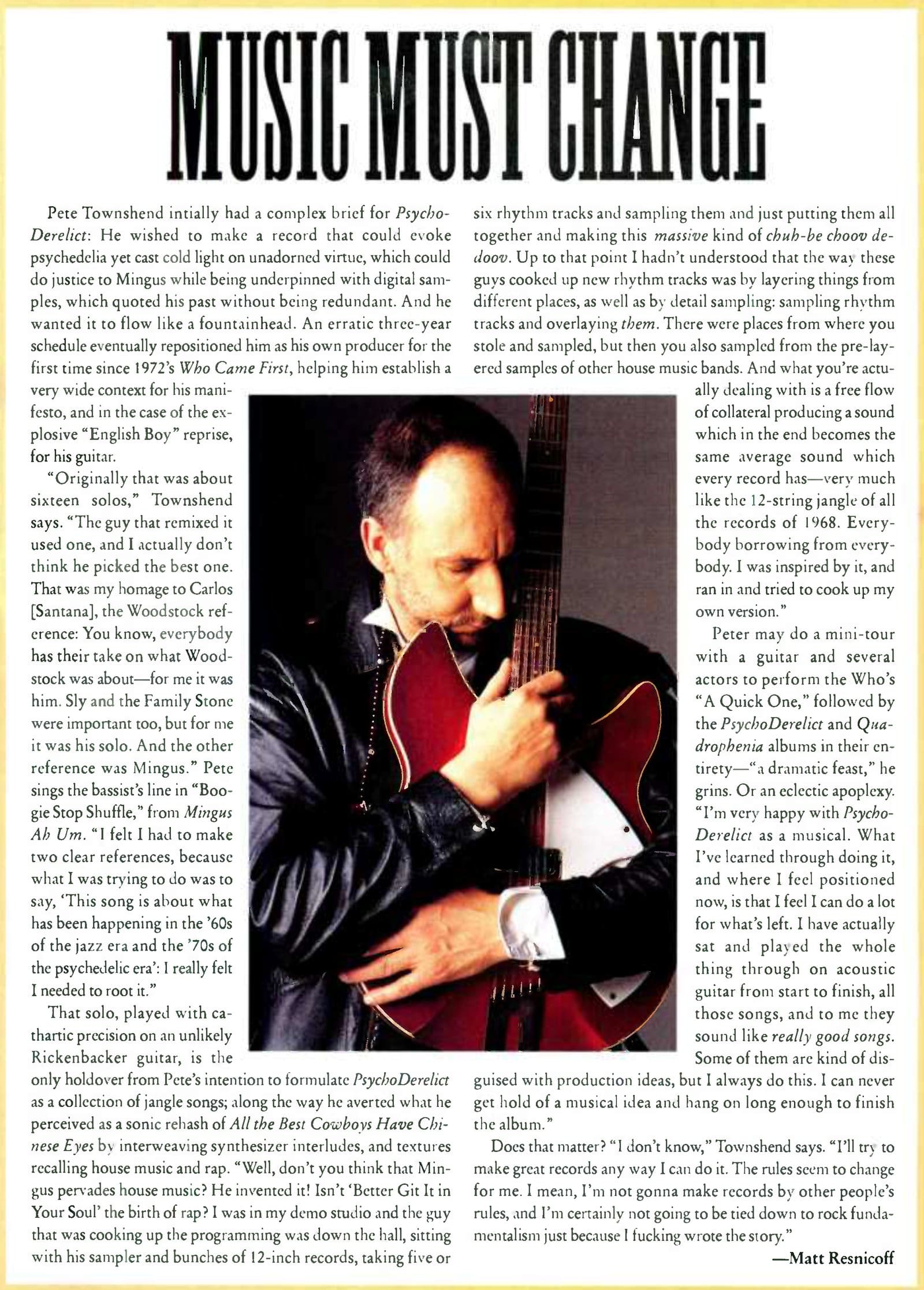
Pete Townshend initially had a complex brief for PsychoDerelict: He wished to make a record that could evoke psychedelia yet cast cold light on unadorned virtue, which could do justice to Mingus while being underpinned with digital samples, which quoted his past without being redundant. And he wanted it to flow like a fountainhead. An erratic three-year schedule eventually repositioned him as his own producer for the first time since 1972’s Who Came First, helping him establish a very wide context for his manifesto, and in the case of the explosive “English Boy” reprise, for his guitar.
“Originally that was about sixteen solos,” Townshend says. “The guy that remixed it used one, and I actually don’t think he picked the best one. That was my homage to Carlos [Santana], the Woodstock reference: You know, everybody has their take on what Woodstock was about—for me it was him. Sly and the Family Stone were important too, but for me it was his solo. And the other reference was Mingus.” Pete sings the bassist’s line in “Boogie Stop Shuffle,” from Mingus Ah Um. “I felt I had to make two clear references, because what I was trying to do was to say, ’This song is about what has been happening in the ’60s of the jazz era and the ‘70s of the psychedelic era’: I really felt I needed to root it.”
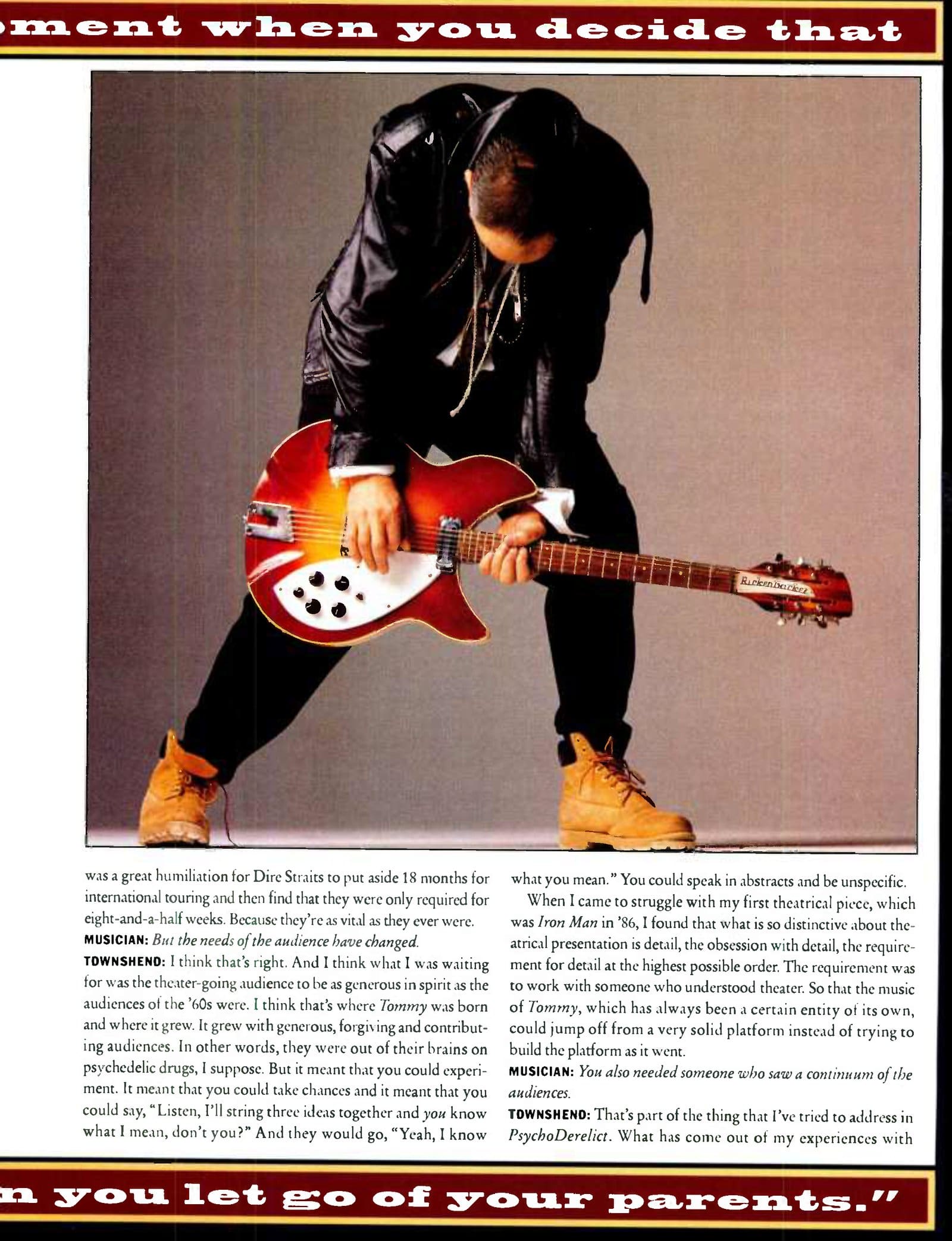
That solo, played with cathartic precision on an unlikely Rickenbacker guitar, is the only holdover from Pete’s intention to formulate PsychoDerelict as a collection of jangle songs; along the way he averted what he perceived as a sonic rehash of All the Best Cowboys Have Chinese Eyes by interweaving synthesizer interludes, and textures recalling house music and rap. “Well, don’t you think that Mingus pervades house music? He invented it! Isn’t ‘Better Git It in Your Soul’ the birth of rap? I was in my demo studio and the guy that was cooking up the programming was down the hall, sitting with his sampler and bunches of 12-inch records, taking five or six rhythm tracks and sampling them and just putting them all together and making this massive kind of chub-be choov de-doov. Up to that point I hadn’t understood that the way these guys cooked up new rhythm tracks was by layering things from different places, as well as by detail sampling: sampling rhythm tracks and overlaying them. There were places from where you stole and sampled, but then you also sampled from the pre-layered samples of other house music bands. And what you’re actually dealing with is a free flow of collateral producing a sound which in the end becomes the same average sound which every record has—very much like the 12-string jangle of all the records of 1968. Everybody borrowing from everybody. I was inspired by it, and ran in and tried to cook up my own version.”
Peter may do a mini-tour with a guitar and several actors to perform the Who’s “A Quick One,” followed by the PsychoDerelict and Quadrophenia albums in their entirety—“a dramatic feast,” he grins. Or an eclectic apoplexy.
“I’m very happy with PsychoDerelict as a musical. What I’ve learned through doing it, and where I feel positioned now, is that I feel I can do a lot for what’s left. I have actually sat and played the whole thing through on an acoustic guitar from start to finish, all those songs, and to me they sound like really good songs. Some of them are kind of disguised with production ideas, but I always do this. I can never get hold of a musical idea and hang on long enough to finish the album.”
Does that matter? “I don’t know,” Townshend says. “I’ll try to make great records any way I can do it. The rules seem to change for me. I mean, I’m not gonna make records by other people’s rules, and I’m certainly not going to be tied down to rock fundamentalism just because I fucking wrote the story.”
—Matt Resnicoff
Photos